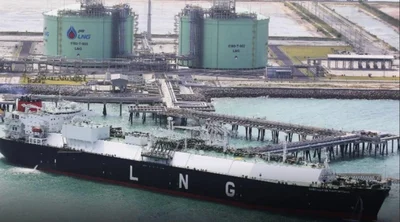
An LNG receiving terminal operated by PTT in Map Ta Phut, Rayong.
Natural gas continues to play a pivotal role in global energy systems even as the world accelerates its transition towards cleaner alternatives.
While solar, wind and biomass are increasingly in the spotlight as part of international efforts to curb rising temperatures, natural gas is still considered a relatively cleaner fossil fuel and a key driver of economic growth.
In Thailand, 70% of natural gas supply comes from the Gulf of Thailand and Myanmar, with the remaining 30% being liquefied natural gas (LNG). Gas accounts for roughly 60% of fuels used in electricity generation.
Though not entirely clean, it produces significantly less carbon dioxide compared with coal and oil.
This has prompted the national oil and gas conglomerate PTT Plc to intensify its focus on LNG trade, aiming not only to boost volumes but also to establish itself as a global-scale LNG trader by 2030.
DOMINANT ENERGY
Growing awareness of greenhouse gas reduction has reinforced natural gas's role as a crucial fuel for industry, said Kongkrapan Intarajang, PTT's chief executive and president.
He noted that compared with coal, natural gas costs are not significantly higher for producing the same amount of electricity, making it a practical option during the energy transition.
"Natural gas has diverse sources in the US, the Middle East, Southeast Asia and Africa," Mr Kongkrapan said.
"It is a vital energy source in the transition from fossil fuels to cleaner energy. Global energy demand will continue to emphasise natural gas."
According to Exxon's Energy Outlook 2025 report, coal and oil are projected to account for just 10% and 28% of global energy demand by 2050, down from 26% and 31% in 2024. Meanwhile, natural gas and nuclear power are expected to rise to 25% and 7% of demand, up from 24% and 5% in 2024.
Asia dominates global LNG demand, accounting for 70% of consumption.
Southeast Asia is emerging as a major demand hub, with 14 LNG terminals already operating at nearly 60 million tonnes of capacity, and several new facilities expected in the coming years.
Mr Kongkrapan emphasised that natural gas is central to Thailand's economic transformation, driving industries from petrochemicals to automotive, plastics, textiles, and packaging.
As Thailand drafts its new energy development plans, natural gas remains a cornerstone of both economic growth and environmental strategy, according to energy experts.
While renewable energy sources are expanding, their intermittent nature makes natural gas indispensable for maintaining stability in power generation.
BOOSTING TRADE
To achieve global LNG player status, PTT plans to increase trading volumes through portfolio optimisation and risk management across its LNG value chain.
Operations span the entire supply chain, from upstream exploration and liquefaction to downstream distribution.
The company is investing roughly 5-10% in oil and gas exploration and production, liquefaction processes, and international supply contracts, both spot and long-term.
Mr Kongkrapan highlighted the importance of accessing LNG demand in Cambodia, Laos, Myanmar, and Vietnam (CLMV), particularly for industrial customers and power plants.
PTT expects its LNG trading volume to reach 10 million tonnes by 2030 and 15 million tonnes by 2035, up from 3.3 million tonnes in 2025.
This year's volume is projected to surpass 3 million tonnes, with 2.2 million tonnes already traded as of February, he said.
DIVERSIFICATION CRUCIAL
Beyond trading, PTT is making strategic moves to strengthen its business foundation.
Mr Kongkrapan said diversification is key, with the company expanding its trading base across demand and supply regions worldwide.
This involves buying and selling LNG at different reference prices in each region, broadening partnerships to include producers, end buyers and traders.
Flexibility in portfolio management is another priority. PTT aims to secure direct access to producers and shipping markets to deliver LNG efficiently.
The company plans to balance short-term and long-term contracts, combining spot deals with stable supply agreements to maximise trading opportunities.
DEVELOPING INFRASTRUCTURE
Infrastructure expansion is central to PTT's LNG ambitions, said Mr Kongkrapan.
The company has partnered with Gulf Development Plc, a power and telecom operator, to jointly develop Thailand's third LNG receiving terminal.
The facility, located at the Map Ta Phut deep-sea port in Rayong, is being built by Gulf MTP LNG Terminal Co, a joint venture in which Gulf holds a 70% stake and PTT Tank Terminal, a wholly owned subsidiary of PTT, owns 30%.
Thailand's first two LNG terminals are also located in Rayong. The Map Ta Phut LNG Terminal 1 (LMPT-1) has a storage capacity of 11.5 million tonnes per year, while the second terminal, Nong Fab LNG Terminal (LMPT-2), co-invested with the Electricity Generating Authority of Thailand (Egat), has a capacity of 7.5 million tonnes annually.
The third terminal is designed to handle 8 million tonnes a year.
PTT and Gulf are among seven domestic gas shippers licensed by the Energy Regulatory Commission. Other licence holders include Egat, Hin Kong Power Holdings Co, B.Grimm Power Plc, Electricity Generating Plc, and Siam Cement Plc.
With Asia leading global LNG demand and Southeast Asia emerging as a new hub, Thailand's role is set to grow.
PTT's ambition to become a global LNG trader by 2030 underscores the country's commitment to balancing energy security, economic competitiveness and environmental responsibility.