- READ MORE: E–bike handlebars are riddled with faecal matter, study reveals
- See more Daily Mail on Google - save us as a Preferred Source
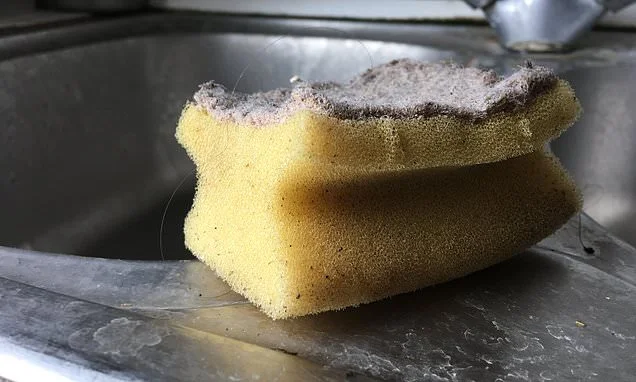
Experts often warn that your old kitchen sponge could be harbouring millions of potentially harmful bacteria.
But, just how often should you be changing out this essential cleaning tool?
This question has left the internet bitterly divided, with answers ranging from every day to 'when it completely falls apart'.
Now, Dr Primrose Freestone, Associate Professor in Clinical Microbiology at the University of Leicester, has settled the debate once and for all.
According to the expert, you should be changing out your sponge every single day.
Using your sponge for much longer can risk spreading food poisoning–causing bacteria onto your clean dishes and surfaces.
Dr Freestone says: 'Kitchen sponges really should have a single day of use.
'They can take up bacteria really quickly, which then can over time grow on the food residues and moisture within the sponge interior.'
Dr Primrose Freestone, Associate Professor in Clinical Microbiology at the University of Leicester, says you should be changing out your sponge every single day
The debate over how long a kitchen sponge really lasts has raged online for years, with social media users dividing into two camps.
On one side are those who wouldn't dream of keeping a sponge in use for more than a week at most.
In one recent discussion on Reddit, one commenter claimed they would get a new sponge 'twice per week because it gets wet and I don't want any bacteria on my dishes.'
Another vented: 'Sponges are foul after a couple days, and nothing you do is going to get them clean enough to be used to wash your dishes.'
On the other side of the debate are those who think sponges should be used for as long as physically possible.
'I replace it if it's ugly or stinks,' said one commenter.
Another suggested that the time to get a new sponge was when the old one 'has fallen apart'.
The bad news for these thrifty cleaners is that a new study has shown that the 'sniff test' won't help protect you from potentially dangerous bacteria.
The debate over how long a kitchen sponge really lasts has raged online for years, with social media bitterly divided between those who say to change their sponges at least once a week and those who use a sponge until it falls apart
Researchers from the German Federal Institute for Risk Assessment grew bacteria from sponges in the lab and examined them under powerful microscopes.
They discovered that kitchen sponges harboured food–poisoning pathogens, including Salmonella enteritidis, E coli and Staphylococcus aureus, deep within their structure.
The researchers also found that smell and colour didn't correlate with how many bacteria were present, meaning you can't tell when it's time to ditch the sponge.
However, if your sponge does start to smell, the experts' advice is clear: bin it as soon as possible.
Dr Freestone adds: 'Bad odour usually means microbial growth at a high level and you really would not want this sponge to clean your worktop or wash up your pots!'
Unfortunately, your kitchen sponge is a perfect 'reservoir' of bacteria that spread infections around the kitchen.
Sponges are almost constantly wet, packed with food residue, and left in warm kitchens, creating a perfect environment for bacteria to multiply.
Dr Freestone says: 'The longer you leave the sponge, and use it, the more germs and food bits it will pick up.
Scientists have found that sponges are perfect 'reservoirs' of bacteria due to their porous structure that creates places where pathogens can hide and breed
'The sponge microflora will eat the food residues in the sponge and start increasing in numbers.'
To make matters worse, the porous structure that makes them so good at cleaning makes it almost impossible to get rid of the bacteria once they start growing.
Researchers have discovered that bacteria grow sticky, protective layers that help keep bacteria safe from the environment.
The longer the bacteria were allowed to grow, the less effective disinfectant became, eventually reaching a point where the sponge wasn't clean even after being soaked in bleach.
These illness–causing bugs were even able to survive when the sponge had been completely dry for up to two weeks.
Worryingly, research now shows that these bacteria don't just stay hidden inside the sponge.
'Bacteria inside sponges grow and can be transferred to any surface the sponge touches. If there are food poisoning bacteria in the sponge, these pathogens could then be spread onto whatever that contaminated sponge touches.'
So, if you're still holding on to an old manky sponge to save a few pounds, you could be putting your whole household at risk of food poisoning.