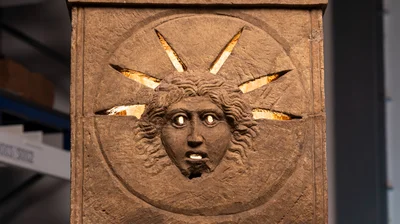
The altar to Sol was pierced from behind so that light could shine through. (Image credit: © National Museums Scotland)
QUICK FACTS
Name: Altar to Sol
What it is: A carved sandstone altar
Where it is from: Inveresk, Scotland
When it was made: Second century
Before construction workers began building a new cricket pavilion in Lewisvale Park, just east of Edinburgh, Scotland, in 2010, archaeologists were called in to survey the area. In their brief dig, the excavators discovered a unique Roman-era altar that had once been used to worship the sun god in a mysterious, male-only ritual.
The Altar to Sol was found in two pieces. Made of buff sandstone, it originally stood around 4 feet (1.23 meters) tall. Four female busts representing the seasons grace the top of the monument. In the middle, a face representing the sun god Sol rises from the monument, inscribed within an incised circle. The eyes and mouth of the humanlike face and the six rays of Sol's crown have been pierced so that the altar could be illuminated from behind. Traces of red paint were found on the front of the altar, and the two sides feature carved laurel wreaths.
Based on the inscription, the altar appears to have been dedicated by a soldier named Gaius Cassius Flavianus, who may have been in command of the Roman military base in Inveresk, Scotland. In A.D. 142, the fort at Inveresk was established along the Antonine Wall, where Roman soldiers were sent to protect the northernmost frontier of the Roman Empire.
According to National Museums Scotland, which recently acquired the Altar to Sol along with a second altar that honors the god Mithras, these monuments would have been focal points for worshippers participating in secret religious ceremonies. The mythical Mithras was born from a rock and was often depicted slaying a bull. Sol played an important role in the Mithras cult and was sometimes equated with Mithras.
MORE ASTONISHING ARTIFACTS
Temples to Mithras, called Mithraea, were always situated underground, and only men were allowed to join the mysterious cult, which purported to celebrate the triumph of light over darkness and goodness over evil.
"In the dark of the temple, you would see the rays and the eyes of the sun god glaring at you," Fraser Hunter, curator of Iron Age and Roman archaeology at National Museums Scotland, explained in a video. The altars to Sol and Mithras are unique in Scotland and point to the beliefs of soldiers stationed along the Antonine Wall. Mithras and Sol gave soldiers "a sense that there was a purpose to the world and that there was a life after death," Hunter said.
The rare carved altars will be on display at National Museums Scotland starting Nov. 14.
For more stunning archaeological discoveries, check out our Astonishing Artifacts archives.