UK AI datacenter capacity could migrate away from London as power shortages, planning constraints and reduced reliance on low-latency connections to financial firms make other locations more attractive.
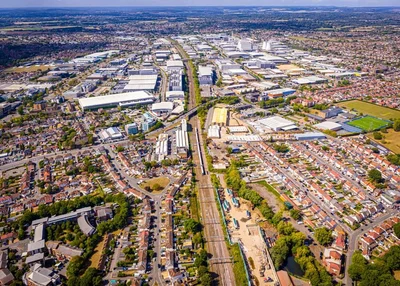
Drone image of Slough Trading Estate, one of Europe's largest industrial business parks. While geographically located in Berkshire, Slough is considered part of the "Greater London" datacenter market – as are other outlying areas like Redhill and Hayes. Altogether there are over 200 DCs in Greater London – Pic: Alexey Fedorenko / Shutterstock
Britain's biggest city has been a magnet for server farms, with more than 80 percent of the island's total capacity located in the areas surrounding London. However power availability has started to become a problem, with datacenters and housing projects vying for the available resources, as The Register has previously reported.
West London in particular is "beginning to reach saturation point," according to cloud and colocation biz Pulsant, with limited land and electrical grid capacity. The borough of Slough reportedly has up to 35 bit barns, and nearby Heathrow airport is another hotspot.
Pulsant operates a number of facilities across the UK linked by a private network, so it has a certain amount of self-interest in seeing greater uptake outside the UK's major metropolis.
Many AI use cases do not need a low latency connection into the City of London, and this is why the availability of land – and access to the grid – are starting to trump proximity to the capital for those operators looking to build out AI infrastructure.
"A lot of organizations still default to London in early planning, then run into delivery friction. AI has made the power question impossible to defer. The smart move is to start with the workload, the latency tolerance and the power profile, then choose the geography that can deliver on those constraints," said Pulsant chief marketing officer Mark Lewis.
The UK government's AI Opportunities Action Plan, which aims to drive economic recovery by positioning the country at the forefront of AI development, has added further impetus.
This includes AI Growth Zones built around datacenter campuses, offering streamlined planning and priority grid access. But priority access requires available power so the Department for Science, Innovation and Technology (DSIT) outlined plans to offer targeted pricing support - effectively energy discounts - to steer operators toward locations where capacity exists.
There are mismatches between the electricity generation capacity of some UK regions and the grid's ability to transmit that electricity elsewhere, DSIT claimed at the time. It cited Scotland's wind power resources as an example, saying this often exceeds transmission capacity.
"When datacenters locate in Scotland and the north of England, they can harness this generation, and reduce the overall cost of our electricity system," the policy document states.
Encouraging operators to set up shop in other parts of the UK is not a call to abandon London, Pulsant insists, but instead recognizes that clustering infrastructure into one region is a recipe for failure as power becomes contested and AI loads expand.
At the same time, the UK's Science, Innovation and Technology Committee has opened an inquiry into whether emerging low-energy compute architectures could halt the spiralling power demands driven by the current AI trend.
Just this month, ChatGPT developer OpenAI put on hold plans for a planned Stargate server farm project in the UK just months after announcing it, citing the cost of energy and regulatory environment.
The UK has among the most expensive electricity in the world, according to the Institute of Economic Affairs (IEA), which previously reported that UK prices are some four times higher than those in the US. ®