- See more Daily Mail on Google - save us as a Preferred Source
The worst postcode for Japanese knotweed has been revealed – with one new homeowner claiming a hidden infestation will cost him £15,000.
Whitehall, a small neighbourhood in Darwen, Lancashire, with a population of 9,000, has the highest number of recorded infestations in the country, new data shows.
The fast-growing invasive plant spreads through an underground network of roots and can wreak havoc on gardens, property values and house sales.
A total of 92 cases were logged in BB3 2, which sits in Blackburn with Darwen – itself named the worst-affected borough with 2,135 cases, or 40 per square mile.
Nathan Hannaway, 33, lives with his partner and their two children in the worst-hit postcode, where he claims knotweed was concealed in the garden of their £430,000 dream home.
The family stretched their budget to buy the five-bedroom Victorian semi in the leafy suburb in August last year.
They moved from a two-bedroom house in Bury and hoped to transform the overgrown garden and create more space to expand their family.
But soon after moving in, a neighbour asked Mr Hannaway whether Japanese knotweed was discussed during the sale.
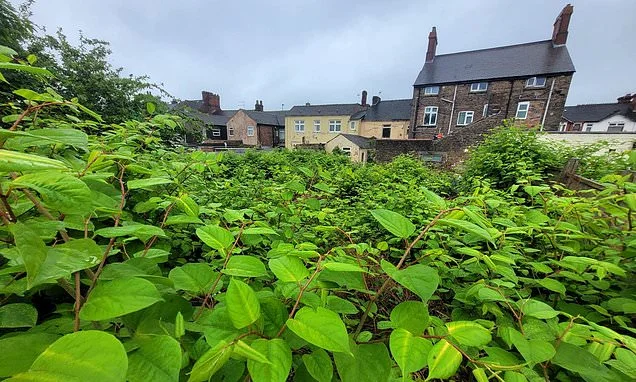
Nathan Hannaway, 33, stretched his budget to buy his dream home near Blackburn last year, only to discover the garden is riddled with a severe case of Japanese Knotweed
Blackburn Old Cemetery, which suffers from a serious Japanese Knotweed infestation
Mr Hannaway had planned to transform his new garden (pictured), until he realised it was plagued by the invasive plant
Japanese Knotweed visible in the area named the worst postcode for the plant
Mr Hannaway, who runs a wind-turbine testing company, had barely heard of it, so researched its red-speckled stems and walked along nearby riverbanks to see what it looked like.
Back home, he was horrified to spot five shoots in his garden which appeared to have been cut back. A survey by leading invasive-plant specialist Environet found knotweed growing in three separate areas.
Mr Hannaway said: 'I was quoted £15,000 to remove it. I was shocked.
'What they found when they excavated was unbelievable. There was so much of it.'
He is now locked in a civil dispute with the previous owner, claiming the infestation was not disclosed before the sale.
He said the seller answered 'no' to the knotweed question on the TA6 Property Information Form – the document used to give buyers information about a home.
The Law Society's TA6 form instructs sellers to answer truthfully, completely and accurately – warning that misleading information may leave a buyer able to claim compensation.
Mr Hannaway said the former owner disputes his allegation and maintains they discussed the plant.
He said: 'It was infuriating. I can't really explain how I felt because this house was already way out of our budget.
Mr Hannaway stands in his garden, with knotweed visible in the background. The plant will cost around £15,000 to remove
An area of knotweed in Blackburn with Darwen, blocking the door to a residential property
A patch of knotweed outside a door to a home in Blackburn with Darwen
Maurice Ffelan, member of Friends of Blackburn Old Cemetery, which has serious issues with Japanese Knotweed
'When we heard it would be £15,000 to remove, that was a big chunk of our budget for the renovation.
'Everything I wanted to do with the garden is now on hold.'
Mr Hannaway's neighbour Brian Hartley, 84, said he had seen knotweed appear in his garden during the 30 years he has lived there.
He said: 'If you don't stay on top of it, it spreads like wildfire.'
Nearby at Blackburn Old Cemetery, fresh clumps have also been cordoned off to stop lawnmowers slicing the plant into fragments and spreading it across the grounds.
Maurice Ffelan, 82, of the Friends of Blackburn Old Cemetery, said: 'It's a bugger to get rid of. It can grow to 10ft tall.'
The plant can also grow up to 10cm a day in the summer heat, reaching up to three metres across a single season.
In a bid to get rid of it, volunteers in the area inject glyphosate weedkiller into mature stems in an attempt to kill the dense underground root system.
Maurice added: 'The problem is if you start mowing it, you transfer little bits about and you don't notice until the next year when it suddenly starts popping up everywhere.'
Environet's research includes more than 100,000 verified sightings gathered over more than two decades and is updated by specialists and the public.
The company says it provides Britain's most comprehensive picture of Japanese Knotweed.
Operations director Emily Grant said the Blackburn and Darwen figures were particularly reliable because local residents had meticulously recorded infestations.
She said: 'They are the most accurate of every location we have in the UK.'
She said many of Britain's biggest hotspots had histories of heavy industry, mining, railways, shipping and large-scale soil movement.
Knotweed was also deliberately planted beside rivers and railways to stabilise embankments.
Emily said: 'Japanese Knotweed remains a serious issue because it does not respect boundaries.
'The problem is the stigma that tends to be attached to the plant, which can cause financial damage.
'You can be sued by your neighbour if you allow it to encroach into their property. It's definitely not something that you should ignore.'
Guidance from Propertymark, the professional body for estate agents, says knotweed is material information which should be disclosed and warns it can reduce prices, delay transactions and cause sales to collapse.
Figures supplied by Environet combines infestations recorded by specialists with reports from homeowners, surveyors, treatment companies and members of the public.