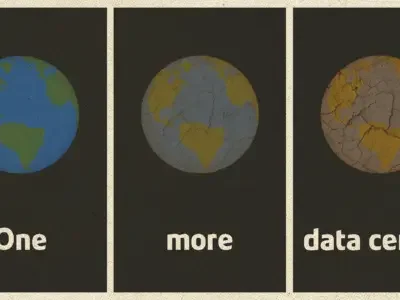
By Paula Villar for APC. Used with permission.
By Mariana Tamari
Translated by* Gwynneth*Kably
This article is part of the series “Don't ask AI, ask a peer,” a collaboration among Global Voices, the Association for Progressive Communication, and GenderIT. The series aims to re-emphasize the importance of knowledge sharing among people, as has been done for decades. You can follow the series on APC.org, GenderIT.org, and globalvoices.org. It is alsopart of Global Voices’ April 2026 Spotlight series, “Human perspectives on AI.”You can support this coverage by donating here.
The question “What can be done to create and promote a human rights-based approach to artificial intelligence?” generally leads us to circulate through abstract, universalist realms of ethical principles, regulatory frameworks and innovation per se. However, when this series challenged me to write an article answering this question from my own experience as a researcher, I felt it needed to be grounded in concrete realities, where artificial intelligence, automation and digitalisation are already being deployed in territories, and their impacts are felt by specific bodies, biomes and communities.
It was this need to materialise the debate that led me to the path of action-research I developed, in co-authorship with Joana Varon at Coding Rights, for the Tramas Project of the Coalizão Feminista Decolonial pela Justiça Digital e Ambiental (Decolonial Feminist Coalition for Digital and Environmental Justice). Throughout this research, we came to understand that the question of a human rights-oriented AI ceases to be speculative and becomes urgent and situated. Who controls these tools, in whose service do they operate and which forms of existence do they erase?
When we turn our attention to the trends and narratives currently shaping the large agribusiness industry, we are immediately transported into a reality resembling a dystopian science fiction script. Far removed from the traditional image of the farmer with a hoe in hand, working in communion with the land, the fields managed by industry giants consist of thousands of hectares with virtually no people and no agricultural diversity.
Digitalised agribusiness is masculine and patriarchal, in contrast to the imaginary of traditional, family-based agriculture, in which the reproduction of life was carefully and delicately cultivated by nature. It is hyperconnected, aseptic and dominated by heavy machinery that resembles spaceships or war tanks. This is agribusiness orchestrated by the predatory symbiosis between the world’s largest technology companies, massive agribusiness conglomerates and vast flows of financial capital. It is a powerful alliance between Big Tech, Big Agro and Big Money.
Unmasking false narratives
Investigating the brutal impacts of the digitalisation of Brazilian monoculture and the web of economic power within it raises critical questions about this model. In a context where digital technologies, artificial intelligence and connectivity present themselves as inevitable forces of land expulsion, what can and should be done to create and promote an approach to technological and AI advances that is grounded in the defence of rights?
To address this contradiction, the mask has to be stripped away from the industry’s discourse. The hegemonic narrative, promoted at major trade fairs and technology events, celebrates so-called “precision agriculture” or the “digitalisation of agriculture”. Swarms of sensors spread across the land, remote monitoring, automated fleet management and complex predictive models based on artificial intelligence are marketed as magical technological solutions to all the disasters caused by monoculture itself, from accelerated soil degradation, to pest infestations resulting from lack of diversity, to labour shortages.
In the parallel universe created by the corporate sector, the imminent climate collapse simply does not exist. The promised future is always one of control and abundance, guaranteed by digital technology and the precision that only AI can provide. The grand promise of the alliance between Big Agro and Big Tech is that vast expanses of monocultivated land will be accessible at the touch of a mobile phone screen, with colossal harvesters and tractors being operated remotely, turning the management of life into a cold video game.
It is precisely at this point in the discourse that the most serious breach of fundamental rights emerges. Unrestricted digitalisation consolidates a model in which human presence – intimate, direct and respectful engagement with the land – no longer prevails. Empirical knowledge of the territory, refined over centuries and passed down through generations by traditional communities, is summarily discarded as obsolete. We are witnessing an overwhelming ontological mutation, in which our labour relations, commercial ties, affections and interactions with nature are structurally transforming and being reduced to an immense and humanly unmanageable quantity of data.
The entire complexity of biomes and those who inhabit them is extracted, chewed up and processed into AI algorithms, and stored in an obscure technological “cloud”. This invisible infrastructure dictates all solutions and pathways for maximising monoculture business. The effect of this generalised digitalisation is the brutal erasure of forms of existence deemed undesirable by capital. Within this narrative, traditional communities and longstanding land conflicts virtually disappear beneath distant satellite imagery. Villages, riverside settlements and Quilombola territories are not computed by the monitors of remote operators. As they are invisible to algorithms trained to see only commodities, these populations are ignored by public authorities, who become dazzled by modernity and delegate governance to the digital realm.
Impacts on lived realities
This programmed invisibility materialises as violence and dispossession in rural areas of the country, as seen in the Cerrado region of Matopiba in Brazil (an area encompassing parts of the Brazilian states of Maranhão, Tocantins, Piauí and Bahia), which currently constitutes the country’s main agricultural expansion frontier. There, the advent of technological “innovations” and the narratives of digitalised agribusiness set the tone for violent displacement, adding to longstanding agrarian conflicts.
The case of the traditional community of Gleba Tauá in northern Tocantins exemplifies the weight of this alliance. (Data from the Matopiba region and Gleba Tauá were obtained through research collaboration with Antônia Laudeci Oliveira Moraes.) Families who have occupied the territory for nearly a century are seeing their homes being strangled by new technologies of expulsion manipulated by land grabbers. Land grabbing is the loose English translation of “grilagem de terras,” a term used in Brazil to describe the illegal appropriation of public or private land through the falsification of documents such as deeds and registrations. It is linked to fraud, corruption, illegal deforestation and violence against traditional peoples. The term originates from an old practice of artificially aging fake papers in boxes with crickets (“grilos”) so that they appear authentic.
The digitalisation of land management, driven by self-declaratory mechanisms such as the Rural Environmental Registry (CAR), institutionalises digital land grabbing. In the Matopiba region, the digitalisation of land records via the CAR system overlays irregular registrations that generate a digital land dispute, rendering traditional territorial occupations invisible and paving the way for massive deforestation of the Cerrado. As satellites and automated validation systems are unable to distinguish between the historical occupation of traditional communities and recent invasions driven by illegal deforestation, large landowners use digital platforms to register public and collective lands as their private property. The result is the creation of a “Fictitious Brazil,” in which algorithmic registration generates financial assets on the market, legitimising the encirclement of communities and concealing deforestation.
And when the erasure promoted by databases is not enough to dissuade communities from asserting their rights, technology reveals its armed face. Drones marketed under the pretext of sustainability and precision have been deployed as instruments of terror. Unmanned devices circle agro-ecological properties in an intimidating manner, spraying clouds of agrochemicals over the homes, water sources and gardens of small producers. Small farmers are overflown by these technological tools that disseminate fear, cornering and driving them out.
How can technologies be integrated without violating rights?
When we witness the imposition of this model upon territories, coded as unquestionable progress, we are compelled to ask how digital technology, grounded in data and artificial intelligence, can be integrated into rural life in ways that respect and guarantee rights.
The first step is to abandon the fallacy of technological and algorithmic neutrality and to question the underlying architecture of power embedded in these systems. At the core of the debate on human rights in the digital age must be an effort to unveil what these tools serve and, above all, who controls them. An AI that respects rights and advances humanity must be conceived with transparency and decentralised governance. Concealing land grabbing processes, spreading fear, dehumanising relationships, or optimising socio-environmental destruction cannot be admissible practices. Public technological infrastructures must be redesigned to incorporate collective participation, ensuring that they are used to map and protect social territorialities and diversity, rather than to erase them beneath a standardised green veil imposed via satellite.
Moreover, forging a rights-based approach requires dismantling of techno-solutionism. We must understand that answers to the sustainability of life and the defence of biodiversity will not come from Big Tech or Big Agro. These actors must remain under constant scrutiny by public authorities and civil society. We must recognise the superior validity of regenerative, agro-ecological and ancestral technologies.[9] Highly technologised agribusiness marginalises these practices, yet it is traditional smallholder plots, dense networks of exchange among communities, heirloom seeds and small farmers’ ancestral reading of climate patterns that truly preserve socio-environmental justice and ensure food security. Solutions such as drone fleets or predictions based on big data are violent and, in most cases, serve only to guarantee agribusiness profits at the expense of diversity and life.
The path toward a human-centred AI requires humanity to recover the essence of cooperation. In her “Carrier Bag Theory of Fiction”, feminist science fiction writer Ursula K. Le Guin suggests that the great technology of survival should not be the weapon that wounds, conquers and sprays poison from the sky, but rather the human vessel that gathers seeds, weaves networks of mutual care and preserves knowledge. We must abandon the cold, dystopian logic of patriarchal domination if AI is not to become the executioner of our future. The development of an AI that guarantees rights and preserves life must be non-negotiably subordinate to socio-environmental justice, embracing the ancestral premise that, within the great technological web of existence, we are not isolated manipulators at the top of a chain, as articulated by the Quilombola thinker Nêgo Bispo (Antônio Bispo dos Santos). We must always bear in mind that “the land gives, the land demands.”
Some references for this article could not be incorporated on the Global Voices site. You can see them on the Association for Progressive Communication website.
Mariana Tamari is a journalist and researcher working at the intersection of politics, feminisms, technology and socio-environmental justice. A founding partner of Agência Mira, a strategic political communications consultancy, she previously served as co-executive director of Coding Rights, where she led research, projects, institutional operations and a multidisciplinary team. Prior to that, she held positions as regional programme officer at ARTIGO 19 Brasil, the Fundação Rosa Luxemburgo and Cisco Networking Academy. She also served as partnerships director at Mapeo– AI and Big Data. Trained in journalism, she worked as a reporter for Folha de S.Paulo and Reuters News Agency, and has contributed to numerous media outlets in Brazil, including Revista A Rede, Brasil de Fato and Carta Capital, among others.
Paula Villar was born in Rio de Janeiro, Brazil, in 1992. She graduated with a degree in psychology and completed a postgraduate course in clinical psychology. Although she has been drawing since a very young age, it was only during the COVID-19 pandemic that Paula decided to change careers, devoting herself to digital art and activism. In addition, she also works with other media, such as oil paint, realistic pencil drawings and Indian ink.