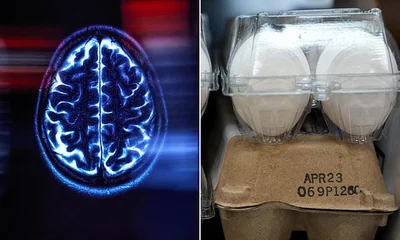
Scientists say eating eggs just twice a week cuts Alzheimer's risks by a fifth
- For confidential advice, call Alzheimer's Society's Dementia Support Line on 0333 150 3456
- Alzheimer's Society's symptoms checker can help spot the signs of dementia
Published: 00:54 BST, 26 April 2026 \| Updated: 01:47 BST, 26 April 2026
Tucking into an egg just twice a week can reduce the risk of Alzheimer's disease by at least 20 per cent.
New research shows that the benefits are even greater for those enjoying eggs five times a week or more, with the risks lowered by more than a quarter.
Scientists think that nutrients in them may help to protect the brain against the ravages of the disease. Now they are recommending regular egg intake as part of a balanced diet to keep Alzheimer's and other types of dementia at bay.
Britain has an estimated one million people living with dementia.
The Mail on Sunday partnered with Alzheimer's Society last year to launch the Defeating Dementia campaign to raise awareness of the country's biggest killer.
The average Briton consumes about 200 eggs a year. Demand slumped in the 1980s when Edwina Currie wrongly said that most UK-produced eggs were affected by salmonella.
For the new study, researchers at Loma Linda University in California tracked nearly 40,000 men and women over a 15-year period. They found those enjoying eggs once or twice a month were 17 per cent less likely to develop incurable dementia than those who never ate them.
Scientists are recommending regular egg intake as part of a balanced diet to keep Alzheimer's and other types of dementia at bay
Among volunteers indulging in eggs two to four times a week the reduction in risk was 20 per cent.
And five times a week or more pushed the figure up to 27 per cent, according to results in the Journal Of Nutrition.
Eggs are packed with nutrients such as choline, a nutrient that produces the chemical acetylcholine - vital for healthy brain cells and good memory function.
They are also rich in vitamin B12, which is essential for good cognitive function. One egg can provide a quarter of the body's daily vitamin B12 needs.
Everyone experiences dementia differently. Use this checklist to help you make a note of your symptoms before you talk to your GP.
Eggs have been linked with high cholesterol. But the British Heart Foundation says it's safe to eat at least one a day.
There are an estimated one million people in the UK living with dementia - and by 2040 that figure is expected to climb to 1.4 million.
But while the search for a cure continues, there is mounting evidence that prevention may be the best form of defence for now.
A major report in 2024 by The Lancet Commission on Dementia concluded that almost half of all cases globally could be prevented, or at least delayed for several years, if action was taken to address 14 risk factors - ranging from smoking and excess alcohol consumption, to loneliness and a sedentary lifestyle - that are driving up rates of illness.