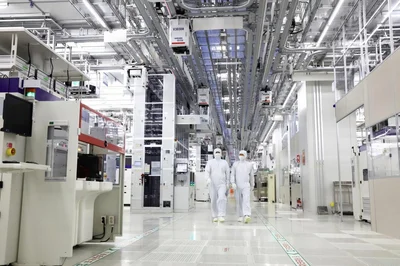
Samsung Electronics' production line in Pyeongtaek, Gyeonggi Province / Courtesy of Samsung Electronics
Park, an office worker in his 30s living in Seoul, has been agonizing for days over whether to sell part of his holdings in SK hynix. Although his returns have surged as the stock has rallied, expectations for further gains driven by artificial intelligence (AI) demand remain strong.
“If I sell now, I can lock in profits, but if it rises further, I’ll feel like I missed out. I keep wondering whether this is the peak, given how much it has already gone up,” Park said.
Another office worker in his mid-40s living in Gyeonggi Province, surnamed Jung, faces a similar dilemma. He recently sold part of his holdings in Samsung Electronics, judging that the stock had already risen enough. However, he remains conflicted about the shares he still holds.
“I couldn’t bring myself to sell everything in case it keeps going up,” he said.
KOSPI’s sharp and rapid rally in recent days, even amid Middle East-related uncertainties, is leaving more than 5.38 million retail investors in Samsung Electronics and SK hynix weighing a difficult choice: whether to hold on for further upside or cash out after locking in steep gains.
Those opting to stay invested argue that the semiconductor upcycle still has room to run, citing robust demand for advanced chips, particularly high bandwidth memory (HBM) used in AI applications, which continues to outpace supply.
On its first-quarter earnings call last Thursday, SK hynix effectively confirmed a prolonged supply crunch, noting that demand for HBM over the next three years is expected to exceed its production capacity.
In a seller’s market where customers prioritize securing supply over price, such conditions are directly translating into stronger corporate earnings.
Yet caution is building just as quickly, with skeptics pointing out that semiconductors are inherently cyclical. They argue that periods of peak optimism are when investors should consider trimming positions by locking in partial gains and shifting toward a more defensive stance rather than relying solely on the current bullish narrative.
Another variable to watch is a planned strike by the labor union at Samsung Electronics next month.
Early signs of disruption already emerged Thursday when output fell by around 58 percent in foundry operations and about 18 percent in memory production during a union rally.
Analysts warned that a prolonged strike could erode confidence among global clients and accelerate a shift in orders to rival suppliers, potentially weighing on earnings.
“Under a worst-case scenario, an 18-day strike, if it materializes, could be followed by an additional two to three weeks needed to fully restore normal operations,” Kim Dong-won, a senior researcher at KB Securities, said.
Meanwhile, data from the Korea Exchange show that retail investors have been aggressively selling this month, marking the largest exodus on record even as KOSPI staged a strong rebound.
Individuals offloaded a net 14.8 trillion won ($10 billion) worth of shares on the main bourse as of Friday, already surpassing the previous monthly high set in September last year, when net selling reached 10.5 trillion won.
The scale of the sell-off suggests that individuals are largely viewing the rally as an opportunity to realize profits rather than chase further upside. In particular, about 62 percent of total net selling this month was concentrated in Samsung Electronics and SK hynix.
This stands in sharp contrast to foreign investors, who have taken the opposite stance, recording net purchases of 2.53 trillion won in the KOSPI over the same period.