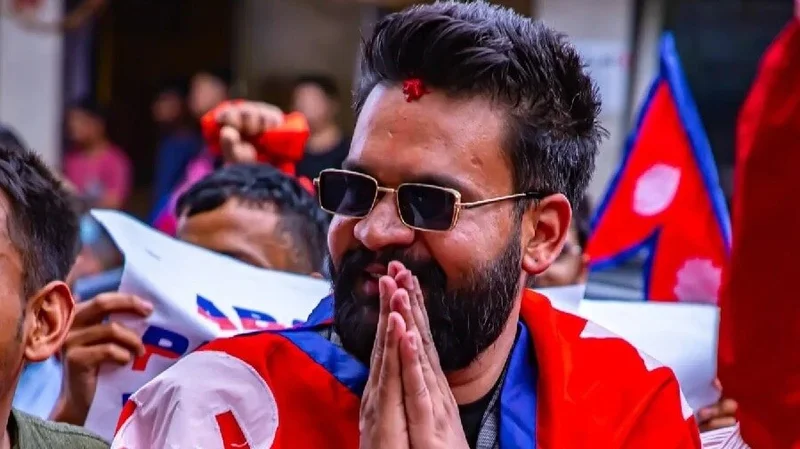
Nepal's Prime Minister Balen Shah, who has thus so far followed a protocol of refusing to sit down in one-to-one meetings with foreign envoys, is set to break his self-imposed rule and meet the envoys from India and China this week, The Kathmandu Post reported, citing his aides and diplomatic sources. Shah will also be trying to portray that the two countries are equally important for him.
Shah, who rode a wave of Gen Z agitation, has seen at least two big rounds of protests within 100 days of his stint as the PM. One had to do with the enforcement of the customs duty at the Indo-Nepal border, while the other was sparked after a ride-share driver immolated himself over police action.
According to The Kathmandu Post report, Balen Shah is set to hold separate meetings with Indian and Chinese ambassadors this week. Although the exact dates are yet to be announced, the meetings, which are reportedly being coordinated by Nepal's Ministry of Foreign Affairs, are expected to take place shortly after Shah's administration completed 100 days in office.
The report in the Nepalese newspaper also noted that to underscore that New Delhi and Beijing are equally important to Kathmandu, Shah is scheduled to meet Indian Ambassador Naveen Srivastava and Chinese Ambassador Zhang Maoming on the same day.
In the recent past, prime ministers in Nepal have been analysed to be either pro-Beijing or pro-Delhi.
Shah became PM in March this year, riding on the backs of a Gen-Z-backed movement that ousted the previous KP Oli Shah-led administration. Since then, however, Balen departed from established diplomatic practices by refusing to meet foreign envoys individually.
This stance has seen the PM decline requests to sit down in meetings with India's Foreign Secretary Vikram Misri, China's Deputy Minister of Commerce and Communist Party leader Yan Dong, and the US' Assistant Secretary of State Samir Paul Kapur and US special envoy Sergio Gor.
According to The Kathmandu Post, Shah instead held joint meetings with Kathmandu-based ambassadors on April and May this year. The only exception to this rule was his meeting with Asian Development Bank President Masato Kanda, who was on a three-day visit to Nepal earlier in July.
Balen Shah's self-imposed protocol of refusing one-on-one meetings with foreign envoys has drawn sustained criticism from diplomats, former officials and commentators in Nepal.
"When India's Foreign Secretary Vikram Misri wished to visit Kathmandu in May, Balen Shah reportedly didn't want to meet him. His stance was that he wouldn't meet anyone below the rank of foreign minister. Earlier, he didn't even meet the Indian ambassador to Nepal separately, but only as part of a group of envoys. This is unprecedented," veteran journalist Keshav Pradhan told India Today Digitalearlier in June.
BALEN SHAH'S STRATEGY OF NO ONE-ON-ONE MEETING CRITICISED
An editorial in The Kathmandu Post argued that while Nepal should not appear weak by acceding to every request from foreign officials, "it also cannot be seen as aloof or unmindful of the interests and sensitivities of Nepal's important partners."
"Nepal occupies a precarious geopolitical landscape and preserving its sovereignty entails maintaining a delicate balancing act with outside powers, especially India and China, as well as the 'sky neighbour', the US," the editorial noted.
A separate editorial in the Nepali Times said Shah's insistence on meeting only foreign leaders of equivalent rank had resonated with some domestic supporters but had "alienated many in the international community who say such aloof protocol is counterproductive for one of Asia's poorest nations."
The Nepali Times also quoted former Nepal Ambassador to Denmark, Vijay Kant Karna, as saying, "There is no changing the fact that we are a small state that needs foreign investment and support. So, when the PM backs out of meeting foreign envoys, it is Nepal's loss, not the US, China or India's."
NEPAL MINISTERS REQUESTED PM TO MEET INDIA, CHINA OFFICIALS
According to The Kathmandu Post, even members of Shah's own government, including Finance Minister Swarnim Wagle and Foreign Minister Shishir Khanal, had earlier urged him to meet senior officials from India, China and the US. However, the PM chose not to heed their advice.
That stance now appears to be changing. Nearly four months after taking office, Shah has now decided to abandon his self-imposed protocol and hold separate one-on-one meetings with foreign envoys, beginning with the ambassadors of India and China.
"PM Shah will soon be meeting ambassadors of two immediate neighbours, India and China," one of the prime minister's aides told The Indian Express.
Another aide told The Kathmandu Post: "The prime minister has started meeting various stakeholders over the past two weeks. We have now concluded that he should also engage with foreign ambassadors and diplomats. It is only natural to begin with the ambassadors of our two neighbours, India and China, given Nepal's foreign policy priorities."
Amid advice and mounting criticism, Balen Shah must have thought that course correction was the most practical thing to do. That is why the Nepal PM is planning to hold one-on-one meetings with the envoys of India and China soon.
- Ends
Published By:
Shounak Sanyal
Published On:
Jul 22, 2026 13:53 IST