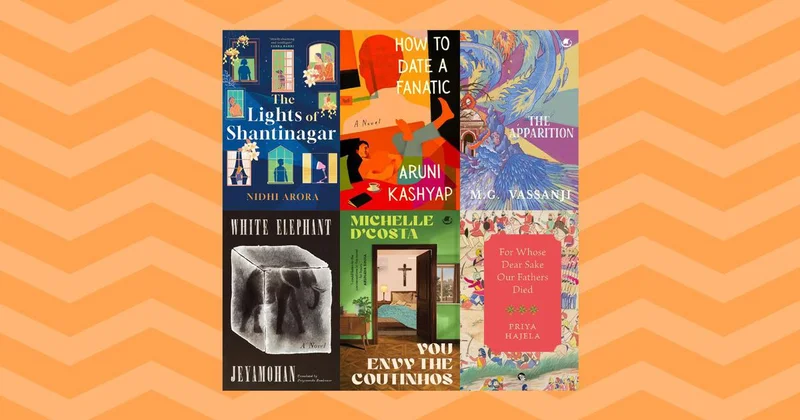
All information sourced from publishers.
The Apparition, MG Vassanji
It’s the 13th century, and Delhi is slowly slipping into decline under the ageing Sultan Alauddin Khilji. Fears of famine, foreign invasion and court intrigue plague the city. In the midst of all this ferment, a strange, enigmatic object appears in the sky. No one knows what it is, but the persistence of the apparition and its passivity seem to portend something sinister.
The Sultan orders Amir Hassan al-Shirazi – Sufi, poet, intellectual and, some would say, the Sultan’s favourite – to investigate this cosmic phenomenon. Hassan’s search takes him to every quarter of Delhi, and everywhere, paranoia, confusion and fear reign supreme. Just when it seems that the city will collapse under the weight of its own misgivings, a distant grey cloud approaches. As its people watch, awestruck, strange creatures – half-man, half-bird – descend on the city. It is a takeover by the Avians and the death of the old order in Delhi.
Amir Hassan observes Delhi adapt to this new reality. Will alien rule finally bring peace to the beleaguered city, he wonders. And will that be at the cost of its identity?
White Elephant, Jeyamohan, translated from the Tamil by Priyamvada Ramkumar
It is 1878, and Aiden Byrne, an Irish police officer in Madrasapatnam, loyal servant to the crown and Queen Victoria, knows that there is no danger that he ought to fear in this heat-blasted and famine-devastated land.
But when he discovers two labourers from Tudor Ice Company being brutally whipped in the countryside, he is dragged into a world whose surface he has only skimmed before. He sees the horrific conditions under which the local workers, members of the lowest rung of the caste system, process the mammoth blocks of ice that are carved out of frozen New England lakes and transported to India for use in the drinks and iceboxes of the colonial forces.
When the two workers disappear – presumably killed – Byrne is approached by Kathavarayan, a charismatic young activist belonging to a lower caste, who is looking to put things right. He sets Byrne off on a journey that brings him face-to-face with the bloody toll of the famine raging through the country – one that would kill more than eight million people before it was done – and forces him to grapple with his own precarious and complicated role in the machinery of the British empire.
The Lights of Shantinagar, Nidhi Arora
Newly married Sumi arrives in Shantinagar, a seemingly peaceful middle-class town in modern India, ready to begin the next chapter of her life. An aspiring quantum physicist, she soon discovers that the world around her is not unlike the mysterious universe she studies – where unseen connections, unexpected interactions, and hidden forces shape everything.
As Sumi settles into her husband’s family home, she begins to notice the intricate web of relationships that binds the residents of Shantinagar together. Neighbours watch one another, long-held secrets quietly simmer beneath the surface, and small events set off consequences that ripple through the entire community.
The Lights of Shantinagar explores family, marriage, identity, and the changing face of modern India. As old traditions collide with new ideas, the people of Shantinagar are forced to confront uncomfortable truths about themselves and those they love.
You Envy the Countinhos, Michelle D’Costa
When Joachim moves to Bahrain from Mangalore to improve his prospects, little does he know how hard immigrant life can be. As he strives for a chance at a happy and successful life in the Gulf, the everyday realities threaten to overwhelm him and his young family.
Meanwhile, his nephew Darrel, unaware of the struggles of their lives, envies his uncle’s family and dreams of moving to Bahrain himself.
Set in India and Bahrain, You Envy the Coutinhos is an intimate domestic novel that jostles with ideas around identity and belonging.
For Whose Dear Sake Our Fathers Died, Priya Hajela
At the heart of this story is Beant Kaur – sitting on a comfortable chair, shawl wrapped tight on winter nights, gathering her family around her, and telling them who they are.
What begins as a granddaughter listening to her grandfather’s half-mumbled memories soon unfolds into something far larger: a deeply personal history that moves from the battlefields of the Anglo-Sikh wars to the uneasy years of British rule, and into the wider currents of a changing world, from the upheaval of 1857 to the Komagata Maru voyage that carried Indians across oceans and into confrontation with empire.
These stories are not found in official records, but are passed down in fragments – through memory, grief and pride. These are stories of men who chose to fight when ordered to retreat; of soldiers who found themselves serving the very power they had once resisted, and of families who carried both honour and contradiction in equal measure.
As Beant pieces together the lives of those who came before her – her grandfather Balwant, and the generations that shaped him – she begins to understand that history is never as simple as it is told. It lives in the choices people make when survival, loyalty and belief pull in different directions. Intimate and rooted in oral memory, For Whose Dear Sake Our Fathers Died is a story about inheritance – not just of land or name, but of the tales we must choose to tell before they are lost to time.
How to Date a Fanatic, Aruni Kashyap
As political tensions rise precipitously across India, Rohit returns to Delhi University to teach and gets caught in a web of unrequited love with his friend Dhruv. To alleviate his inevitable heartbreak, Rohit seeks relationships with other men on campus, until he meets and embarks on a delicate new romance with the effervescent Sayan, a literature student he hopes will be the answer to getting over Dhruv.
Rohit’s life soon becomes more complicated as the country's political tensions erupt on campus, sparking a turbulent student-led movement that entangles Rohit when Dhruv joins the fray, a tipping point that changes Rohit’s life forever. Set against the vibrant, volatile tapestry of modern India, Rohit and his friends must learn to navigate the challenges and triumphs of queer life to survive in an unpredictable political landscape.
We welcome your comments at letters@scroll.in.