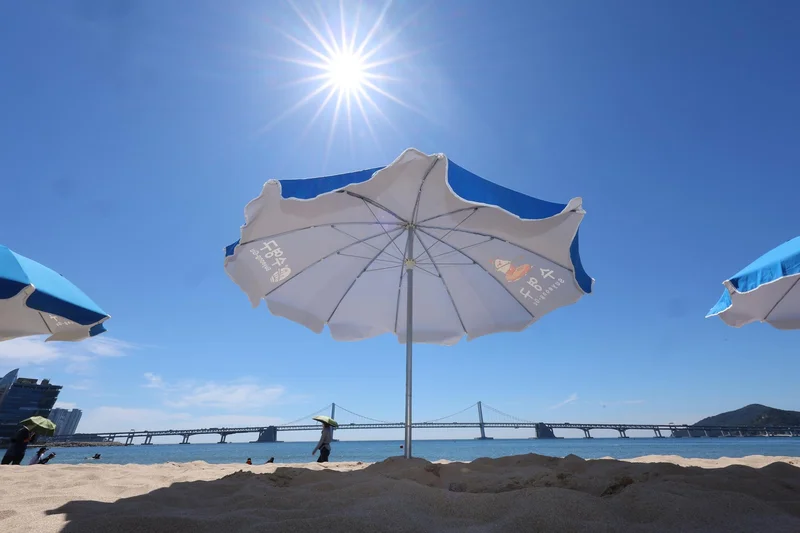
Yangsan, South Gyeongsang Province recorded a temperature of 42.5 degrees Celsius on Sunday, the highest ever measured in Korea since modern weather observation began in 1904, as a record-breaking heat wave grips the country.
The temperature was recorded at approximately 1:26 p.m. The southeastern city set a new local temperature record for a fourth straight day since Wednesday, with temperatures climbing higher each day.
Daytime temperatures also topped 40 degrees in other areas, including northern Busan, Gimhae in South Gyeongsang Province, Gyeongju in North Gyeongsang Province and Gwangyang in South Jeolla Province.
At 11 a.m., the Korea Meteorological Administration (KMA) upgraded the heat wave advisory for northwestern Seoul to a heat wave warning, placing all of the capital under the second highest-level heat alert. Heat wave warnings had already been in effect for southeastern, southwestern and northeastern Seoul since Wednesday.
As the prolonged heat wave continued across the country, the government raised the Central Disaster and Safety Countermeasures Headquarters to Level 2, stepping up nationwide response efforts with expanded field inspections and financial support.
According to the KMA, a rare combination of large-scale weather patterns and local geographic conditions fueled the extreme heat that engulfed Yangsan and other parts of South Gyeongsang Province.
Overlapping high-pressure systems over the Korean Peninsula created ideal conditions for the heat wave. The North Pacific High, a semipermanent anticyclone, brought hot, humid air, while the Tibetan High, a seasonal high-pressure system that forms over the Tibetan plateau, reinforced atmospheric warming to produce clear skies and intense sunshine that drove temperatures even higher.
Dry conditions left by below-average monsoon rainfall also intensified the heat, while the stagnant weather pattern allowed it to build across the southeast.
Local geography further amplified the heat in Yangsan. Surrounded by mountains, the city is in a basin that traps heat and limits air circulation, which allowed temperatures to climb to record levels.
The prolonged heat wave continued to cause casualties and disruptions across the country.
According to the Korea Disease Control and Prevention Agency, 1,871 cases of heat-related illnesses were reported between May 15 and July 31, including 13 deaths.
The scorching temperatures also disrupted professional baseball across southern region. Korean Baseball Organization League games in Changwon, South Gyeongsang Province, were canceled on both Saturday and Sunday after forecasts showed temperatures would be above 38 degrees at first pitch.
In Busan, Saturday's game was canceled, while Sunday's game was rescheduled to begin at 6:30 p.m., 30 minutes later than originally planned, to avoid the worst of the heat.
Meanwhile, sweltering temperatures are expected to persist this week, with daytime highs forecast to reach as high as 38 degrees in some areas.
The KMA said heat wave conditions and tropical nights are likely to continue across most of the country, with the heat index expected to exceed 33 degrees in most regions and 35 degrees in inland areas.
Under the continued influence of the North Pacific High, most of the country is expected to see clear skies throughout the week. Morning lows will range from 23 to 27 degrees , while daytime highs are forecast at 32 to 37 degrees — about 3 to 4 degrees above the seasonal average.