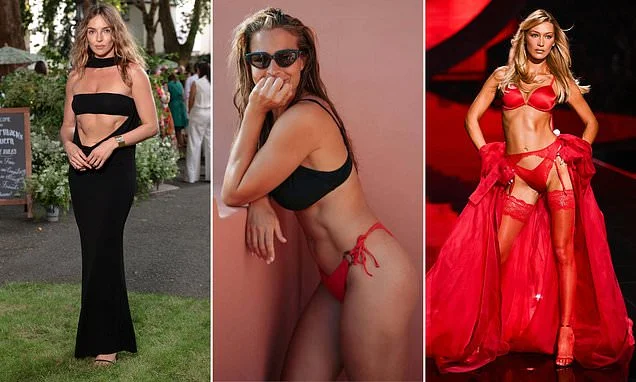
- Hollywood stars have neem flaunting '11-line' abs
- READ MORE: How I got rock-hard abs in midlife: ROSIE GREEN reveals her top ten waist-whittling tips - and insists age is no barrier to you getting a six-pack
- See more Daily Mail on Google - save us as a Preferred Source
Fitness influencers everywhere are touting workouts which promise chiselled '11-line' abs - the likes of which have been seen on the red carpet, flaunted by Jodie Comer, Zendaya and Gemma Atkinson, just to name a few.
The sculpted physique, which is characterised by two pronounced vertical lines running down the sides of the abdomen, has been hailed as a revered new body ideal.
However, experts have warned that not only does it require arduous - and potentially unsustainable - training that builds muscle and keeps fat off, but it may also come with health risks.
Personal trainer Edwina Jenner told the Daily Mail that while the are often held up as the holy grail of fitness and the ideal physique, 'they aren't a measure of health'.
'For some women, that look can come quite naturally, however, for many others achieving and maintaining visible abs may require body fat levels that are difficult and unrealistic to sustain over the long term,' she explained.
Fitness influencers everywhere are touting workouts which promise chiselled '11-line' abs - the likes of which have been seen on the red carpet, flaunted by Jodi Comer, Zendaya and Gemma Atkinson , just to name a few
Gemma Atkinson recently posed in a bikini for a summery post on social media
'In some cases, very low body fat through chronic calorie restriction can negatively affect hormonal health, recovery, bone health and muscle maintenance.
'Having the abs themselves isn't the problem, but issues arise when pursuing a specific look, such as 11 line abs, becomes the focus.
'Chasing a particular aesthetic can encourage overly restrictive dieting, excessive exercise and an unhealthy preoccupation with food and body image.'
This can include three full-body strength sessions a week as well as exercises like squats, deadlifts, rows and overhead presses, along with dedicated core work such as planks, dead bugs and anti-rotation exercises two or three times a week.
And intense fitness by itself wouldn't be enough - diet would also have to be monitored.
'Visible abdominal definition comes from building muscle, having a relatively low level of body fat, eating in a way that supports your training, and being consistent over time,' Edwina added.
However, because of this, many may find that if they don't have the dedicated time and personal trainers A-listers likely do.
Bella Hadid pictured during the Victoria's Secret Fashion Show last year
Zendaya pictured last month, at an event for her new film Spider-Man: Brand New Day in Germany
Jennifer Lopez pictured at the Fontainebleau Las Vegas last year
Emma Thynn, the Marchioness of Bath, and Naomie Harris pictured last month
'For some people, it can increase the risk of disordered eating patterns or repeated cycles of losing and regaining weight (yo-yo dieting), which is unlikely to support long-term health,' the expert continued.
'Being in good health isn't defined by how visible your abs are, it's about having enough muscle to support your body, eating a whole foods diet that keeps you energised and that you can maintain, moving regularly, sleeping well and feeling mentally and physically well.
'These habits deliver far greater benefits in your life than trying to achieve a body shape that depends on your genetics and adhering to a restrictive training and nutrition plan.
'Chasing visible abs isn't the best measure of health. Hormonal changes can alter where we store body fat, particularly around the middle. I'd much rather see women focus on building a strong, functional core that supports posture, balance and everyday life. If visible definition comes as a by-product, that's a bonus, not the goal.'
Elsewhere, personal trainer Luis Tibbles stressed that genetics plays a large part.
'The growing obsession with aesthetic markers like "11-line abs" has blurred the line between looking fit and actually being healthy,' he explained.
'While these defined vertical lines are often seen as the ideal physique, they're largely influenced by genetics, lifestyle, body fat distribution and muscle shape, not simply how fit or healthy someone is.
'Unlike a traditional six-pack, which reflects development of the rectus abdominis muscles alongside low body fat, 11-line abs are typically created by definition around the obliques and core muscles.
'Some people naturally have the structure to achieve this look, while others won't, no matter how hard they train.'
He urged against trying to recreate the physiques of celebrities like Gemma Atkinson or Jodie Comer.
'This can also be unrealistic because we don't understand the full picture,' Luis added.
'We don't know their genetics, lifestyle, training history, nutrition or the professional support they have behind them.
'Achieving that level of leanness often requires an extremely disciplined lifestyle that, for many people, can actually contradict good health if taken to the extreme.
'Most people would struggle to consistently consume enough calories and essential vitamins while trying to maintain such low body fat levels.
'It's also important to remember that these images are often just a snapshot in time. They may have been taken for a photoshoot, a film role or after a period of targeted preparation, and that level of definition isn't necessarily realistic or healthy to maintain all year round.
'Real fitness is about far more than visible abs. Strength, cardiovascular health, mobility, energy levels, good sleep and consistency are much better indicators of long-term health.
'Rather than trying to copy someone else's physique, focus on building sustainable habits that support the strongest and healthiest version of your own body.'