Self-driving vehicles have become a common sight in the San Francisco Bay Area, and there are more companies looking to deploy their autonomous vehicles to public riders in the coming months.
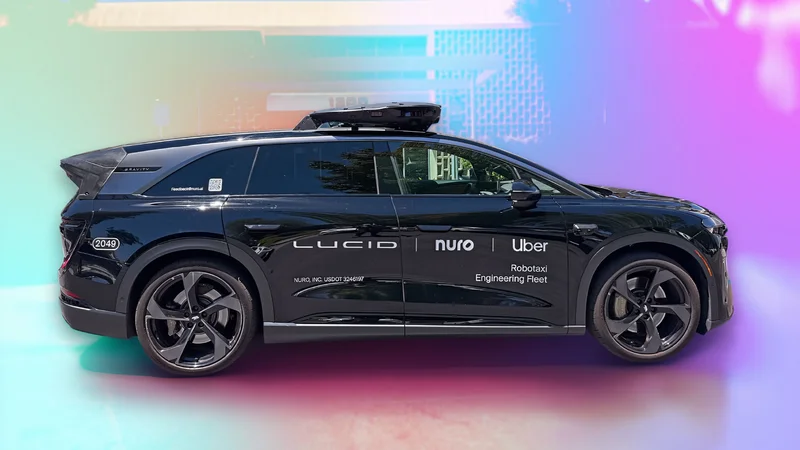
Earlier this year, ride-hailing giant Uber, electric vehicle maker Lucid Motors and autonomous vehicle company Nuro unveiled the Lucid Gravity robotaxi, the result of a three-way partnership announced last year. I got an early look at what the companies have deemed the “industry’s most luxurious robotaxi” at CES in January, but the vehicle was parked inside a conference hall.
Last week, Nuro invited me to swing by its headquarters in Mountain View, California, to take a ride in one of its engineering prototype vehicles — with a safety driver onboard — as the companies aim for a public launch later this year.
Nuro is conducting tests on public roads with safety operators behind the wheel in the San Francisco Bay Area and in Houston. The company is also using closed-course testing and simulations to prepare its self-driving technology for a public rollout. Lucid is manufacturing the robotaxis at its factory in Arizona. Once the service becomes available, riders will be able to hail an autonomous ride in the Uber app.
“The beauty of this partnership is that it allows each company to do what it does best,” Nuro COO Andrew Chapin told me. “Uber brings the marketplace logistics, the demand and the overall in-app experience. We bring this safe AI driver, and Lucid brings a really awesome vehicle. “
The Lucid Gravity robotaxi will join the ranks of other AV companies, including Waymo and Zoox, which was just granted federal regulatory approval to begin charging for rides in its steering-wheel-less vehicles. One element that sets the Lucid Gravity AV apart is that it can fit up to six passengers, topping the four-passenger capacity of Waymo and Zoox’s offerings.
Here’s a look inside the roomy robotaxi prototype from Uber, Lucid and Nuro.
The sensor suite equipped with cameras, lidar and radar is pretty subtle on the Lucid Gravity robotaxi, at least compared with the more prominent sensor suite on Waymo’s Jaguar I-Pace vehicles.
There’s plenty of leg room, whether you’re sitting in the front or the back. The interior colors may differ in the final version of the vehicle, but I quite like the color contrast between the tan seats and the black surroundings.
A look at where the safety operator sits as the test vehicles navigate roads.
There’s a nice panoramic roof to elevate the rider experience.
This isn’t the final version of what riders will see aboard the Lucid Gravity robotaxi, but it’s meant to show how the car navigates around other vehicles.
Temperature controls allow riders to adjust the air in the cabin.
Notice how the safety operator’s hands are hovering next to the steering wheel, ready to take over if needed. They remained positioned that way for the duration of our nearly 20-minute ride.
Some Lucid Gravity robotaxis will seat up to six people, while others will seat up to four. Both options will have space for luggage, so you could take the vehicle to or from the airport without worrying about where to put your things.
A closer look at the sensor suit atop the vehicle.
Uber, Lucid and Nuro’s robotaxi partnership is slated to kick off in the San Francisco Bay Area later this year and in Houston in mid-2027.