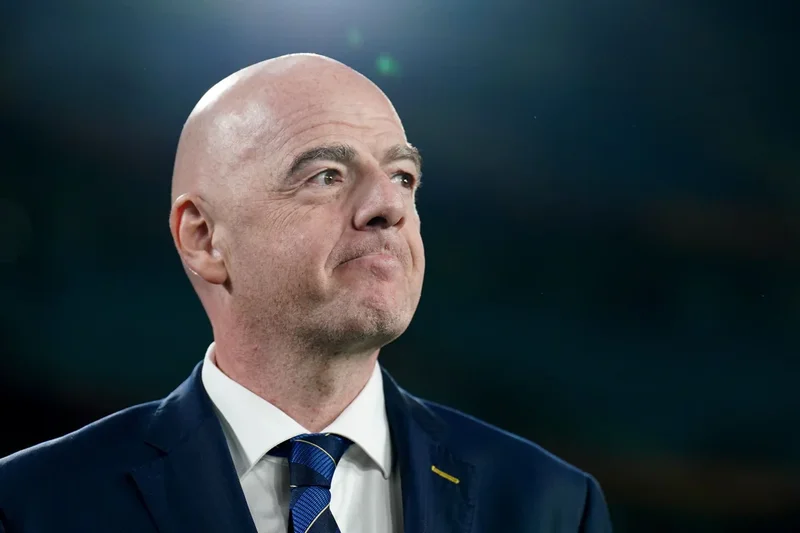
In sport as in so much of life, a sensible leader will quit while they’re winning, and a decade in charge of any major organisation is generally a good time to blow the final whistle. That would be true even when things are going well. In the case of Gianni Infantino, president of Fifa for the time being, that is patently not the case, and has not been for some time.
One way or another, his botched attempt to hand a critical interest in the World Cup over to private equity, and to someone closely linked to the Trump family to boot, will end his career, and rightly. But that will only raise fresh questions about the way football is run at this level, and what it’s future will look like.
In the world of sport, the stakes could scarcely be higher.
The irony is that world football needs investment as much as any sport, and is already closely involved with the commercial world, with television rights, sponsorship, merchandise and so on.
Mr Infantino could usefully have sparked a debate about how that should evolve. That he instead tried to hoodwink everyone into a get-rich-quick scheme was his tragic, and rather foolish, mistake.
It doesn’t take too much of an effort to recall the dramatic circumstances of his rise to the top of international football governance in 2016. He replaced Sepp Blatter, a man so mired in allegations of corruption that they overwhelmed even Fifa’s morbid complacency.
On arrival, Mr Infantino promised change and reform. In some respects, it’s fair to say he succeeded, and for the lasting good of the game.
He was the first president of Fifa to pay much attention to the women’s game, to developing grassroots support in emerging nations, and especially boosting African participation in the World Cup.
To his credit, he at last managed to help football gain some traction in North America. Mr Infantino also set about cleaning up Fifa. He promised transparency and declared: “The money of Fifa is your money. It’s not the money of the Fifa president. It’s your money. You are the national associations and the money of Fifa has to serve for the development of football and not for anything else.’”
Ten years on, and those words ring hollow. Somehow, like any once bright footballer whose form slides into irreversible decline, Mr Infantino lost his way.
He has been accused of interfering in crucial disciplinary matters according to his own discretion – reversing a suspension on Cristiano Ronaldo last December, and the infamous revocation of a red card issued to US squad member Folarin Balogun during the World Cup tournament – a decision involving President Trump.
“Dynamic” ticket prices were set obscenely high. The discriminatory treatment of the Somali referee Omar Artan and the Iranian team was shameful. Hydration breaks and a turgid half-time show in the final were also offensive.
Much of that was tolerated because Mr Infantino appeased Mr Trump. In return, Mr Trump seems to like Mr Infantino so much that he informally nominated him to be the next secretary general of the United Nations.
Some took that to be a direct quid pro quo for Mr Infantino awarding the ludicrous Fifa Peace Prize to Mr Trump, who understands geopolitics about as much as he does the offside rule.
The Fifa president’s implausible plan to sell a 21 per cent stake in the World Cup to private investors therefore came as a shock but not so much a surprise to anyone who has observed Mr Infantino’s recent gravitation towards money, power and the orbit of Mr Trump. The fact that it was backed by Joshua Kushner’s investment fund – the brother of President Trump’s son-in-law Jared – only heightened suspicions.
Perhaps the worst aspect of the secret manoeuvring was that Mr Infantino assumed he could get away with it without the support of the most powerful football association, Uefa in Europe, as well as Concacaf, in North and Central America and the Caribbean.
The crude £30m bung to football associations in smaller and poorer nations was an insult to anyone’s intelligence. As the World Cup was gradually privatised, as was going be inevitable in this plan, they would see less and less such money, and lose more and more influence.
Even if Mr Infantino could have swung the votes in the one-nation-one-vote structure of Fifa, the declared threat of boycott from Uefa and Concacaf would end the deal. Without European involvement, there is no World Cup.
Mr Infantino’s position now resembles that of any democratic politician who has lost the confidence of his own party. The Fifa chief still has backing from grateful associations in some places favoured during his tenure, for example as destinations for the World Cup – Qatar, Morocco and the African body, the CAF; and he may thus have sufficient votes on the Fifa Council to evade immediate defenestration via an emergency meeting.
However, to draw an unhappy comparison, he is now limping around the pitch having suffered a severe injury by pushing his luck. He will have to be substituted, preferably by someone from Africa who can balance the realpolitik power exerted by UEFA and Concacaf.
He’s lost the fans and the dressing room, and he really has no alternative but to retire with as much grace as he can muster.