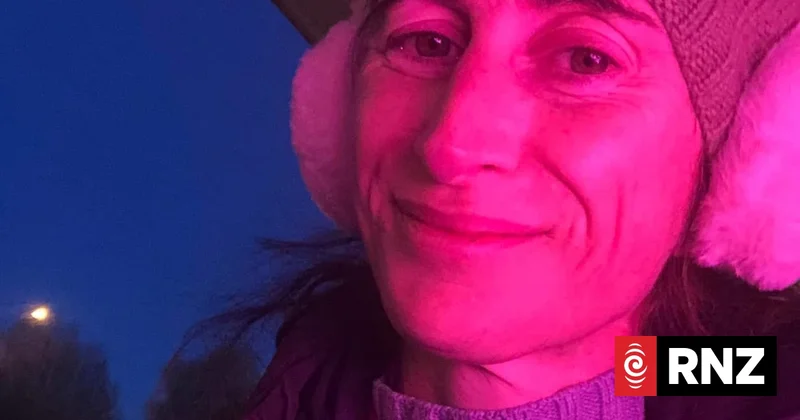
Soon after Tony Kett invited Caitlin McDonald to stay, she set about rearranging his St Albans flat.
A month later, McDonald's sudden death on Kett's couch turned his world upside down again.
He is still trying to come to terms with such a tragic end to a troubled life.
"I don't think she had hope. She wasn't long for this world and she knew it," he said.
Kett met McDonald while volunteering at an Easter Sunday lunch for the city's homeless and hard-up in April 2025.
Standing at the back of the line, he asked her to come forward to be served first with other women and children.
McDonald told Kett about being beaten in Addington, her smashed phone and life on the street.
With bad weather looming, Kett suggested she doss in his lounge. She stayed for weeks.
Kett was drawn to McDonald's fierce intellect, quirky personality, sense of humour and a shared love of second-hand shopping.
"There was just something about her nature, her personality, her presence in this world. She had really good traits but she was obviously different," he said.
In the brief time they spent together, Kett and McDonald pottered around her two Addington storage units, drank at a bar, donated clothing to Christchurch Hospital and distributed sleeping bags to other street homeless who needed warm gear.
Kett admired McDonald's urge to help others when she had so little herself.
"I thought that was really cool, that says something about someone, doesn't it? Who does that? That's a real statement about who you are," he said.
McDonald showed Kett where she had slept on bark and in bushes and where she had camped in a dangerous Addington park.
"People could find her in the tent, crackheads and stuff. Sometimes when it got really bad she would stay in her storage unit," he said.
Twice evicted from flats, McDonald had plunged down a sink hole of hospital admissions, police welfare checks, suicide attempts, threats, a restraining order, arrests and charges.
She documented her descent into homelessness in an extraordinary series of 460 YouTube videos filmed on her phone, showing the threads of a life unravelling.
Soon after they met, Kett went with McDonald to a police station, where she was arrested and detained for days after missing a court date.
On Saturday 17 May, a week before McDonald died, Kett was served with a police safety order after an argument at his flat.
He told RNZ she was abusive and threw away his phone, so feeling "a bit freaked out" he locked her on the balcony. McDonald called police.
Days later, on the afternoon of Thursday 22 May, McDonald rang her mother to say she was returning to collect warm gear from Kett's flat.
Kett said he asked her inside, where they talked amicably, ate and slept.
He drank vodka alone in Abberley Park the following day, then went home to bed. It was the last time he saw her alive.
Kett thought McDonald was asleep on the couch on the morning of Saturday 24 May. Later, sitting in the kitchen, he thought to check she was not dead. Touching her forehead, he knew in an instant she was gone.
"That was horrible, I'll never get over that," he said.
"I think she might have come back here because she knew the end was approaching. I think she came back here because it was better than dying in the park. That's pretty sad, isn't it?
"It's been really difficult for me, I think it has affected me more than I thought."
McDonald had scrawled on the pillow and wall in orange highlighter, "Police say I'm the problem". Traces of the words remain, a memory Kett is not ready to erase.
In February, coroner Alexandra Cunninghame closed her investigation into McDonald's death after finding she died of natural causes at the age of 47.
McDonald's complex medical and mental health history included a 2016 kidney transplant that predisposed her to infection.
Her principal cause of death was concurrent respiratory tract infections in the context of kidney transplant immunosuppression.
Police were satisfied there were no suspicious circumstances.
Two months earlier McDonald had applied to withdraw $48,000 in KiwiSaver funds on serious illness grounds, with her doctor certifying that she was at serious and imminent risk of death. Her application was declined.
Kett believes McDonald would still be alive if she had been able to access the funds.
"If they had made a different decision, that would have changed the whole thing. It would have given her that independence, she wouldn't have to deal with the system. That's her taking control and sorting herself out. She would have loved it, it would have saved her life," he said.
Scheme supervisor Public Trust said McDonald's application contained insufficient detail about a terminal illness diagnosis in the documents she provided.
Public Trust said it approved many withdrawals for McDonald under significant financial hardship criteria between 2020 and 2024 and recommended she reapply under that category when her serious illness application was declined.
Public Trust has since made changes to its system to better help people applying for withdrawals.
In the months before she died, McDonald's GP, police and prison staff noted that she declined help for her precarious living situation from social workers and others.
RNZ's Official Information Act request for further details about McDonald's entitlements and housing support was refused by MSD for privacy reasons.
Kett said McDonald's poor mental health, non-mainstream mentality and deep distrust of authority meant she would have struggled with offers of support like transitional housing.
"It's too controlling. I've never been to jail, but I assume that's like jail. A lot of people wouldn't be able to handle that, they would rather live in a tent somewhere," he said.
"She was really independent and just needed a different approach. A lot of people are non-conforming. I don't think the establishment quite gets that. These people need to be approached differently to the status quo," he said.
"We're not all in the same box."
Kett has changed little at home since McDonald's death. Her garland of light-up leaves is still draped over art in the lounge and prints decorate otherwise bare bathroom walls, mourning and memories entwined.
"It's just such a fail. She should still be alive. I'll always remember her, I'll never get over it. I'll never forget her," he said.