One of the most common questions I get from clients as a personal trainer is: “What can I do to improve my posture?”
It’s a concern I hear repeatedly: people noticing that their shoulders are rounding forwards, they have pain in their necks or lower back, or both, their head is drifting towards their screen, or they simply don’t feel as tall and upright as they once did. In our increasingly digital world, where many of us spend hours each day looking down at devices or sitting for prolonged periods, it’s easy to blame the rise of “tech neck” and rounded shoulders entirely on modern life.
But the story is more complicated than that. While our daily habits certainly play a role, one of the biggest reasons our posture changes as we get older is that we gradually lose the muscle strength needed to support our spine and hold ourselves upright.
As we age, muscle mass declines, bones become less dense, spinal discs lose height and connective tissues become stiffer. The result can be familiar: rounded shoulders, a more curved upper back, a forward head position and a tendency to stoop as we walk.
The good news is that this isn’t simply an unavoidable consequence of getting older. Posture is not just about age, it is also about strength. Building the muscles that support your body, will help you stand taller, move more easily in daily life and reduce the risk of injuries due to misalignment.
Why does our posture change as we get older?
From around the age of 30, we begin to gradually lose muscle mass, a process known as sarcopenia. Unless we actively work to maintain it, this loss can accelerate as we get older. The muscles of the upper back, shoulders, spine and core all play an important role in keeping us upright, acting almost like a natural support system for the skeleton.
With poor posture, the muscles at the front of the chest, particularly the pectoral muscles, can become tight and less flexible. At the same time, the muscles of the upper back that help pull the shoulders back and stabilise the shoulder blades can become weaker and less active.
And this is when problems occur and we see rounded shoulders, increased curvature through the upper back and a tendency to lean forwards as we walk.
Does poor posture cause back pain?
There isn’t one simple answer here. Yes, slouching and forward head posture will place uneven stress on spinal joints, overwork muscles, and compress discs. It is this repetitive mechanical strain that causes stiffness, muscle fatigue and tension that can eventually lead to chronic discomfort. However, poor posture alone does not automatically cause back pain. Plenty of people have rounded shoulders or a less-than-perfect sitting position and experience no discomfort, while others with excellent posture can still develop back problems. It is staying in this position for long periods of time that can contribute to this pain – the spine requires movement to stay healthy. And this is where exercise comes in.
Why strength training is one of the best tools for posture
If there is one intervention backed by strong evidence, it is strength training.
A 2024 systematic review published in Sports Medicine Open, which analysed 23 studies, found that strengthening exercises led to significant improvements in posture, particularly in the upper back and neck, whereas stretching alone had little measurable effect.
In other words, standing taller isn’t simply about remembering to pull your shoulders back and down; it is about building the strength to hold yourself there.
Resistance training also has benefits far beyond posture. It helps preserve muscle mass, supports bone health, improves balance and helps maintain independence as we age.
The good news is that you don’t need hours in the gym. A small number of specific exercises, performed consistently, can target the muscles that help us maintain an upright posture.
I incorporate the following five movements into all of my full-body workouts and try to do these three or four times per week. I do 10 reps of each and three sets. You can start with just bodyweight and build up to using dumbbells.
I recommend anyone starting out to begin with a set of 2-kilogram dumbbells and increase the weights gradually. The last couple of reps should feel like a challenge.
Five exercises to help improve your posture
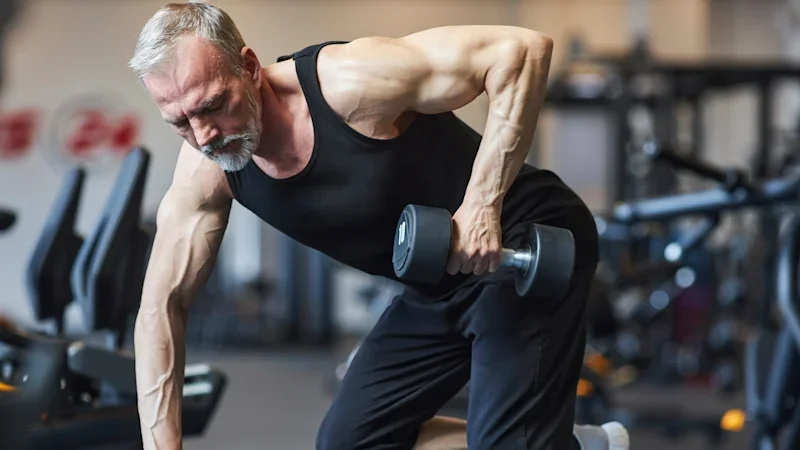
1. Bent over row
Hinge forwards from the hips, keeping your back straight and your core engaged. Holding a dumbbell in each hand, draw the weights towards your lower ribs by squeezing your shoulder blades together. Pause briefly at the top before slowly lowering the weights under control.
Why it works: This strengthens the upper back muscles that help pull the shoulders back and support the spine.
2. Prone ‘T’ raise
Lie face down with your gaze towards the floor. Keeping your body relaxed, lift your arms slightly away from the mat to form a “T” shape, squeezing the muscles between your shoulder blades before slowly lowering.
Start with bodyweight only and progress to holding light weights as you become stronger.
Why it works: This targets the smaller stabilising muscles around the shoulder blades that are often weakened by prolonged sitting and rounded posture.
3. Reverse fly
Hinge forwards at the hips and raise your arms out to the side, keeping a soft bend in your elbows. Start with light weights, pause briefly at the top of the movement and gently lower with control.
Avoid using momentum – the movement should come from the muscles of your upper back.
Why it works: This strengthens the rear shoulders and upper back, helping to counter the forward-rounded position many of us adopt.
4. Single-arm row
Hold a weight in one hand and rest your opposite hand on your knee or a chair for support. Using the full range of movement, draw the weight back towards your hip while keeping your elbow close to your body. Slowly lower before repeating on the other side.
Why it works: Working one side at a time challenges the upper back while also encouraging the core muscles to stabilise the spine.
5. Weighted dead bug
Lie on your back and, with or without weights, slowly extend the opposite arm and opposite leg away from your body. Keep your lower back gently pressed down throughout the movement and return slowly to the starting position before changing sides.
Why it works: A strong core is essential for supporting the spine. This exercise teaches the deep abdominal muscles to stabilise the body while the limbs move.
To conclude
Getting older does not mean we have to accept becoming smaller, weaker or more stooped.
While we cannot stop the natural changes that come with ageing, we can influence how our bodies adapt. Building strength helps us maintain the muscles that support our spine, protect our bones and allow us to move with confidence in all of our everyday activities.
Good posture is not about standing rigidly or trying to hold yourself perfectly all day. It is about having a body strong enough to support you, so you can continue to stand tall, whatever your age.
Make the most of your health, relationships, fitness and nutrition with our Live Well newsletter. Get it in your inbox every Monday.