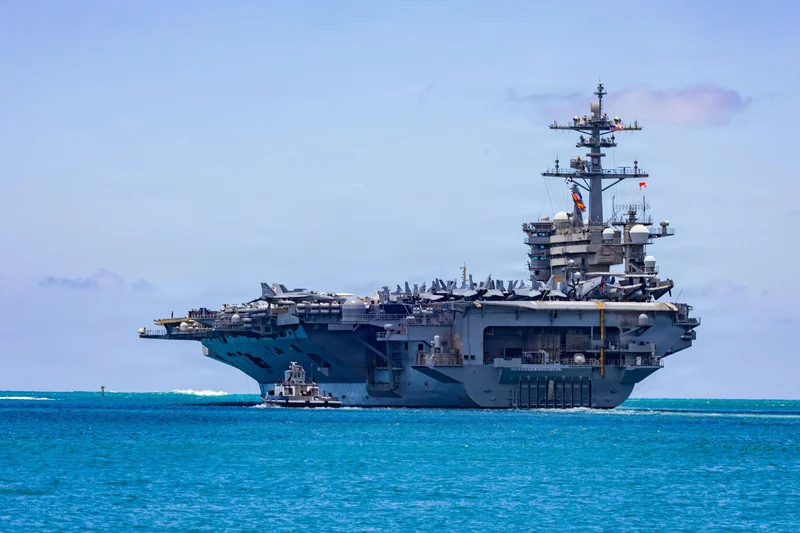
In the coming days, the United States Navy will have one fewer nuclear-powered aircraft carrier operating in the Pacific Ocean as the USS Theodore Roosevelt (CVN-71) is set to return to its homeport in San Diego in the coming days. The U.S. Navy’s fourth Nimitz-class supercarrier had previously departed Naval Air Station North Island on June 15 to lead the Rim of the Pacific 2026 biennial international exercises near Hawaii, which began in late June and concluded last week.
The aircraft carrier was one of more than 30 surface combatants to take part, along with five submarines and nearly 200 aircraft.
According to the San Diego Union-Tribune, CVN-71 will undergo a brief turnaround before a full deployment that is now expected to begin in September.
U.S. Carriers Are Operating In The Western Pacific And Middle East
Currently, the United States Navy has just one aircraft carrier operating in the Western Pacific, the forward-deployed USS George Washington (CVN-73). The Yokosuka, Japan-based supercarrier began its current deployment on May 10, 2026.
Last Thursday, CVN-73 became just the fourth U.S. Navy aircraft carrier to make a port call in Vietnam since 2018. The USS George Washington is now expected to depart the port of Da Nang on Monday and resume its 2026 patrol, which could last through the end of the year. The aircraft carrier had made a port visit to U.S. Naval Base Guam in the middle of June, and then spent several weeks operating in the Philippine Sea. During that time, it participated in the Valiant Shield joint exercises with the Japan Maritime Self-Defense Force. It transited the Luzon Strait into the South China Sea last week, becoming the first U.S. Navy carrier to operate in the waters claimed by China since January.
There are now two Nimitz-class supercarriers deployed to the Middle East, including the USS Abraham Lincoln (CVN-72) and the USS George H.W. Bush (CVN-77). Both flattops have remained in the U.S. 5th Fleet and U.S. Central Command’s area of responsibility to support combat operations against Iran.
However, CVN-72 has now been deployed for more than 254 days as of Sunday, and has been at sea for 233 days without a port call, since it made a one-day visit to Naval Base Guam on 12, 2025. If the warship remains at sea for three more months it will close in on the newly set record for longest deployment of 326 days, set by USS Gerald R. Ford (CVN-78), which was set in May.
That has led to speculation that the USS Theodore Roosevelt will head to the Middle East if a final peace deal can’t be reached, allowing the USS Abraham Lincoln to return home. It would be safe to suggest that it would be familiar waters for the USS Theodore Roosevelt.
Familiar Waters For The ‘Big Stick’
The fourth Nimitz-class supercarrier was commissioned 40 years ago this coming October. The first of the United States Navy’s supercarriers to be assembled using modular construction, the USS Theodore Roosevelt has been deployed several times to the Middle East in its decades-long career, beginning with Operation Desert Shield and Operation Desert Storm in 1991.
Known by the nickname “Big Stick,” the flattop took part in the attacks against al-Qaeda in Afghanistan for Operation Enduring Freedom following the September 11, 2001, terrorist attacks on New York City and the Pentagon.
During the Global War on Terror, the USS Theodore Roosevelt became the first U.S. Navy aircraft carrier since the Korean War to embark a Naval Reserve squadron – Strike Fighter Squadron 201 from Naval Air Station Joint Reserve Base Fort Worth, Texas.
CVN-71 later took part in Operation Iraqi Freedom in 2005-2006, and was again deployed to the Middle East in September 2008. In its 2015 deployment, in which the warship circumnavigated the globe, the carrier’s air wing conducted more than 1,800 sorties against Islamic State militants in Iraq and Syria as part of Operation Inherent Resolve, totaling 10,618 flight hours and over one million pounds of ordnance employed through 1,085 guided munitions.
In July 2021, the USS Theodore Roosevelt underwent a modernization that allowed the carrier to embark the Lockheed Martin F-35 Lightning II fifth-generation stealth fighter.
CVN-71’s last deployment to the Middle East was in the summer of 2024, and the warship returned to port after 278 days.