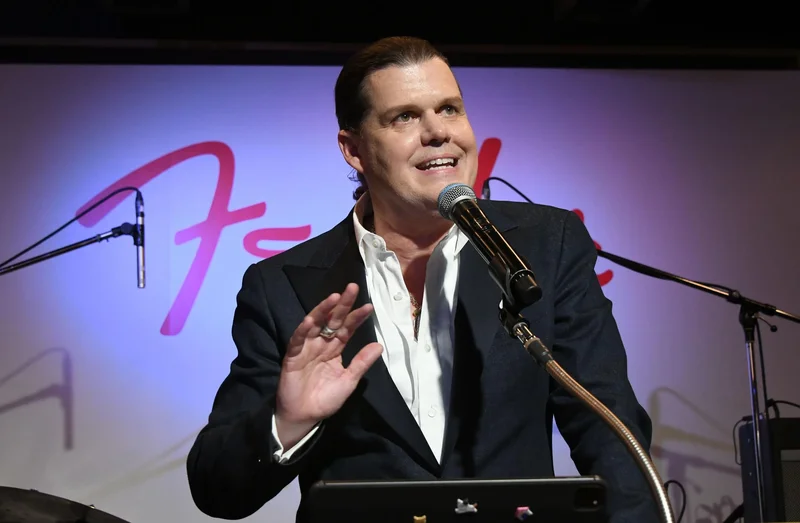
Fender CEO Edward “Bud” Cole gave an interview to T3 in May celebrating the 75th anniversary of the Telecaster with comments on AI and music that initially flew under the radar. But it has started making the rounds recently, pouring more fuel on an already raging fire of bad PR following the company pissing off basically the entire guitar-playing community by sending cease-and-desist letters to builders, claiming copyright of the Stratocaster body shape.
Fender’s CEO seems to think your bandmates are just analog AI
Bud Cole also compared learning cover songs to AI training data in a controversial interview.
Some influential guitar YouTubers have even said they’re done buying Fender gear in the wake of the controversy. And Cole’s resurfaced comments comparing cover songs and bandmates to a sort of “analog AI have only sunk the company’s standing further among the loudest of its fans online.
T3 editor-in-chief Mat Gallagher’s feature mostly paraphrases Cole’s statements, and Fender did not immediately respond to a request for comment or clarification. But here are the relevant bits from the interview:
Cole’s philosophy is that AI in music is nothing new. “I think AI has existed in music as long as there’s been recorded music,” he says. While the biggest barrier to playing guitar is the time it takes to learn the instrument, it’s the second barrier, writing songs, where he believes AI plays a part.
“I actually believe cover music has been sort of analog AI for a long time,” says Cole. Those that don’t yet have the skills to write their own songs can play the songs written by their favourite artists instead. “I listened a lot to REM, U2, The Smiths and The Cure, and at some point I got sick of just listening to them. I wanted to play it, so I learned to play guitar.”
Those taking their first steps into writing, according to Cole, can also lean on a second analogue form of AI: their band mates. You might just have a chorus or a riff to start with but then the drummer or bassist can add to it, and a song is born. AI can also play this role. “I actually think that we are in the brink of freeing up people to move beyond the same old covers and to really get into working like they do with their bands,” says Cole.
Cole is trying to draw a comparison between a human “training” on a handful of cover songs and an AI ingesting enormous datasets of copyrighted music. He appears to be suggesting that, by learning to play other people’s songs, internalizing those influences, and then synthesizing them into something new, you are essentially doing the same thing as an AI. This is a woefully misguided take that says to me that Cole either doesn’t understand AI or doesn’t respect artists.
For starters, scale matters. No person could possibly learn all of the songs used to train your average generative AI model, which, in the case of Suno, is suspected to be in the millions. Additionally, it dismisses the inherent humanity of the millions of tiny decisions, conscious or otherwise, that an artist makes during the songwriting process. Whether they’re driven by emotional response, reacting to a happy accident, or compensating for limitations, the artistic decisions made by a human are unique to them.
This is fundamentally different from a model spitting out something based on a prompt and a network of data points. As Steve Onotera, better known as Samurai Guitarist, points out, a player’s physicality, or the tiny errors that every human is prone to, prevent them from replicating someone else’s work perfectly. That kind of serendipity can’t be replicated by an LLM.
The same is true of bandmates. Humans who pull from their own unique sets of “training data,” life experiences, and physical skills or limitations are not the same as a chatbot. An AI doesn’t have taste or instincts in the way that your picky bassist who studied jazz composition in college does. If you told your drummer they were no different from an AI model, they’d rightfully be insulted.
Later in the interview, Cole says: “I believe that AI is actually going to help create a whole new world of guitar players that use it. To help connect with other musicians, to be more productive. And across the chasm into becoming a student of songwriting to a master of songwriting.”
Cole’s assertion that AI will somehow help people “across the chasm” to becoming master songwriters is also, frankly, ridiculous. Evidence is mounting that relying on AI tools is actually leading to deskilling. Using an AI to suggest rhymes or metaphors for pain isn’t the same as practicing songwriting and developing skills. The AI has never been left at the altar or sweated over the perfect pre-chorus transition. Repetition is the key. The adage is that you need to write 100 (or 1,000) (or 10,000) bad songs before you write one good one. That’s how you grow beyond tired tropes and learn to recognize when you’ve stumbled into something good.
Follow topics and authorsfrom this story to see more like this in your personalized homepage feed and to receive email updates.