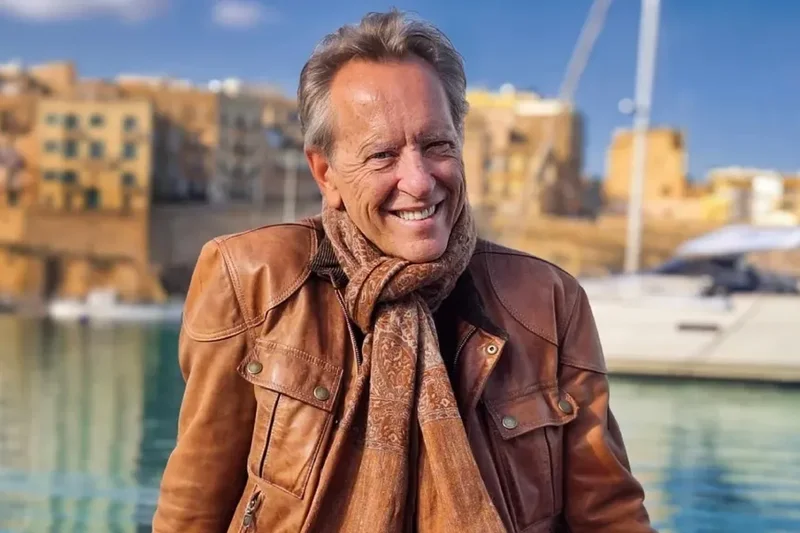
As light-entertainment schedule-filler television goes, you can’t really fault the logic behind Richard E Grant’s Very Modern Odyssey. The four-part series, in which the actor and presenter explores the Mediterranean locales that inspired Homer’s ancient Greek epic The Odyssey, arrives just a couple of weeks after Christopher Nolan’s lavish, phenomenally popular film adaptation came out in cinemas. It’s safe to say there hasn’t been this much interest in The Odyssey in centuries. Grant’s Channel 4 series plays dumb on this front – not really alluding to Nolan’s film or The Odyssey’s re-emergent relevance – but the thinking here is obvious.
One of the big problems that Very Modern Odyssey runs up against is that the most resonant moments of Homer’s story were not historical, or even geographical, but magical. Grant travels around the places Odysseus passed through on his journey – Malta, Sicily, Italy, Tunisia, Turkey, Corfu and Ithaca – but the modern-day reality of these places is fairly prosaic. In Malta, he tours the awe-inspiring Baroque designs of St John's Co-Cathedral, and learns how to craft traditional Maltese floor tiles. It’s mildly, innocuously interesting, but far removed from the potent imagination of Homer’s story. Grant can wander around beachfronts and churches all he likes, but he’s never going to encounter the sirens, or run afoul of a cyclops. (Which is a shame, really, because “Withnail and Eye” would be a picture caption too good to pass up.)
In truth, the words “very modern” are a red herring: this is a show about the history of the Mediterranean, explored eclectically in relics and tourist hideaways. Grant isn’t on an Odyssey so much as a cushy European getaway. The enduring appeal to all of these Grant-fronted travel shows (past entries in the genre include Richard E Grant’s Hotel Secrets, The Riviera: A History in Pictures, and Write Around the World) is Grant himself, a man who manages to be somehow shambling and urbane at once. There’s a gentleness to his voice and his manner; you believe he is sincere in his appreciation of history and ancient art. (And unlike Tom Hiddleston, he manages this without hand-flailing time travel.) But there’s not all that much more to it than gentleness and sincerity; sometimes, the crux of the scene is simply watching him look at something that seems like it must be very impressive in person, sort of a fusty, long-form equivalent of one of those dismal YouTube “reaction” videos.
The other big problem with Very Modern Odyssey is one that the programme’s creators could not have necessarily foreseen – which is just how much Nolan’s film has inspired people to engage with Homer’s story, and the context behind it. Thanks in part to interminable debates about “historical accuracy” and fidelity to the source material, the internet has been awash with discussion of The Odyssey for weeks now. The average member of the public is likely to have significantly more knowledge of the Greek epic than would have been the case back when this series was commissioned. This does not really matter, of course, but it does make you wish that Grant were allowed to go a little deeper into the text.
It also creates an amusing disconnect when Grant travels to the site of the Trojan War, in modern-day Turkey. In Nolan’s film, the fabled Trojan horse scheme is framed as an insidious, epoch-destroying betrayal – Nolan radically and ingeniously re-framing one of history’s most well-known stories from a triumph into a travesty. Here, Grant brushes it off with what has always been the received logic: that it was a “military masterstroke”.
It would be wrong to expect this series to engage with a film that its creators had not seen at the time of its making, but the timing here makes these sort of comparisons unavoidable. Very Modern Odyssey attempts to ride a slipstream of interest that everyone could see coming – only to find that it’s already been left far behind.