It has been soccer’s epiphany – its moment to recognise that its soul is worth saving.
A hellish week for Gianni Infantino, whose grand scheme to carve up the World Cup promised to benefit only the private equity boys and his own bank balance, has been a happy one for anybody calling out his cupidity.
This time, the grenades were thrown inside his own building. No sooner did Carlos Cordeiro, his long-time advisor, lambast his shabby back-room plot with Donald Trump’s associates as a “bad deal” than Kevin Lamour, FIFA’s chief operating officer, claimed staff had been “deceived”.
The global game has unearthed, albeit belatedly, a few big shots with a spine.
The change in tone is staggering. Once, an organisation such as UEFA would issue only cold, bureaucratic statements. But its latest bulletin, accusing Infantino of seeking to sell off the “family silver” and excoriating the “faceless individuals” who do his bidding, comes dripping in sulphuric acid.
It reflects not just the deep disdain of UEFA president Aleksander Čeferin for how his opposite number in Zurich operates, but the righteous indignation that Infantino’s arrogance has unleashed.
While it is rare for soccer to speak as one on any subject, the sheer conceit of a preening Swiss bureaucrat devoid of charm or wit or empathy has united 143 nations and counting in disgust.
“In many ways this has been a boost for the principles of football,” says Laura McAllister, Čeferin’s deputy at UEFA. “It’s a validation – football comes out of this stronger.”
It feels necessary, when we so often lament the tin ear of the game’s executives, to give credit where it is due. As soon as UEFA learnt of FIFA’s proposal to hive off the World Cup’s commercial interests for the enrichment of Infantino and Joshua Kushner, the brother of Trump’s son-in-law, it pronounced that it took the move “extremely seriously”.
England’s Football Association, likewise, displayed a concern for the common good, declaring that the World Cup “belongs to football and always will”, even if there was the awkward juxtaposition of Debbie Hewitt, the FA chair, turning on Infantino just six weeks after presenting him with a personalised England shirt.
In reality, Infantino just looks like a money-grabbing gargoyle in a pair of Stan Smiths.
Still, you cannot help but wonder where the red lines are drawn. For a decade, confederations watched the insidious expansion of Infantino’s powers and did nothing. They saw his unctuousness around despotic leaders, his description of feeling like a “child in a toy shop” on visiting Vladimir Putin at the Kremlin, and deemed it a price worth paying.
They were so at ease with the World Cup’s enlargement to 48 countries that Infantino felt emboldened, and within days of this summer’s tournament concluding, he set a two-week deadline to approve a 64-team leviathan in 2030.
And the heads of more than 200 national associations clapped like seals when the FIFA president orchestrated the charade of Saudi Arabia’s unopposed bid for the 2034 World Cup, demanding it be rubber-stamped with a round of applause.
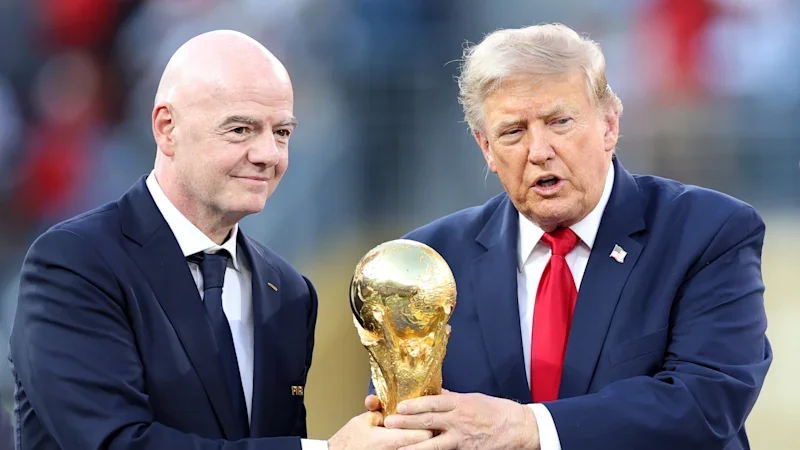
So why the handbrake turn now? Why, after signing off on so many of his shams, does football regard this example of Infantino’s overreach as beyond the pale? One crucial reason is the Trump factor. Of all the rulers at whose feet Infantino has prostrated himself, the US president has brought out the worst in his grasping, simpering nature.
If you found him awarding his friend the inaugural FIFA “Peace Prize” difficult to stomach, you should have tried sitting through his performance at the final World Cup press conference, where he coated Trump in verbal treacle for staging the “greatest human, social and cultural event that mankind has ever witnessed”.
He imagines he comes across as the ultimate statesman in such speeches, when in reality he just looks like a money-grabbing gargoyle in a pair of Stan Smiths.
The more the bromance has grown, the more Trumpian Infantino’s behaviour has become. Just as the president arrived late to a G7 summit in Evian this year, crassly joking “I’m the boss”, Infantino pulled the same stunt at FIFA’s 2025 congress in Paraguay, raising UEFA’s hackles by keeping everyone waiting because he had been conducting all-important business in the Gulf with, yes, you guessed it, Trump.
Copying his friend’s tiresome “fake news” taunts, he also characterised justified scrutiny of the World Cup as “false rumours” and “hate”.
The company of an autocrat seemed to convince him that he, too, was untouchable, or at least that he could shield himself through a cult of personality. Except he never had much of a personality in the first place.
You have to marvel at how quickly he has mangled his position of dominance. One minute, he is sitting pretty atop World Cup revenues of more than £13 billion ($25 billion), ready to be re-elected without any rival candidate until 2031. The next he finds himself in apparently terminal peril, an object of universal mockery, with his cynical vision of “FIFA Forward Enterprise” a smouldering shell.
And yet, soccer deludes itself if it imagines its work is complete. Infantino has been so seduced by the trappings of high office that he will fight to retain that cachet like a cornered animal. Even when disavowed by UEFA, CONCACAF and his contacts at Kushner’s Thrive Eternal, he was still scrabbling around to revive the plan with other backers, shameless to the end.
The map to his dethroning remains complex. But we should be heartened by the fact that the soccer world, stirred into action by one scandal too many, has rediscovered some semblance of a moral compass.
The Telegraph, London