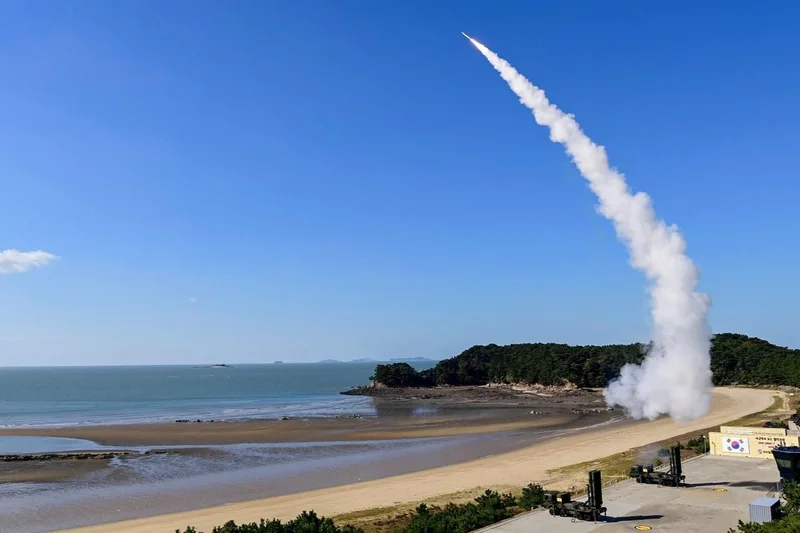
In a decisive step to bolster its aerial defenses against an increasingly complex array of airborne threats, South Korea officially deployed the latest production batch of its domestically engineered surface-to-air defense system, Monday.
The move marks a significant milestone in Seoul’s decades-long push to achieve strategic self-reliance in high-tech warfare, reducing its dependence on foreign military architecture while fortifying its umbrella against North Korea's ballistic missile program.
The system, known as the M-SAM-II, or Cheongung-II, formally assumed combat duty on Saturday following months of rigorous operational readiness simulations in Gyeonggi Province, which cradles the nation's densely populated capital region. Capable of neutralizing incoming short- to medium-range ballistic and conventional threats in their terminal flight phase, the M-SAM-II forms the bedrock of Korea’s lower-tier missile defense network.
Military analysts view the operationalization of the 2026 deployment quota not merely as a routine inventory upgrade, but as the centerpiece of a broader, more aggressive doctrine: the construction of a comprehensive, multilayered defensive shield.
Historically reliant on U.S.-supplied Patriot interceptors, South Korea has steadily built a home-grown defense industrial complex capable of rivaling world-class defense contractors. The M-SAM-II hit-to-kill vehicle operates at lower altitudes, engaging targets that slip past high-altitude interceptors.
Looking ahead toward the late 2020s, military planners intend to integrate the M-SAM-II with the Long-Range Surface-to-Air Missile (L-SAM) system, currently undergoing advanced development. While M-SAM-II guards the lower atmosphere, L-SAM is engineered to strike incoming threats at significantly higher altitudes and broader perimeters. By layering L-SAM above M-SAM-II and existing Patriot batteries, defensive forces gain overlapping engagement windows — dramatically raising the probability of interception should North Korea launch a saturation strike, according to the Ministry of National Defense.
"We will seamlessly execute subsequent deployment phases to decisively heighten our military’s missile response capabilities," said Kim Ki-young, director general of the Force Policy Bureau at the defense ministry. "By mobilizing cutting-edge defense science and technology, our armed forces will continuously perfect a multi-layered, overlapping defense architecture capable of responding swiftly and precisely to increasingly sophisticated aerial threats."
Yet South Korea's defense posture extends beyond current capabilities.
Recognizing that North Korea continues to hone its asymmetrical capabilities — including hypersonic glide vehicles and massed artillery arrays directed at Seoul — defense authorities are pressing forward with next-generation interceptors. Projects currently under development include the upgraded M-SAM-III with enhanced target tracking, the high-altitude L-SAM-II and a specialized defense framework tailored specifically to counter long-range artillery shell barrages. Defense officials also confirmed active exploration into directed-energy weapons, hinting that high-output military lasers could soon serve as a cost-effective countermeasure against low-altitude drone swarms and missile strikes.
As security dynamics across East Asia grow increasingly precarious, the ministry said South Korea’s steady technological ascent signals a clear message: Seoul is determined to secure its own skies with indigenous precision engineering, constructing an ironclad dome capable of outpacing any threat on the horizon.
This article was published with the assistance of generative AI and edited by The Korea Times.