For Three Hours Every Day, Open Ocean Transforms Into Australia’s ‘Ghost’ Reef
An isolated wonder some 1,200 miles from the nearest city, Montgomery Reef disappears as quickly as it appears, mirroring the supposed vanishing of its original owners, a tribe of Indigenous giants
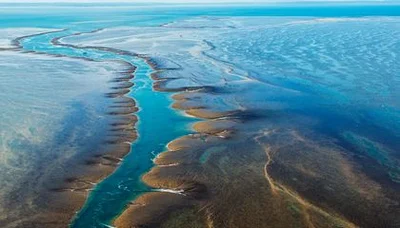
Known as Yowjab to Indigenous Australians, the inshore reef covers about 100,000 acres.
laurenepbath/RooM the Agency/Alamy
The harsh Western Australian sunlight had been reflecting off a calm patch of the Indian Ocean, making me squint as I sat in a tender boat surveying the water for signs of a mysterious natural wonder.
Our timing was cursed, it seemed. “Sorry, but the reef is not visible right now, although we will have good visibility through the water,” tour guide Greg Watson apologized, as the vessel motored away from our cruise ship toward Montgomery Reef, known as Yowjab to Indigenous Australians.
Before disappointment could take root, cheers erupted. It was nowhere until, suddenly, it was everywhere. Some 600 feet away, a huge coral shelfwas ever-so-slowly rising out of the sea, like a theater stage being lifted by hydraulics. That was an optical illusion, however, as the reef remained stationary while the water obscuring it gradually receded.
Most tourists encounter the reef’s magic amid multi-day cruises of the Kimberley, which run from March to November, and are especially popular during its dry winter from June to August.
Ronan O'Connell
“Ladies and gentlemen, that is how quickly things can change here,” Watson explained. Extreme tides are a key feature of the Kimberley, a remote, wild region of Western Australia, and the cause of this daily spectacle. Soon, our boat was encircled by the world’s largest inshore reef, teeming with rare creatures and echoing with the legend of a vanished tribe of Indigenous giants.
Covering about 100,000 acres, Yowjab is one of the “most remarkable reef systems on Earth,” says Zoe Richards, a coral biologist at Curtin University. Located 1,200 miles north of Perth, Western Australia’s capital, and about 12 miles from the mainland, it protrudes out of the sea for only a few hours each day.
During low tide, Yowjab can rise up to 26 feet above the ocean surface, which is unmatched by any other reef Richards is aware of. Water trapped across the reef-top then pours over its edges in cascading waterfalls, a dazzling event rarely seen on coral formations, she notes.
That’s when a few hundred tourists arrive to witness this unique show, which typically lasts two to three hours. Some observe it from above, during scenic helicopter day trips from the nearby towns of Broome and Derby. Most tourists, however, encounter the reef’s magic amid multiday cruises, which run from March to November, and are especially popular during its dry winter, from June to August.
During low tide, Yowjab can rise up to 26 feet above the ocean surface.
Ronan O'Connell
Yowjab’s crocodiles, dugongs, humpback dolphins, blacktip sharks and green sea turtles can briefly become marooned on the newly exposed reef before sliding down its slippery surface back into the safety of the sea.
“Yowjab is built primarily by coralline algae, and the algae forms low ridges around the edge of the reef that trap water as the tide falls,” Richards explains. “Over low tide, the reef top is transformed into a maze of shallow pools where corals, reef fishes, turtles and other marine life persist. Larger animals, such as dugongs and sharks, withdraw to deeper channels and surrounding waters, waiting up to four hours for the rising tide to reconnect them with the productive feeding grounds that lie across the reef top.”
While those creatures have evolved to cope with the fierce tides, so too has Yowjab, says Claire Ross, a research scientist at Western Australia’s Department of Biodiversity, Conservation and Attractions. “During low tide, large areas of the reef are exposed to air, intense sunlight and fluctuating temperatures for several hours,” Ross explains. “Research on Kimberley coral reefs shows that many species have developed a high tolerance to these conditions, including resistance to heat stress and periodic exposure to air.”
A land of peculiar beauty
Though it may seem curious to outsiders, Yowjab is entirely normal by the standards of the Kimberley—a region laden with alien landscapes and natural phenomena. Once roamed by dinosaurs, the Kimberley is as ancient as it is distinctive. Some 1.8 billion years of furious natural forces—including some of the world’s largest tides, rising up to 36 feet—have decorated it with dramatic gorges, colossal caverns, towering sea cliffs, sandstone domes striped like bees and waterfalls that flow horizontally.
To reach this land of peculiar beauty, most tourists fly into the Kimberley town of Broome, then venture on by rental car. Others join one of the many cruises from here north to the city of Darwin, like the 10-day cruise I took.
A Pacific reef heron hunts for prey on Montgomery Reef.
Michael Nolan/robertharding/Alamy
In the Kimberley, Australia bares both its prehistoric soul and its teeth, as its majesty can distract from endless dangers. Ravenous crocodiles, lethal snakes and toxic spiders populate the isolated region.
Cruises departing from Australian ports Broome, Darwin or Fremantle are arguably the safest way to explore the Kimberley coast, as many of its finest sites can only be reached by boat, including Yowjab. These cruise ships anchor a few miles from the reef, which passengers can then admire for an hour or two while scything along its channels in a tender boat before returning to their cabin. Driving trips are comparatively arduous, and dangerous, due to this region’s vastness, rough roads and extremely low population density.
The stewards of Yowjab
The Kimberley is larger than all but three U.S. states, covering 163,000 square miles. Yet it feels almost empty, with fewer than 40,000 residents, about half of whom are Indigenous Australians. Rather than being a homogenous culture, Australia’s 984,000 Indigenous people come from more than 200 traditional groups, each possessing distinct rituals, language and laws.
The Dambeemangaddee people are the traditional owners of Yowjab and nearby coastal lands. For 56,000 years, they moved as lightly as possible across its unique environment only to watch colonial interlopers degrade it after Australia was invaded by the British in the late 1700s. Now, however, the Indigenous group of about 1,500 people—further divided into clans—has regained greater influence over this coastal wonderland.
Yowjab is located in Lalang-gaddam, one of three marine parks established in recent years in the Buccaneer Archipelago, a sublime cluster of more than 800 islands. Lalang-gaddam, Mayala and Bardi Jawi Gaarra marine parks are co-managed by the Western Australia government and the Indigenous owners of those locations. Under this system, Indigenous rangers track biodiversity, monitor pollution, advise on land management and safeguard culturally significant sites. Traditional owners are also increasingly involved in tourism, teaching visitors about the Kimberley’s Indigenous heritage.
Quick fact: Not your typical coral reef
- Montgomery Reef is not made entirely of coral. Its foundation is a 1.8-billion-year-old mesa made of dolomite and sandstone that is now covered in coralline algae.
Tourists must respect the Kimberley’s fragile nature and ancient cultures, urges Anneke Brown, managing director of Tourism Western Australia. They could do so by using experienced tourism companies to visit Yowjab. Wijingarra Tours, owned and run by Dambeemangaddee siblings Neil Maru and Naomi Peters, partners with cruise and helicopter companies that visit Yowjab. Its staff provide insight into tribal history and cultural heritage.
“It is very important; we are saltwater people, and Yowjab is a big part of Worrora culture,” Maru says of the reef and the region’s traditional Worrora language groups. “My mum helped form the first marine park here to protect it, and all the wilderness and animals here. We tell people about our cultural stories when they visit us.”
The myths swirling around Montgomery Reef
Yowjab’s evocative origin story is part of the Dreamtime, an ancient set of lore and beliefs that underpin Australia’s Aboriginal culture, explaining creation and offering a guidebook to human life. According to the Dreamtime, Australia’s landscape was carved by Indigenous ancestor spirits.
Rainbow serpents and Wandjina are the chief ancestral spirits of this patch of the West Kimberley. In the creation story of Yowjab, its ferocious tidal movements were spawned by a fight between a heartbroken Wandjina woman and a rainbow serpent. After her son went missing while hunting on the Yowjab, the Wandjina woman paddled a raft to search for him. When she was unsuccessful, the devastated mother vented her anger at the rainbow serpent, which created the sea. She reached down and poked a whirlpool, which represented an eye of the powerful snake. The rainbow serpent dragged her into this deadly vortex, leaving Yowjab with its extreme tidal movements.
Countless creation stories are depicted in rock art images across the Kimberley. Indigenous people have, over many millennia, decorated this region with tens of thousands of rock paintings. Daubed on cave walls with clay pigment, they illustrate Indigenous mythology and the evolving nature of this region’s flora, fauna and topography.
At stops along our cruise, we hiked through scrub and scaled steep paths to see several ancient rock art sites not far from Yowjab. We admired ancient paintings of turtles, frogs, snakes, birds, humans and the unmistakable scenery of the Kimberley. However, what I didn’t spy amid these galleries were the giants of Yowjab.
Yowjab is located in Lalang-gaddam, one of three marine parks established in recent years in WA’s Buccaneer Archipelago, a sublime cluster of more than 800 islands.
Ronan O'Connell
Intensifying Montgomery Reef’s mystique is the remarkabletale of an Indigenous people who supposedly stood up to seven feet tall, known as the Yawijibaya. A French film crew captured them in 1929 before they allegedly vanished due to a tsunami or warfare. This story was repeated by Watson, our cruise guide, and features in many tourism articles about Yowjab. Yet the truth remains unclear. What we know is that, for centuries, the Yawijibaya people inhabited the Montgomery and High Cliffy Islands on the reef’s fringe and thrived by fishing.
The Yawijibaya so fascinated Australian archaeologist Sue O’Connor that she conducted field trips to those islands in the mid-1980s. Now a professor at the Australian National University, she says this popular tale about the Yawijibaya was not backed by evidence.
“I think all of these statements about giants are nonsense,” O’Connor says. “There is no doubt that many of the coastal people near Yowjab were very tall. The fact the coastal people were so tall and well built—having regular access to protein from seafood—compared to their desert neighbors may have given rise to the myth that they were giants.”
She also argues that the Yawijibaya people didn’t disappear. O’Connor points to research by late Australian anthropologist Norman Tindale, who reported the Yawijibaya integrated with mainland Indigenous Worrora people in the early 1900s. “At this time, there were missions established along the mainland coast and these were bringing people in from the islands,” she says.
Rather than dying out, as legend goes, the Yawijibaya people still have a presence near Yowjab. They live on through their descendants, like Maru. “That’s my mob,” he says of the purported giants. “We are all Wandjina peoples.”
Some destinations rely on mythology to attract tourists, like Scotland’s Loch Ness and its infamous “monster.” But Yowjab and the Kimberley need no embellishment. Both are magnificent examples of nature proving reality is more puzzling than fiction.
“I don’t even know how to start describing that,” fellow passenger Nicholas Korner said to me as our tender motored away from Yowjab’s confounding display.
I jotted down adjectives and superlatives in my notebook, but no volume of vivid portrayals could adequately encapsulate what we’d just seen. Its elusive nature—dazzling now, concealed later—elevates it to a true phenomenon.
Planning Your Next Trip?
Explore great travel deals
A Note to our Readers
Smithsonian magazine participates in affiliate link advertising programs. If you purchase an item through these links, we receive a commission.