If you browse the tourist traps on Water Street, the historic main drag of St. John’s, you can’t avoid the puffins. Puffins on coffee cups, aprons and shot glasses; puffins on postcards, calendars, beer coasters and stickers; puffin stuffed toys, puffin key chains, puffin bottle openers, puffin walking sticks.
Everyone loves a puffin. Newfoundland’s official bird is famously cute. People come from all over to see them in their coastal colonies.
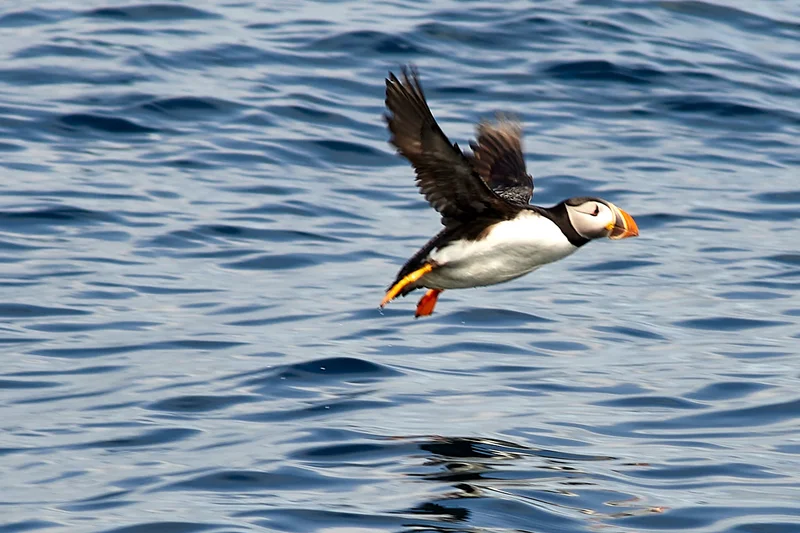
In summertime, the birds put on an unforgettable show: strutting unsteadily around the clifftops like butlers after too many brandies; wheeling through the air, their stubby wings going at up to 400 times a minute; flapping their way along the water’s surface like hurried rush-hour commuters.
A Memorial University professor who studies them, Ian Jones, says they look like something Salvador Dali might have come up with if asked to paint a bird. There is that white, Marcel Marceau face, with its dark, sweepy eyebrows, those bright orange webbed feet and, above all, that crazy beak, a multicoloured marvel with bands of yellow, orangey red and bluish grey.
The beak takes on those vivid hues when the birds return from the open sea to the coast of Newfoundland every year to breed. The question that fascinates Prof. Jones is why. “It is still one of the great mysteries, why these animals look the way they do,” he says.
Most seabirds are white, black, grey or some combination of those. Their bills might feature an orange dot or a black ring, but nothing like the puffin’s, which stands out for its almost tropical appearance. Despite decades of research, ornithologists are still trying to find a reason.
Naturally, they have some theories. On a drive down Newfoundland’s southeast coast to show a visitor a huge puffin colony, Prof. Jones lays out a few of them.
Prof. Jones grew up in Ottawa. An awkward, long-haired teenager who didn’t fit in at school, he started watching birds as an escape. It turned into a career that took him from Hawaii to Norway and eventually to Newfoundland, where he studies seabirds and how to save them from threats like climate change. With its craggy coastal cliffs and offshore islands, ideal for breeding birds, the province nicknamed “the Rock” is a great place to find them.
The biggest colony of Atlantic puffins in North America is at the Witless Bay Ecological Reserve south of St. John’s. More than a quarter of a million pairs of the birds gather there every spring. They raise their young in burrows dug into the turf of offshore islands, where predators like rats and foxes can’t reach them. The males and females, which look the same and usually mate for life, work together to protect and feed their chicks (called – what else? – pufflings). Each pair produces just one a season.
Once they are big enough, the young take off and fly out to sea alone. For the next few years, till they reach breeding age themselves, they live on the waters of the wild North Atlantic, bobbing on the surface and using their short, strong wings to dive for small fish.
In these early years, puffins are effectively an aquatic animal, never touching land. They look nothing like the gaudy creatures that tourists love to photograph. Their legs are dark, and their beaks are a nondescript grey with a browny-yellowish tip. For years, the birds found at sea were thought to be an entirely different species, for how could they be related to the colourful “sea parrots” seen on the coasts?
But as spring comes and the light out in the ocean starts to change, puffins of breeding age go through a dramatic metamorphosis. They grow new flight feathers for the trip back to land. A bright red ring appears around their dark eyes, an effect heightened, as if by eyeliner, with that eyebrow streak. The testicles of the male grow from the size of a poppyseed to that of a bean.
Most striking of all, their beaks take on a flattened, hatchetlike look, enlivened by those bands of deep colour. A rosette of yellow skin like a flower petal forms at the corner of their mouths. Voilà, you have the classic puffin portrayed on dish towels and fridge magnets.
“These deeply readied birds are the beautiful, perfected creatures you see gathered in spring at the colony,” British author Adam Nicolson writes in The Seabird’s Cry: The Lives and Loves of Puffins, Gannets and Other Ocean Voyagers.
He says the beaks serve as a kind of billboard of health, demonstrating that the bird is ready and able to mate and raise young. To create such a bright billboard, the birds must eat lots of fish rich in the pigments known as carotenoids, which go into creating the colours on their beaks. It is a biologically “expensive” process that only a healthy bird can accomplish.
“Breeding puffins, like hidalgos at court, need to look like heroes, an exhibition of their own marvellousness,” Mr. Nicolson writes.
But Prof. Jones says it is not quite that simple. For one thing, he says, studies have found that there is not always a strong link between the health of a bird and the splendour of its ornamentation. The puffin with the brightest beak may not be the most robust puffin.
So scientists have come up with other possible explanations. One is that birds, and other animals, tend to be attracted to the shapes and colours found in the foods they eat. They have a “pre-existing bias” about what they find stimulating.
Prof. Jones points to the king vulture of Central and South America, which has a head, ornamented with a floppy wattle, that looks a lot like a pile of fresh guts. Vultures eat the guts of dead animals, so that may make the bird attractive to a mate.
Puffins might be doing something similar. Red is the colour of food for many animals, so red is a popular colour of animal ornamentation. Puffins sometimes eat krill, shrimp-like crustaceans that appear in the sea in pink or red swarms. That could help explain the red bill.
Another theory holds that weird genetic traits arise in species when an anomaly gets out of hand. Say a female bird sees a male bird with an unusual hooked beak and for some reason finds him irresistible. Their sons and daughters will inherit both the hooked-beak mutation and the preference for that look. As generation follows generation, the mutation will “run away” till the whole species has it. This is called the Fisherian runaway theory, after its author, Ronald Fisher, a British statistician and biologist.
So it could be that the puffin beak is just a meaningless mistake that became fixed in the species over time. We recognize puffins because of it, and they recognize each other as fellow puffins because of it, but it has no special utility otherwise.
Apart from its practical role as a fish-catcher, that is. Its serrated edges allow puffins to catch several fish at once, holding the first catches in place with their muscular tongues while seizing others one by one. They surface holding the fish crossways and side by side, making it look as if the birds have droopy moustaches as well as comical beaks.
A colleague of Prof. Jones at Memorial, Pierre-Paul Bitton, is working on yet another hypothesis about those beaks. Many birds communicate with each other through song. Puffins are notably quiet, a marked contrast to the raucous seabirds that they hang out with on Newfoundland’s coast. Their only significant vocalization is a chainsaw-like growling noise they sometimes make.
So Prof. Bitton thinks they use the patterns of their beaks instead of their voices to recognize one another. Puffins study each other closely, especially when they are courting. Males and females reuniting after months at sea can often be seen “billing,” tapping and rubbing their beaks together in a kind of ritual dance. Their beaks have distinct ridges and grooves, set apart by their colours, and those may serve as identifying marks.
To test the theory, Prof. Bitton and his students put stuffed puffins in a colony and watched how the birds reacted. Now he is working on a new wrinkle. He wants to put the fake birds on miniature tracks and make them pop out of their burrows as real puffin parents would. His students have the privilege of designing the world’s first puffin railway.
But even if he finds support for his ideas, they wouldn’t necessarily cancel out the others, Prof. Bitton says. A puffin’s ornamental summer beak may do many things at once: signal its condition, identify it and help it form relationships with others.
“You’re dealing with these really complex dynamics,” he says. “Are we ever going to solve it all? Probably not.”
He keeps trying in part because the information might help scientists understand the social dynamics among puffins and what happens to those dynamics if populations decline, as they have been in some places. Britain has seen its numbers drop by a quarter since 2000, the Royal Society for the Protection of Birds said on April 14, World Puffin Day.
Whatever its purpose, the beak that delights tourists is a transitory thing. Toward the end of the breeding season, its colours fade, and the horny plates that give it shape start to flake off. Shedding their costumes and makeup, the puffins go back to their anonymous offstage life, ranging over the expanse of the grey ocean.