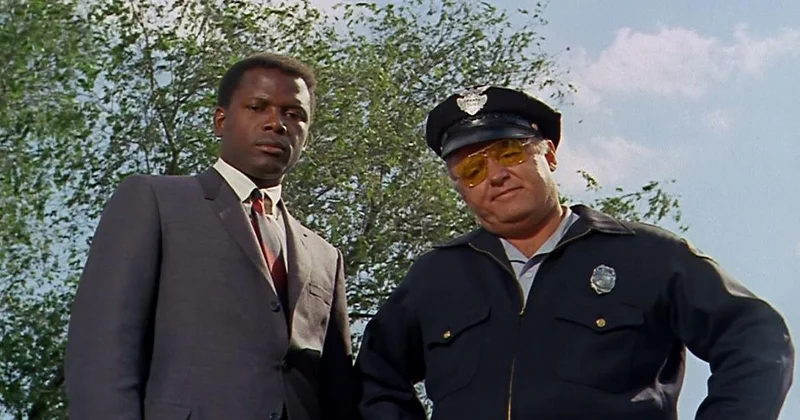
Virgil Tibbs is arrested for the murder of the wealthy industrialist Philip Colbert. In the eyes of the local cops, Virgil has every reason to be a suspect: he has a wallet full of money; he’s leaving town; he’s Black.
The last factor is the most important in this small American town seething with racism. When Virgil (Sidney Poitier) reveals that he too is a police detective from Philadelphia, who was passing through town, the local police chief Bill (Rod Steiger) is gobsmacked.
Vigril wants to leave on the next available train, but his investigative skills are superior to those of Bill and his posse. Bill takes Virgil’s help to solve the murder, hating nearly every minute of it and not holding back with his feelings either.
Norman Jewison’s Oscar-decorated In The Heat of the Night (1967) is a film about a murder as well as one of the oldest crimes there is. Adapted by Stirling Silliphant from John Ball’s novel of the same name, the movie examines racism through the prism of a tightly constructed police procedural. Released during the Civil Rights movement in the United States, the film is one of the highlights in Sidney Poitier’s mould-shattering career.
In The Heat of the Night can be rented from Prime Video. Superbly shot by Haskell Wexler and edited by Hal Ashby (himself a renowned director), the film has several tense sequences that reveal what Virgil is up against.
Jewison and Ashby hold the moments when Virgil is being put down, allowing both the ugly things that are being said and his exasperated reactions to register. In one of the most quoted scenes, Virgil snaps at Bill, who keeps calling him “boy”: “They call me Mister Tibbs!”
The film doesn’t varnish the prejudice against Blacks in this corner of America, nor does it over-emphasise Bill’s crime-fighting skills. Virgil is forever trying to prove himself to an array of disbelieving white people, starting from Bill and going all the way down to a cafe employee, who point blank refuses to serve Virgil.
Although Bill develops a grudging respect for Virgil, he can’t help himself. While driving through a cotton plantation, Bill takes a dig at Virgil, suggesting that he could have been one of the Black labourers working on the plantation.
Sidney Poitier’s dignity in the face of horrid meanness is superbly countered by Rod Steiger’s unthinking pettiness. The two actors make an excellent oddball pair, their characters setting aside their differences for a short while in order to solve the murder. It isn’t the end of racial injustice, but at least a beginning has been made.
We welcome your comments at letters@scroll.in.