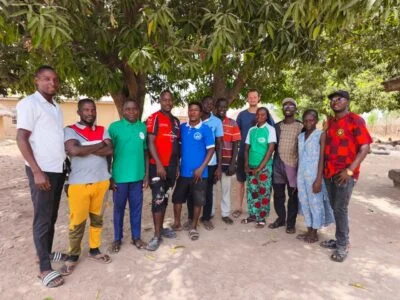
What if the most effective way to combat language endangerment is to empower community members to document their own languages? The Kam Language Project is an example of how community-led efforts can help preserve endangered languages.
Kam (also known as Nyingwom) is a language spoken in 29 villages in the Bali Local Government Area of Taraba State in Nigeria. There are an estimated 8,000–11,000 Kam language speakers today. Like many other Indigenous languages in northeastern Nigeria, Kam received no attention from researchers before 2016. As a result, there was no written literature, dictionary, standardized orthography, or audiovisual recordings of the language that could be used for documentation and preservation.
To preserve this language, Dr. Jakob Lesage, a linguist and lecturer at the Institute of Asia and African Studies, Humboldt-Universität zu Berlin, started the Kam Language Project in 2016. Over ten years, he worked alongside Kam community members using what he calls a “decentralized” approach: Rather than parachuting in as an outside expert, he trained a language documentation team comprising 14 members of the Kam community. At the completion of the ten-year project in March 2026, the team had produced grammar reference material for the Kam language, a digital Kam dictionary, 307 recordings (audio and video), and a website dedicated to the Kam language.
Speaking to Global Voices’ Abdulrosheed Fadipe via WhatsApp, Lesage shared the story behind the documentation project.
GV: What first drew you to work on Nigerian languages?
JL:Nigeria has a striking combination of enormous linguistic diversity, major gaps in documentation, and communities who want their languages studied and represented. About half of Nigeria’s 500-plus languages have never received serious scientific attention – the highest proportion of undocumented languages anywhere in Africa.For a linguist, the work is urgent and exciting. Studying a single undocumented language properly can overturn what we thought we knew about language classification, history, and even linguistics more generally. Kam was exactly that kind of discovery — it belongs to the Niger-Congo family, but beyond that it doesn’t fit neatly into any known subgroup, raising questions of how it arrived where it is. And it has some unusual grammatical features that can shed light on broader linguistic debates.
Beyond the science, the work is meaningful to the speakers of the languages, who want their history recorded and their languages preserved. Nigeria is one of those rare places where linguistics is both scientifically important and genuinely meaningful for the people who speak the languages — people want to document their languages.
GV: Where does Kam sit on a language endangerment scale — is it under immediate threat?
JL:Kam is still actively spoken, so it’s not in crisis — but like many languages in the area, it’s under real pressure.Language loss is never just about language. A language lives in the contexts where it’s used. When those contexts disappear, the language starts to slip too. Take farming: Most Kam people are traditionally farmers. They use their language when they work the land, process crops, and trade with neighbors. But if people leave for the city — drawn by a centralized economy or pushed by unpredictable weather that makes farming difficult — those contexts vanish. New ones take their place, and those new contexts run on different languages. Move to Jalingo, the state capital, and you’ll find yourself speaking more Hausa simply because that’s what daily life there demands. As lifestyles shift, so do languages. And with roads now linking Kam villages to larger economic centers, that kind of shift could happen fast.
So I’d describe Kam as locally stable but vulnerable. The crucial thing is that we’re documenting it while it's still in active, everyday use — and that's exactly what the past ten years have been about.
GV: How do you navigate the ethics of documenting a language that is not your own? And what role did native speakers play in shaping the documentation?
JL:For me, it’s important that the community isn’t just involved, but that they’re in charge of what gets documented and how. Over time, I’ve moved toward what I call a decentralized fieldwork model: The researcher isn’t the sole expert or decision-maker. Skills, equipment, and authority are shared between community collaborators. The linguist plays a supporting role.In practice, that meant Kam team members were central at every stage — recording, transcription, translation, and crucially, deciding what was worth preserving in the first place: Oral histories, local knowledge, culturally important stories. The documentation reflects what the community team considered valuable.
I should be honest, though: Academic structures don’t always make this easy. There’s still strong pressure toward short-term outputs and purely theoretical results. Much of linguistics prioritizes research questions over anything directly valuable to language communities. But the field is shifting, and more projects are trying to build models where high-quality research and community priorities don’t have to pull in opposite directions.
My goal is to design workflows where communities have real ownership and where the work still holds local value long after the project ends. And I’d argue that our theoretical work also stands to gain enormously from deeper partnerships with the people whose languages they study. Everyone benefits when the relationship is built right.
A community member who served as the language documentation coordinator, Babangida Audu, shared how the project started:
When the white man [Lesage] came to Sarkin Dawa in 2016, he started going to elders in the community, one of whom was my father. So he asked my father if he had an educated child who he could work with and that was how I was contacted by my father to come back home because then I was in Abuja. By the time I came back we had meetings with the white man where I helped him in transcription and translation. I joined the project because I wanted my language to move forward. Later on I was made to serve as the language documentation coordinator. We later went on to recruit others and created six teams of two individuals per team making a total of 12 people.
He added:
We communicated in English. It took a while to get used to the way he speaks. We had to demonstrate sometimes for him to understand better. He was always ready to learn. If he does not understand anything, he always asks for a better explanation.
Another team member, Garba Rahab Precious, believes the project has helped to preserve the language for generations to come, and this was made possible by working together with the community members.
The project crew were trained to use cameras for videos and audio recordings, while I was trained on how to transcribe and translate the meaning to English. On a typical day of documentation, we go to Kam villages and interview native speakers on different topics. The recorded videos will be sent to Yakub [Lesage] who will check it and we will transcribe and translate it.
GV: What challenges did you face while carrying out this project, and how did you resolve them?
JL:The biggest was COVID-19. I had planned to travel to Nigeria — and suddenly that was impossible.It forced a useful reflection for the whole field of descriptive linguistics. We rely heavily on outside researchers physically traveling to communities. The pandemic exposed how fragile that model is. It also confirmed something I’d been moving toward anyway: If community members have the skills and equipment to document their own language, the work doesn’t stop when a foreign researcher can’t get on a plane.
So we pivoted to remote training. Working with Elisha Yunana — someone from a nearby community with hands-on documentation experience — we ran a two-week training for an initial Kam team of around ten people, teaching them to use the recording equipment themselves. Getting that equipment there was its own puzzle: My university had no system for purchasing it locally in Nigeria, so I bought it in Germany and relied on friends who happened to be traveling to waybill it to the Kam community.
File-sharing was another headache. Audio and video files are large, and internet connections in the villages were unreliable. We solved it by routing uploads through people based in Jalingo, where connectivity was more stable.
Transcription posed a different kind of challenge: Kam has no writing system. The approach that worked best was trusting speaker intuitions — starting from how people naturally represented sounds and working through readability problems as they came up, rather than imposing a system from the outside.
The team rose to every one of these challenges and what we accomplished together is something I’m really proud of!
GV: If this language were to disappear tomorrow, what do you think the world would lose?
JL:The Kam world would lose a lot: Jokes, stories, how people express their relationships to one another, a way to keep things secret from people who don’t speak the language.For the rest of the world, it would mean losing a window on human culture and language that we haven't fully been able to open yet.
Lesage believes the ownership of the linguistic heritage belongs to the Kam community and also said that the materials created are, and will continue to be, accessible to everyone.