On July 26, 1876, 150 years ago almost to the day, Surendranath Banerjee founded the Indian Association in Calcutta. Its first great agitation was, at its core, a student grievance. The colonial government had lowered the maximum age for the Indian Civil Service examination from 21 to 19, a change that quietly shut young Indians out of the highest offices open to them. The state treated the complaint as an administrative footnote. Banerjee treated it as a constitutional question, toured the country, and turned the anger of examination-going youth into the first genuinely pan-Indian political mobilisation. The Raj never recovered the loyalty of the generation it dismissed.
Fifty years ago, in the winter and monsoon of 1976, two states on two continents were teaching the opposite lesson in real time. On June 16, schoolchildren in Soweto, South Africa, who marched against the imposition of Afrikaans as the medium of instruction were met with live ammunition; hundreds died in the weeks that followed. In India, the Emergency had already emptied the campuses by other means: student unions stood suspended, and activists of every persuasion sat in jail under the Maintenance of Internal Security Act (MISA). Pretoria used bullets, New Delhi used preventive detention, and both were confident they had restored order. Within a decade and a half, the generation of Soweto had made apartheid ungovernable, and the generation of the Emergency had produced much of India’s post-1977 political leadership. Order purchased through the suppression of the young turned out to be the most expensive commodity either state ever bought.
The pattern repeats again
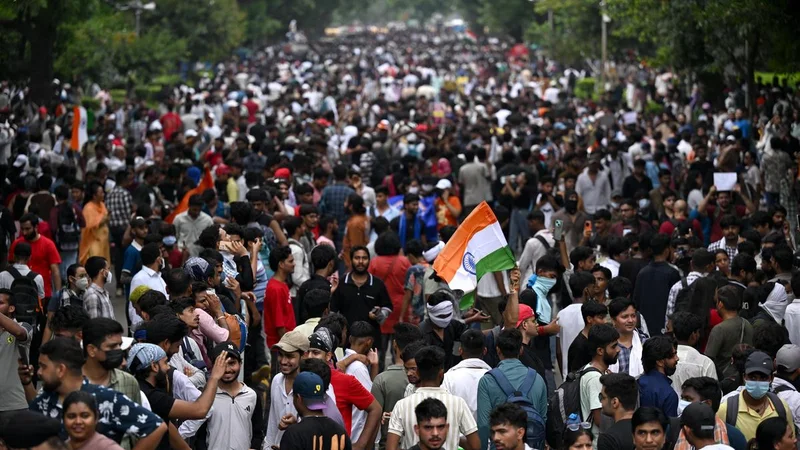
This July, the streets around Parliament and Jantar Mantar have supplied the third panel of the triptych. What began as an online satire has become one of the largest student mobilisations in years, built on grievances that are neither manufactured nor abstract: a leaked National Eligibility cum Entrance Test (Undergraduate), or NEET-UG, paper that forced the cancellation of an undergraduate medical examination taken by over 20 lakh aspirants, and an on-screen marking controversy that left thousands of school students in limbo. So far, the state’s response has followed the familiar pattern of barricades, tear gas, a baton charge that injured more than 100 students during the march on Parliament, and rhetoric from the highest levels of the establishment comparing protesters to vermin.
History suggests three lessons that the state would do well to learn before the pattern completes itself. Lesson one: force does not disperse a genuine grievance, it organises it. The Soweto uprising did not begin as a revolution. It began as a march by schoolchildren over the language of instruction. It was the shooting that made it a revolution. Every image of a fallen student became a recruitment poster, exile camps filled with teenagers who had left the country in the months after June 1976. The regime’s own commission later conceded that the police response, not the original grievance, had transformed a protest into an insurrection.
The mechanism is not South African, it is universal. When the state answers a specific, bounded demand with generalised violence, it converts a policy dispute into a question of dignity, and dignity disputes do not settle. The students who returned to Jantar Mantar the morning after the lathi charge, and said so to every camera available, were following a script written in Soweto and in a hundred places since. A government that reads their return as defiance to be broken, rather than as evidence that force has already failed, is preparing its own sequel.
The politics of disrespect
Lesson two: contempt delegitimises the state faster than it delegitimises the students. The colonial government’s error in 1876 was not primarily one of policy. It was one of register. By treating the civil service age question as beneath serious engagement, it told an entire educated generation that their aspirations had no standing before the state. Banerjee understood that the insult was more mobilising than the injury, and the Indian Association was built on that understanding.
The instinct to belittle is alive today. When constitutional functionaries such as the Chief Justice of India reach for the vocabulary of pest control to describe a section of youth, they repeat the Raj’s mistake with less excuse. Dehumanising language aimed at the young does not shrink a movement but hands the movement its identity, its symbols and its moral high ground in a single gesture. The protesters outside Parliament this week did not have to manufacture the charge that the state holds them in contempt. The state made the charge for them, on the record. A government serious about de-escalation would begin not with concessions but with a change of register by acknowledging, plainly and publicly, that the integrity of public examinations is a legitimate constitutional concern of every citizen who sits for one, and that those raising it are stakeholders, not enemies.
Lesson three: protest is the symptom; blocked accountability is the disease. Students do not camp on pavements because they enjoy tear gas. They do so when every institutional channel for redress has been tried and found closed. The 1876 agitation arose because Indians had no representative forum in which the civil service rules could even be debated and the Association became the forum the constitution did not provide. The Emergency-era campuses went silent because the ordinary machinery of accountability, the courts, the press, the legislature, had been suspended; when it was restored in 1977, the verdict was unambiguous.
The Gen Z-led education reform movement has been explicit that it wants action rather than assurances: credible investigations, examination reform, and accountability for the institutional failures that preceded the leak. These are demands that a functioning system of parliamentary and regulatory oversight should have been capable of processing without a single barricade. The durable answer to this protest is therefore not a better crowd-control strategy but a stronger accountability architecture, wherein an examination authority enjoys genuine independence, evaluation and revaluation are subject to statutory transparency, parliamentary committee scrutiny produces published findings, and consequences attach to officials rather than only to invigilators and middlemen. A state that builds those channels makes the street redundant. A state that refuses to build them makes the street inevitable.
Ensure genuine accountability
It is an accident of the calendar, but a useful one, that the July 2026 crackdown falls in the same week as the sesquicentenary of the Indian Association. The men who governed India in 1876 could not have imagined that a students’ grievance about an examination would seed the movement that ended their rule. Public officials who governed India and South Africa in 1976 could not have imagined that the teenagers they jailed and shot would inherit their states. No government ever believes the pattern applies to itself. That is precisely how the pattern survives.
The young people at Jantar Mantar were not asking the state to surrender. They were asking it to be worthy of the examinations it conducts. On the evidence of a century and a half, the governments that listen to that request are the ones that last.
Shashank Pandey is a lawyer based in New Delhi and former Legislative Assistant to Member of Parliament (LAMP) Fellow
Published - August 03, 2026 12:56 am IST