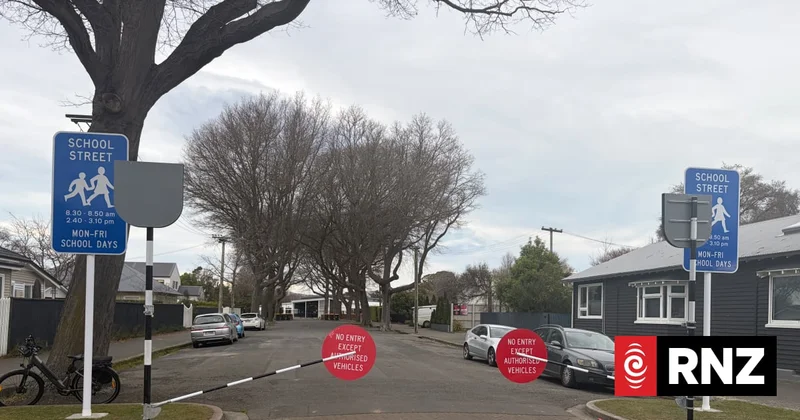
Primary schools say a pilot programme that allows them to close nearby roads during drop off and pick up times is helping to curb dangerous driver's behaviour.
It has been a growing issue in New Zealand's biggest city, with Auckland Transport starting Safe School Streets a couple of years ago.
The programme has been testing how to manage safety, cut peak traffic and encourage walking or cycling at 13 schools.
But other schools across Aotearoa are facing the same issues and some are taking matters into their own hands.
At 8.30am outside Freeman's Bay school in central Auckland, cars were queuing up and were getting as close as they could to the school's gates.
Children were beginning to walk across the zebra crossing, with commuters speeding past on their way to work.
Checkpoint spoke with some parents who had found a park about the behaviour they had seen over the past few months.
"We have had a car accident because just up here someone had done a U-turn in front of us and didn't see us," said one parent.
"I've seen people kind of flip around, do a U-turn to get from one side to the other and on the other side are little kids who run around," said another.
Schools struggle with dangerous driving during drop off and pick up
A school in Christchurch has been facing the same problem as its entrance is in the middle of a busy cul-de-sac.
Waimairi School principal Chris Panther said parents had been parking on yellow lines on both sides of the road and over driveways on Tillman Avenue.
"It felt very chaotic, we had students biking to school, scootering and walking.
"As I watched outside my office, there was always the worry someone was going to back out of their driveway, [with] children crossing across the cul-de-sac."
To counter the problem, with permission from the council, Waimairi School has started closing the road during peak pick up and drop off times.
A teacher kept an eye on the barrier, to make sure residents on the street and emergency services could still get through.
Panther said it had been a game changer.
"Now, it feels very calm, very orderly, we've got a care crossing operating on Blighs Road that also feels much calmer now because we're only dealing with traffic in one direction.
"We've opened up another gate at the back of our school
In partnership with the Christchurch City Council, the school will trial the closures until the end of the year.
It will then reassess whether the change will become permanent.
"We were concerned about moving the problem to other surrounding streets, so the council's been out with us as has the local police and parking wardens.
"Over the last week or so they've been checking those streets so Blighs Road, Windermere Road, Condell Avenue and Westholme Street, they're all looking reasonable."
Waimairi School got the idea from Marlborough Primary School in Auckland's Glenfield.
It was the first school to introduce restrictions under Waka Kotahi's Reshaping Streets regulations in March last year.
Principal Michelle Nell said drivers were having regular near misses with students.
"It was chaos, it was parents behaving very badly and not thinking about their own child's safety.
"They would come into the road and stop wherever they wanted to, open the doors let the kids out in the middle of the road and get really upset because people were blocking them getting out.
"Neighbours were [also] upset about cars blocking the driveways, so they couldn't get out to work."
Nell said because parents now must park further away from the school, it had cleared the roads for students trying to walk.
After surveying the community, Auckland Transport found 82 percent of parents and 90 percent of teachers thought safety had improved.
"Getting our kids safely to school is paramount. I would say just do it, do what you feel is best.
"If somebody comes and complains, tell them that you're doing it for the kids and 99 percent of the time they'll turn around and say, good on you."
But not everyone is sold.
Amy Manos, the deputy principal of Rosebank School in West Auckland, said closing the road would be ideal.
But she said it was not realistic for some schools who were on busy main routes, who shared the road with commuters and industrial traffic.
"A kiss and drop zone would be perfect.
"That's what parents ultimately want to do, is to drive into a safe space, give their kids a kiss, wave goodbye and know that they're safe on the school grounds."
The impact of the trials in Auckland and Christchurch will continue to be monitored over the coming months.