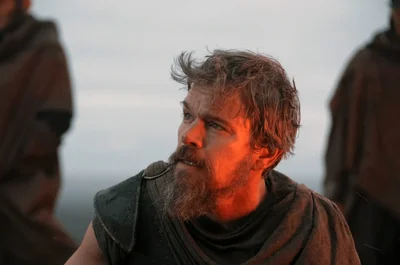
Just as every film is really about filmmaking, isn't every film also an adaptation of Homer's The Odyssey? The hero's journey. The antihero's journey. The road trip movie. The war movie. Movies set in space or at sea, in the middle of a treacherous jungle or a barren desert. The story of Odysseus is a foundational myth, which makes the proposition of an actual movie of The Odyssey seem, among other things, redundant. And that's before you get to the near impossibility of filming it.
But tell Christopher Nolan it's impossible to do something, and he will only want to do it more. And so we have his vision of The Odyssey, a massive, operatic cinematic experience mostly about the story's own operatic massiveness. In many ways, Nolan especially has always been making The Odyssey from the inside out, obsessed as he has been with his own harrowing quest to make big, majestic spectacles. It makes sense for him to just finally go at it for real. Nolan heightens and demystifies the mythology in equal measure, and the result is a throwback to the epic cinematic expressions of David Lean and Fritz Lang. It's also a treatise on Nolan's favorite subject: history's great men and the messes they make.
The Odyssey is, of course, the story of wily Odysseus (Matt Damon) and his 20-year journey back home following the Trojan war. He and his men battle the currents, run into giants, cannibals, witches, sirens, and his own dead soldiers in his bid to get back to his wife Penelope (Anne Hathaway) and son Telemachus (Tom Holland), who are barely holding his kingdom together as the many suitors vying for Penelope impose their will in Odysseus's absence. Damon's Odysseus is a wizened general, weary after another battle fought on behalf of King Agamemnon (Benny Safdie). He's a serious, brilliant man, but arrogant in the face of mercurial Gods, which leads to much of his suffering.
Close readers of the site might remember that I am a very vocal Nolan skeptic. As a filmmaker, his reputation as a hyper-literate, highly intellectual auteur unconvincingly obscures his actual identity as a master of majestic, tightly constructed, reliably huge dumb guy movies. The Batman movies are dumb. Inception and Interstellar are brilliantly crafted expressions of some very dumb ideas and junk science. Oppenheimer is an ADHD action movie version of a historical drama. Tenet might be my favorite movie Nolan has made since The Prestige, primarily because it comes the closest to being self-aware and splashes around so gleefully in its own ridiculousness. These are controversial opinions not because the films don't bear them out, but because they're annoying to express; when you call Nolan films dumb, his fanboys tend to take it as an automatic slight, as if things that are dumb must also be bad. But more than that, Nolan fanboys glom onto this idea that these movies are actually really sophisticated and mature and brilliant, and the fact that they love them means that they themselves are also sophisticated and mature and brilliant. In this way, Nolan fanboys are a little like Kendrick Lamar fanboys—perhaps he should've been the one to open this film instead of Travis Scott.
With that said, thanks to Tenet and Oppenheimer, I have found my cold heart starting to thaw where Nolan is concerned. For all of his flaws, Nolan really is a master of big thematics. His incredibly large productions and scrupulous attention to detail, the dedication to high craftsmanship behind and in front of the camera, and the ability to fit so much into the frame really is admirable, particularly at a time when so few filmmakers are able to pull off a big box office spectacle. It's basically him and Denis Villeneuve carrying the Spielbergian flag for spectacle done right at this point. And if you're going to make your whole thing about process, showmanship, and technical expertise and execution at high levels, you may as well adapt The Odyssey.
And Nolan's Odyssey certainly is a technical achievement of the highest order. At just under three hours, it is an endurance test in every conceivable meaning of the word. Parts of it made me feel like I was sitting through The Revenant again, only actually entertaining. And surprise—this is another Nolan film told out of sequential order by multiple perspectives. I was exhausted by this movie. Nolan goes out of his way to place you in the chaos happening to these Spartan soldiers. You feel the wind and storms that gather in the middle of the ocean. You feel the force by which they try to row out of danger. Your stomach churns as Circe (Samantha Morton) graphically turns these men into pigs. You feel the heat, sweat, and stink of the various bodies living inside the Trojan horse. And you see the strain and power it takes just to get it inside the gates. Everything in this movie feels tactile, grounded, and authentic, even when it isn't realistic.
Does that automatically make for a great film? In Richard Brody's review, he wonders why Nolan has largely ignored the Gods themselves in his adaptation. In Homer's poem, the Gods are much more literal, hanging this curse upon Odysseus's neck and making him confront his own arrogance. But aside from Athena (Zendaya), who takes the form of a slaughtered priestess from the sack of Troy, the Gods are as silent in this story as they are in our own lives. There are two ways to look at this: Either Nolan was right to make certain things more implied in order to streamline the story and ground it in reality, or this proves that Nolan misunderstands the text and the essence of the material he is adapting. I don't know what the answer is, nor am I certain that a version of the film with all the Gods in place and onscreen would be a better movie. But there is something about this and other aspects of The Odyssey that left me more curious than ever about Nolan and the movies being made today in general.
In Namwali Serpell's essay on "The New Literalism" in American movies, she writes about this sense that movies have become too repetitive, heavy-handed, and obvious. As she writes:
"The point is not to be lifelike or fact-based but familiar and formulaic—in a word, predictable. Artists and audiences sometimes defend this legibility as democratic, a way to reach everyone. It is, in fact, condescending. Forget the degradation of art into content. Content has been demoted to concept. And concept has become a banner ad."
Next to this idea, I think that there has also been a real sapping of color from these stories in an attempt to make them seem serious and mature. What this really amounts to, though, is a uniform drabness and dulling effect. It is also apparent in Villeneuve's Dune movies, in Robert Eggers' Nosferatu, and almost certainly in his upcoming Werwulf. It's in Guillermo Del Toro's Frankenstein, Matt Reeves' The Batman, and Todd Philips' Joker movies. And of course, it is in all of Nolan's movies, too. To attain a more grounded and authentic feeling—to attain the aesthetic that passes as seriousness—there is a need to sand off and excise the goofy aspects of the original source material that often inspires these films. On the one hand, we want to continue playing in the sandbox, but we also need that to feel "more adult," a much more mature and "realistic" vision of something old enough to remember from childhood. But that silliness is also part of what made these stories attractive in the first place. They gave it style and magic, and made it feel like play. Yeah, maybe Nolan's giant cyclops looks more authentically like a giant cyclops would look like (whatever that means), but does it still fill you with wonder? Why exactly are all these masterful filmmakers so afraid of the more ridiculous aspects of these stories?
I'm not saying The Odyssey is bad, or that it would be better if it was more over-the-top and campy; I'm simply wondering about the instinct to feign and signal seriousness about what are ultimately unserious stories. Nolan's Odyssey is finely crafted and impressive but also stilted and maudlin relative to something like Wolfgang Peterson's Troy, which is goofy and stupid but also a good deal of fun. For all his vision and ambition, Nolan can often seem to have very little actual imagination. Be it clinging to the lucid, mostly plain dreamscape in Inception or the N64 video game level planets of Interstellar, Nolan likes to work low to the ground of what's possible in movies.
This obviously isn't just a problem with Nolan—it is everywhere in our culture. And while I do not want to indulge the inane politicized discourses that have sprung up online over this movie—because they are the literal babblings of a petulant (and small) troll community—it is apparent that Nolan really does want to use The Odyssey to say something about our lives today. It is a movie that depicts generational degradation. The younger suitors come into a kingdom missing its wise, older king, and in his absence all virtue has been replaced by chaos and striving. They are led by Antinous (Robert Pattinson), a sniveling cowardly snake who would've probably been great in the Trump administration. All that's left of the past are stories and mythos. And that mythos is steadily deconstructed over the course of the movie, as we are shown that the Trojan horse and the sacking of Troy was not heroic in the least, but just an act of rape and pillage under the guise of a gift for the Gods. The Trojan horse, a lie that leads to murder, is reframed as this new act of supreme violence akin to the nuclear bomb. And it is deployed not for Menelaus's (Jon Bernthal) honor or the great beauty of Helen (Lupita Nyong'o), but for ego and conquest.
Nolan wants to use The Odyssey to deal with original sin and how human advancement also often means humans thumbing their noses at God, or the idea that any cosmic morality could ever bind them. And as a result, this sin primes the successive generations to become more vile and more ruthless, and even less respectful or humane. The movie mostly accomplishes this point, but things can get muddy at times. There's just so much movie happening that its easy to get overwhelmed. Nolan has a love for the stoic, serious man who, despite all his flaws, is loyal to a code of honor above all else, but this somewhat obscures or distorts the character of Odysseus, who repeatedly gives into his ugliest urges and desires throughout the poem. It may not be Nolan's job to be loyal to the original text, but he should at least consider what his deviations from it are trying to say. Nolan also loves to depict power being used in ways that cause so much destruction and pain, while also holding out that abuse as the only way to solve the problem at hand. It's a tortured philosophy that makes it seem like he wants things both ways—to de-mythologize Odysseus and these ancient Greek myths while also turning Odysseus into a mythic acton hero over its last 30 minutes.
And if Nolan is full of contradictions when it comes to men, he is typically and totally underwhelming when it comes to women. The fact that every top-tier actor wants to work with him certainly works in his favor when it comes to how he writes female characters. Anne Hathaway could be The Rock with all the heavy lifting she's doing here. Despite being a queen, she is portrayed as completely feckless and incapable of making decisions, a damsel hoping for her husband's return. Zendaya once again has her blank beauty used to provide spectral judgment and insight to a male protagonist. Charlize Theron as Calypso is given little to do except provide narrative momentum, as well as getting Matt Damon gone off that lotus flower like he's an Atlanta trap artist. The movie excises a lot of the sexual violence of the source material, which is perhaps a good thing given Nolan's track record with putting sex on screen, but ultimately feels sterile and safe.
All of which is to say that this is The Chris Nolan Film Experience. It is a spectacle and an adventure. It is maddening, frustrating, and confusing. It is probably just as impressed by its own intense massiveness as the audience is meant to be. It is a universal experience that seems only to prioritize the one man at the center of the frame. It insists upon itself, Lois, and it will almost certainly make a billion dollars. But as is always the case with Nolan, no matter whether I liked the film or not, I end up wondering when this guy will relax and stop taking this all so seriously.