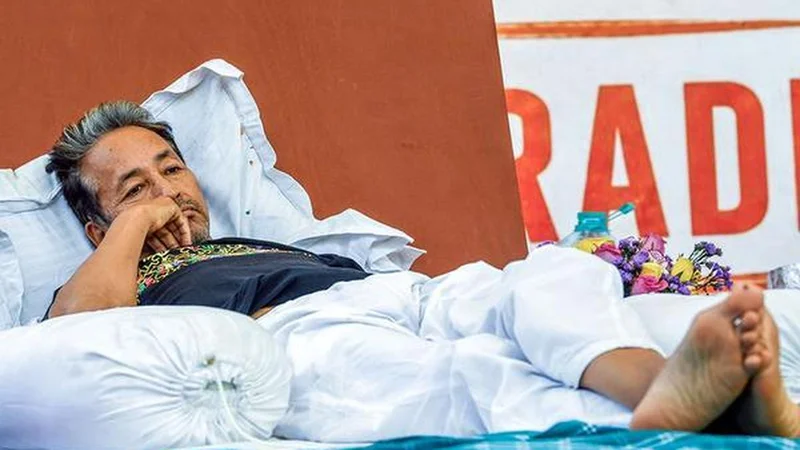
‘Hunger strike’ or ‘fast unto death’ has been observed in the annals of India’s history as one of most crushing forms of non-violent protest, demanding immediate attention to a prevailing issue. Based in Mahatma Gandhi’s ideals of satyagraha, fasting has emerged as a potent tool to bring immediate attention to demand justice and influence opinion. The crux of the method lies on the simple idea: a person or a community purposefully goes into fasting for an indefinite period to pressurise the state for immediate action.
In the face of an acrimonious British colonial rule, Mahatma Gandhi undertook several fasts between 1918 and 1948 to lodge protest against communal violence, partisan policies, and high tax measures. Revolutionary leader Bhagat Singh had also leveraged the tactic, demanding equal treatment for Indian political prisoners under British rule.
Hunger strike as a form of expressing dissent was also undertaken by political leaders. In 2009, the then Tamil Nadu Chief Minister M. Karunanidhiobserved a fast demanding an immediate ceasefire in Sri Lanka which saw a brutal violence targeted against Tamils during the Eelam War. His fast came into an end within a day following an assurance by the Union government. In 1993, Chief Minister Jayalalithaa launched a high-profile hunger strike demanding Karnataka to release Cauvery water to Tamil Nadu. Despite a differing context, both protests garnered significant outpour of sympathy across major public quarters.
With Sonam Wangchuk’s hunger strike — seeking resignation of Education Minister Dharmendra Pradhan and accountability in NEET paper leaks gaining momentum — here are few key activists and leaders whose hunger strikes shaped the politics in India’s post-independence history.
Potti Sriramulu: Birth of Andhra Pradesh
The statue of Potti Sriramulu in Tirupati. File photo.
\| Photo Credit:
K.V. Poornachandra Kumar
Potti Sriramulu’s hunger strike in 1952, demanding a separate state for Telugu-speaking people, remains one of the most consequential cases of hunger strikes in India’s history. His dream for linguistic identity struck a chord with native Telugu speakers. Following an arduous fasting of 58 days, he died on December 15, 1952, triggering widespread protests across the Madras Presidency. The massive unrest, resorting to widespread violence, resulted in then Prime Minister Jawaharlal Nehru’s government to create Andhra State in 1953. Later, this set the stage for the States Reorganisation Act, 1956, which reorganised India’s boundaries largely on linguistic lines.
Irom Sharmila: A 16-year long battle against AFSPA
Irom Sharmila in the special ward of the Jawaharlal Nehru Institute of Medical Sciences (JNIMS) hospital after breaking a 16-year long fast in Imphal on August 10, 2016.
\| Photo Credit:
Ritu Raj Konwar
Recognised as the “Iron Lady of Manipur”, Irom Sharmila started her hunger strike in November 2000 in response to the Malom massacre that claimed the lives of 10 civilians. Her hunger strike demanded the repeal of the Armed Forces (Special Powers) Act (AFSPA). Sharmila’s fought a long battle to establish the human rights violations in conflict-hit regions. For nearly 16 years, she survived on force-feeding through a nasal tube while being repeatedly arrested on charges of attempting suicide. Despite her clarion call to repeal AFSPA, the contentious law remained in force during most of her protest. However, her campaign transformed the national discourse on civil liberties, fundamental rights, state’s use of military force, bringing international limelight into the cause.
Anna Hazare: Crusading fast for anti-corruption bill
Social activist Anna Hazare on the first day of his fast unto death campaign in New Delhi.
\| Photo Credit:
Sushil Kumar Verma
Social activist Anna Hazare helmed the politics of hunger strike in 2011 after he started an indefinite hunger strike demanding a Jan Lokpal law to combat corruption. His protest at Delhi’s Jantar Mantar became one of the watershed movement for fight against corruption. This also led to the birth of the India Against Corruption campaign. This became one of the crucial movement in the country, amassing the dissension of commoner’s against then Congress government.
Medha Patkar: Fasting for environmental justice
Narmada Bachao Andolan leader Medha Patkar
\| Photo Credit:
Murali Kumar K
Medha Patkar, the architect of the Narmada Bachao Andolan, protesting the displacement of thousands of families due to large dam projects, held onto hunger strikes for an indefinite period. Her fast centred more on demanding fair rehabilitation, environmental safeguards and adherence to legal commitments. Her long-drawn fasts compelled courts, governments and international funding agencies to scrutinise rehabilitation policies more closely, making displacement and environmental justice central issues in India’s development debate.
Mamata Banerjee: The Singur agitation
Trinamool Congress leader Mamata Banerjee on the sixth day of her hungerstrike in Singur by the West Bengal government.
\| Photo Credit:
Sushanta Patronbish
Trinamool Congress Supremo Mamata Banerjee in 2006 led a crushing 26-day hunger strike against the acquisition of farmland in Singur for Tata Motors’ Nano project. The fast was crucial in giving a boost to West Bengal’s anti-land acquisition movement, galvanising farmers and opposition parties. Though the immediate standoff remained unresolved, the agitation became a defining force in eroding the Left Front government’s political standing. Ms. Banerjee rode the anti-land acquisition wave in Singur and Nandigram movements to end the Left’s 34-year rule in West Bengal in 2011, showcasing how hunger strikes can become catalysts for broader political change.
K. Chandrashekar Rao: Indefatigable fast for Telangana’s formation
TRS president K. Chandrasekhar Rao ending his fastby accepting a glass of lime juice from party leaders in Hyderabad.
\| Photo Credit:
Sivakumar PV
Demanding a separate state, K. Chandrashekar Rao (KCR), founder of the Bharat Rashtra Samithi (then Telangana Rashtra Samithi), launched an indefinite hunger strike on November 29, 2009. His steadfast determination, demanding the formation of ‘Telangana’, led to widespread protests, student agitations and shutdowns across the region. This intensified the pressure on Centre. Following few days, the Union government announced the initiation of the Telangana statehood process, marking a crucial point in the decades-old movement. Eventually, Telangana was carved out of Andhra Pradesh on June 2, 2014, underlining Rao’s fast as one of the hitting hunger strikes in the post-independence India.
G.D. Agrawal (Swami Gyan Swaroop Sanand): Fasting for the Ganga’s survival
Hindu sadhus on a sit-in protest campaign for 'Save the Ganga' urging the government to take immediate steps to clean the river at Jantar Mantar in New Delhi on June 18, 2012. The Ganga Seva Abhiyanam launched the 'Save Ganga Movement' on Jan. 14 when Swami Gyan Swarup Sanad (the noted environmentalist Prof. G.D. Agrawal) started a fast to save the river.
\| Photo Credit:
Krishnan VV
Environmentalist and former IIT Kanpur professor G.D. Agrawal, later known as Swami Gyan Swaroop Sanand, undertook several extreme measures of hunger strike to demand stronger measures for the conservation of the Ganga. His final fast, which turned to be fateful, in 2018 had demanded a legally implementable framework to halt hydropower projects, alongside unabated growth of projects on the riverside. Following a harrowing protest that lasted for 111 days, he passed away on October 11, 2018, in Rishikesh. His death underlined Union government’s deafening silence that fell short of paying heed to his numerous requests.
Sonam Wangchuk: For Ladakh’s cause
Social activist Sonam Wangchuk undertook a 21-day ‘climate fast’ in March 2024 demanding constitutional safeguards for Ladakh following the region’s conversion into a Union Territory in 2019. During which, Wangchuk demanded Ladakh’s inclusion under the Sixth Schedule of the Constitution to protect tribal land and resources, and stronger measures to preserve the fragile Himalayan ecology. The protest, backed by the Leh Apex Body and the Kargil Democratic Alliance, drew nationwide attention to concerns over land rights, local employment and environmental conservation.
The Ladakh administration charged him under the National Security Act (NSA) in September 2025. Later, he was granted bail from Jodhpur Central jail on March 14, 2026.
Published - July 22, 2026 03:16 pm IST