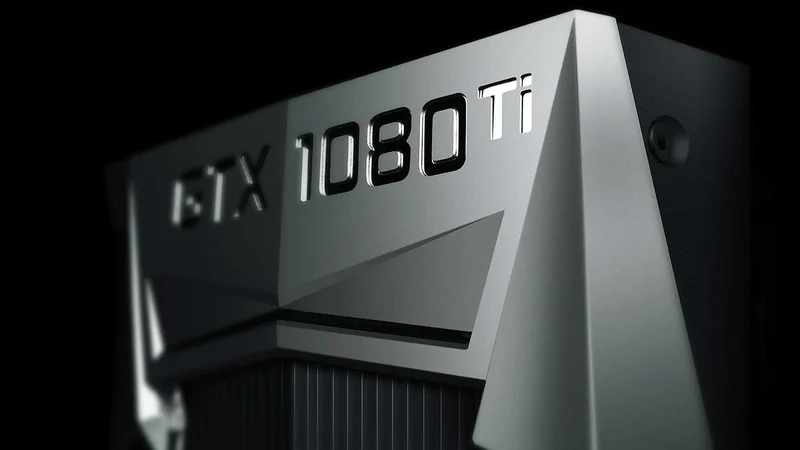
Few names echo in the aisles of tech cathedrals like the legendary GTX 1080 Ti, released by Nvidia all the way back in 2017. The GPU it's based on, GP102, actually debuted a year earlier, in 2016, which is why this story is titled as a decade-old hindsight. German outlet PC Games Hardware just retested all three cards based on the GP102, pitting them against far more efficient modern offerings to answer a simple question: how well does the 1080 Ti hold up in 2026?
At its launch, the GTX 1080 Ti cost $700 and used a cut-down version of the GP102 called "GP102-400," while the Titan Xp that released a month later enjoyed the full-fat GP102-450 silicon. Built on the Pascal architecture, the 1080 Ti featured 3,584 CUDA cores that could boost up to 1.58 GHz, 11GB of GDDR5X memory saturated across a 352-bit wide bus, and a 250W TDP. It was the last (consumer) flagship Nvidia made with pure rasterization in mind.
Jumping to the results, we see the 1080 Ti still pushes close to 60 FPS in modern titles at 1080p resolution. However, it's slower than even the current-gen RTX 5050, and it's unable to beat any recent 60-series GPU as well. You'd have to go as far back as the RX 6600 or the RTX 3060 8GB to find something that the 1080 Ti edges out. Speaking of which, it is still faster than the Radeon VIII that came out two years later and matches the relative performance of the Titan X, while the Titan Xp clears it comfortably.
As you'd expect, the older the game, the better the 1080 Ti performs. Though its large VRAM buffer helps it win in some areas. For instance, it's barely faster than the aforementioned RTX 3060 in Assassin's Creed Shadows, Battlefield 6, Days Gone, and Baldur's Gate 3. X4 Timelines and Spider-Man 2 are surprise cases where it's faster than even the RTX 4060 and RX 7600. Stalker 2 was the only game where the 1080 Ti managed to beat the RTX 5060 as well, once again because of that extra memory.
In recent titles, reliance on technologies like upscaling and ray tracing severely hurts the king of a bygone raster-only era. DLSS and ray tracing were both mocked at the time they debuted, but have become integral parts of the industry now. Pascal lacks any Tensor or dedicated RT cores, forcing it to fall back to software emulation, which is basically unplayable. DOOM: The Dark Ages and the new Indiana Jones game wouldn't even boot on this GPU.
Averaged across all resolutions and 20 different games, testing shows the RX 5700 XT and RTX 2070 as its closest contemporaries. At 1080p, the resolution you'll actually play at, it's slightly more performant than the RX 6600 and RTX 2060 6GB, while being smoked by almost every midrange card from the last five years. Not to mention, even this performance requires an absurd amount of power by today's standards.
The GTX 1080 Ti posted the worst efficiency numbers on the chart, second only to the Radeon VII. The aging architecture mixed with the 16nm process node combines to give it a rating of 0.085 FPS per watt. In comparison, the current-gen RTX 5060 achieved 0.202 FPS per watt, meaning the 1080 Ti wastes 58% more energy under load, while the RTX 5080 had the best results at 0.253 FPS per watt.
Get Tom's Hardware's best news and in-depth reviews, straight to your inbox.
Today, cards like the RTX 5070 have 250W TDPs, and they're almost three times as fast with that kind of power consumption. Not to mention, they're significantly cheaper compared to the 1080 Ti when adjusted for inflation. So, you're paying more for less performance, fewer features, and less efficiency, but maybe not less longevity, since the card is almost a decade old already. Keep in mind that Nvidia has stopped pushing driver optimizations for Pascal at this point as well.
If you want to check out all the benchmarks in detail, make sure to give our friends at PC Games Hardware a visit. Their excellent testing originally included comparisons against the Titan X and Titan Xp, since both use the same GPU, but neither of them is as illustrious as the 1080 Ti. The outlet actually argues its GOAT status and crowns the 2080 Ti as the true visionary, and the charts certainly back that up.
The answer to the question asked at the start is rather straightforward. If you already own the 1080 Ti and only have a 1080p monitor, you can still just about get by, though you're missing out on a lot. However, given the state of the PC hardware industry right now, it would be sacrilegious to recommend upgrading from an icon that championed the people's voice for so long. So if you don't find yourself wishing for more performance, features, or efficiency, ride that 1080 Ti till its dying breath!
Hassam Nasir is a die-hard hardware enthusiast with years of experience as a tech editor and writer, focusing on detailed CPU comparisons and general hardware news. When he’s not working, you’ll find him bending tubes for his ever-evolving custom water-loop gaming rig or benchmarking the latest CPUs and GPUs just for fun.