MOSCOW, August 3. /TASS/. The US abandoned massive attacks against Iran, yet still threatens new strikes; Washington is ready to resume efforts to revive negotiations on Ukraine; and OPEC+ has decided to raise its oil production quotas. These stories topped Monday's newspaper headlines across Russia.
Although US President Donald Trump’s decision to call off a massive attack on Iran has temporarily reduced tensions in the region, the American leader continues to threaten Tehran with large-scale military action. Experts note that Washington is deliberately creating "mood swings" to confuse Tehran and set the stage for a surprise attack. Meanwhile, Russia still sees prospects for a diplomatic settlement to the crisis by the end of the year.
The White House is currently operating under a strategy of strategic ambiguity, experts told Izvestia. Political analyst Alexander Kargin noted that Trump is using "mood swings" to make Iran feel secure before launching a surprise attack. Washington has previously employed these tactics prior to invading Venezuela and on the eve of Operation Epic Fury. According to Kargin, Trump is deliberately trying to ensure that his threats are no longer viewed seriously. And since disorienting the adversary gives the US a clear military advantage, new American strikes against Iran are unavoidable.
Trump is trying to extricate himself from the conflict, but Israel, the main driver of the escalation, is preventing the US from withdrawing from the region, political analyst Igor Pshenichnikov emphasized. The expert pointed out that Prime Minister Benjamin Netanyahu is acting under the influence of religious conservative groups that seek the destruction of Iran. However, the US and Israel lack the resources to destroy Iran's entire military capability.
Nevertheless, the war in Iran could end as early as 2026, Grigory Karasin, the head of the Russian Federation Council Committee on International Affairs, told Izvestia. "Based on how events are unfolding, I think this conflict will be resolved by the end of this year or early next year because the situation is uncomfortable for the countries of the Middle East, especially Iran," the senator emphasized.
The Middle East region is also looking for a ceasefire. According to Pshenichnikov, Qatar, the UAE, and Saudi Arabia are suffering enormous losses due to the Houthis’ blockade of the Bab el-Mandeb Strait. According to Kargin, the Saudis fear attacks from Tehran on their facilities, though the White House is not particularly worried. In this context, Russia, which has established dialogue with all parties to the conflict, could play an effective mediating role. "We are already trying to exert a positive influence on the situation in the Middle East. This is proven by the contacts that have already taken place between our representatives, including high-level contacts involving very different groups of participants. I am referring to both Trump and several other leaders, with our president participating. We will continue these efforts, but our main task right now is settling the Ukrainian crisis," Karasin emphasized.
Media: Washington re-enters talks, ready to mediate between Moscow and Kiev once again
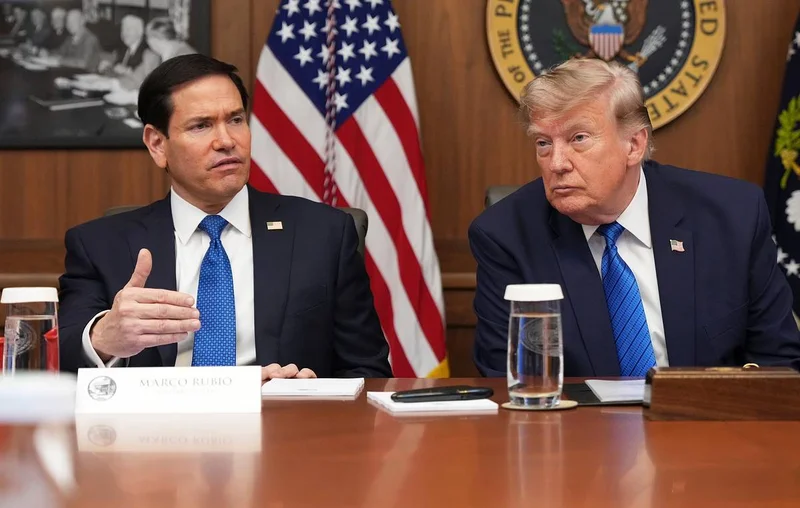
After quite a long pause, the US is resuming efforts to revive negotiations on Ukraine. US Secretary of State Marco Rubio told Fox News that Washington is once again ready to work with Moscow and Kiev to achieve peace, despite their existing "pretty strong red lines." Earlier, President Donald Trump stated that his chief negotiators, Steve Witkoff and Jared Kushner, would soon visit Kiev for the first time. Meanwhile, the US is seeking new means of influence on both sides of the Ukrainian conflict, hoping to push them toward finding a compromise.
According to experts, foreign policy priorities complicate the peace process. Due to the escalating conflict around Iran, Washington is currently unable to exert the necessary pressure on Kiev, Bogdan Bezpalko, a member of the Russian Presidential Council for Interethnic Relations, told Izvestia. Following a recent meeting with Russian Foreign Minister Sergey Lavrov in the Philippines, Rubio outright stated that previous diplomatic efforts, including those made in Alaska, had failed, and therefore the parties need fundamentally new approaches and ideas to settle the Ukrainian crisis.
It is unclear what alternative approaches could resolve the deadlock. So far, none of the parties, including international mediators, have proposed specific diplomatic tools capable of bridging the diametrically opposed positions of Moscow and Kiev. Moreover, Kiev is attempting to develop its own format for an agreement, the so-called "Ukrainian Anchorage," Valdai Club expert Andrey Kortunov noted. The concept's essence is to first agree on new terms with Washington and then present a unified US-Ukraine position in negotiations with Moscow.
However, Kortunov stressed that Moscow is unlikely to agree to the new terms proposed by Kiev and Washington. In that case, the negotiation process will return to the starting point, triggering another round of escalation. According to the expert, this process is, in fact, already underway: the parties are intensifying their strikes, increasing drone attacks, and expanding their list of targets.
Acknowledging that the talks are currently at an impasse, despite the fact that "a lot of time was spent on it in the first year," the top US diplomat named President Trump as the only world leader capable of putting an end to the Ukrainian conflict, Kommersant recalled. According to Bezpalko, negotiations can only become realistic when the parties are ready to make mutual concessions. The situation could change due to developments on the battlefield or political changes in Ukraine.
Media: OPEC+ raises production limits
At a meeting on August 2, seven OPEC+ member states decided to boost their oil production quotas by 188,000 barrels per day in September. Over the past few months, these countries have been gradually increasing output as part of their exit from the voluntary production cuts they imposed in 2023, and they will finalize this process in September. Experts believe that oil producers may continue to lift quotas by small amounts each month to prevent market panic.
According to Igor Yushkov, a leading analyst at the National Energy Security Fund, OPEC+ countries may continue to raise oil production quotas for all member nations, but only by limited amounts. The alliance’s strategy is to raise the oil production limit so high that the quotas will no longer constrain the countries. This will allow them to produce crude oil in any quantity; the only limit on production will be their actual production capacity. This strategy will allow the alliance to prevent panic in the stock market and fluctuations in oil prices, the expert noted.
Yushkov told Izvestia that due to the conflict in the Middle East, production quotas are not yet a factor for many OPEC+ countries because their oil production capabilities are limited by military operations and export restrictions. However, despite the blockade of the Strait of Hormuz, the alliance’s strategy remains the same, the expert stressed.
Energy expert Kirill Rodionov believes that countries may continue to increase their oil production quotas by 200,000-230,000 barrels per day each month. Currently, actual oil production in Middle Eastern countries is significantly below the alliance’s planned quotas. However, the market understands that, once the military conflict stabilizes and the Strait of Hormuz reopens, these countries will increase production to make up for losses. Increasing quotas now is necessary to ensure that a subsequent sharp rise in supply does not disrupt the oil market.
Meanwhile, Open Oil Market CEO Sergey Tereshkin told Kommersant that the market is paying virtually no attention to the quotas since current production levels are significantly below the OPEC+ threshold. According to him, Brent will not fall below $80 per barrel until transit through the Strait of Hormuz is restored. This also includes transit risks in the Bab el-Mandeb Strait.
"However, given the UAE’s withdrawal from the deal, it is in the interest of the remaining alliance members to raise the oil production ceiling so that they can increase their own market share once the Iranian crisis is over," the expert pointed out.
Thousands of migrants who arrived from Morocco are hiding in the small Spanish town of Ceuta, located on the African continent, to avoid law enforcement. News of the crisis in Ceuta, the largest for EU countries since 2021, emerged on July 30. Initial media reports estimated that approximately 40,000 undocumented migrants entered Ceuta as a result of the breach, which is just half the city’s population. Later reports indicated that half of the Moroccans had departed the territory. The events in Spain have caused serious concern within the EU. Brussels scheduled a videoconference for August 4 to discuss the situation. The meeting was prompted by a letter from 20 EU member states that called for coordinated action to address the migration crisis in Spain.
"The events in Ceuta can be described as a profound migration crisis, but one of a regional nature," Georgy Kutyrev, an associate professor at the Russian National Research University Higher School of Economics, told Vedomosti. However, this is not comparable to the crisis in Europe in 2015-2016, when 2.5 million people arrived, including those fleeing the war in Syria. Now, the majority of those arriving are economic migrants from Morocco, not refugees, Kutyrev noted.
It is not entirely accurate to refer to the crisis itself as a "migration crisis," Middle East expert Grigory Lukyanov emphasized. Morocco serves as a transit country for migrants from sub-Saharan Africa heading to Europe, and the enclave in Ceuta is a key route, but Morocco’s cooperation with Spain and the EU has made it possible to control the flow. Madrid will most likely seek to use its military and police forces to stop new breakthroughs, Kutyrev said, adding that "the large number of people who have voluntarily left Spanish territory shows that cooperation with Rabat remains effective."
For Spain, the situation in Ceuta is a national security crisis, the expert pointed out. "At the same time, the Spanish economy is facing a labor shortage. Managed migration helps fill that labor gap, among other things," he explained. According to Kutyrev, the situation in Ceuta is the result of several factors: a ruling by the Spanish Supreme Court limiting the immediate return of people who entered Ceuta and Melilla by sea; the activities of human traffickers; the weakening of border controls on the Moroccan side; and social problems among young people.
Lukyanov agrees that Morocco has seen an increase in disaffected youth. "The local authorities only have tools to suppress discontent, including regulating the flow of people seeking to enter the Spanish city," the expert said. However, Lukyanov noted that these actions by the Moroccan authorities should not be viewed as an attempt to use "migration as a weapon" against Spain and the EU. "There was no motive for such a strike against Europe," he stressed.
On August 2, Armenian President Vahagn Khachaturyan accepted the government’s resignation. On the same day, he appointed Nikol Pashinyan, the leader of the Civil Contract party that won the parliamentary elections, as prime minister, according to a decree published on the president’s website. Pashinyan has held the post since 2018, when he first came to power amid a wave of mass protests.
Pashinyan’s new cabinet will continue the policy of pressuring the opposition and other actors with the potential to gain popularity, Stanislav Pritchin, head of the Central Asia section under the Russian Academy of Sciences’ World Economy and International Relations Institute, told Vedomosti. According to him, there has been a noticeable increase in the number of Armenian citizens who are willing to support anyone as long as they are not affiliated with the ruling party.
Pashinyan also faces a complex situation on the foreign policy front: during the campaign, he actively emphasized his pro-European aspirations, which significantly strained relations with Moscow, Pritchin added. "The Armenian authorities will likely try to maneuver between the Eurasian Economic Union (EAEU), which remains the foundation of their country’s stability and socioeconomic sustainability, and the European Union. Meanwhile, Brussels will continue to push Yerevan toward anti-Russian measures. I believe that over the next five years, the Armenian leadership will try to find a solution that would allow them to balance both sides," the analyst noted.
The Armenian authorities will have to adapt to the conditions of a gradual reduction in their republic’s trade and economic cooperation with the EAEU in the new term, Nikolay Silayev, a leading researcher at the MGIMO Institute of International Relations, stressed. According to him, Pashinyan previously operated under the assumption that preserving integration processes in the post-Soviet space was of fundamental importance to Moscow, and that the fate of the economic union supposedly depended on Yerevan. However, recent events suggest otherwise. "I believe that as early as the next meeting in December 2026, the other EAEU leaders will reconsider the nature of their relations with Armenia. And I do not rule out the possibility of freezing Armenia’s participation in the union, similar to what happened with the CSTO, even though the charters of both organizations do not allow for it. In response, Pashinyan could nationalize Russian assets in Armenia and demand the complete withdrawal of Russian troops," Silayev pointed out.
However, even if such a scenario were to unfold, it would not lead to Armenia’s withdrawal from the EAEU, the political analyst stressed. At the same time, the Armenian elite will not push for a referendum on continuing the course toward the EU, since any outcome would mean a defeat for the Civil Contract party, Silayev said. A vote in favor of the EU would mean the country’s immediate withdrawal from the EAEU and all its negative consequences, while a negative result would force Pashinyan’s cabinet to resign, the expert emphasized.
TASS is not responsible for the material quoted in these press reviews