Calgary boy’s death hits home for parents of autistic kids prone to wandering or running away
Study suggests about half of autistic kids have eloped from home or caregivers
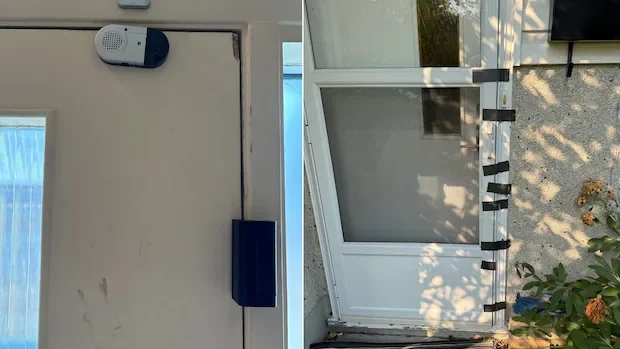
At this point, Nada Kader has so many locks, alarms, even duct tape on her doors to prevent her youngest from getting out of their home, she worries about how her family would exit the house if there were to ever be a fire.
Her son, seven-year-old Omar, is non-verbal, and is a “big eloper,” she said.
That means that despite all their efforts, Omar tries to escape on what can be an hourly basis. It means Kader and her husband live in a state of constant hypervigilance, sleeping in shifts on different floors to keep a trained ear on the doors should Omar try to get out in the night.
The recent death of Parker, an 11-year-old non-verbal autistic boy who disappeared from a care facility in Calgary, has brought new attention to the issue of elopement for parents of young children with autism.
For many parents who spoke with CBC News, his story was one that hit far too close to home, reflecting the immense struggles of their day-to-day reality.
And as many parents languish on the waitlist for help, some say it highlights the need for more provincial funding for children like theirs.
‘A constant fear’
Omar is creative when it comes to finding ways to get out, Kader says. When he does, he’ll often do so naked, prompting calls from neighbours, and frequent returns home courtesy of Calgary police.
Recently, Kader woke up in the night to an officer in her bedroom, bringing Omar back.
“There's a constant fear in our house, like when somebody rings the doorbell, we instantly stop and check to see where he is,” Kader said. “He needs one-to-one supervision all the time.”
That sense of fear extends now to her daughter, who Kader says is also diagnosed with autism, and was recently diagnosed with anxiety, having picked up on the tension the family feels.
There are well-meaning suggestions from other parents: put an AirTag in your child’s shoe, or invest in a GPS tracker like an AngelSense.
But for a child with sensory issues — who escapes without clothes on — those options don’t work.
“At this point, my fear is if something happens to him, you know, the blame can't solely be on us. Because at this point in time, we've exhausted every resource we have,” said Kader.
Why do autistic kids elope?
Elopement occurs when someone wanders away or escapes from a home or caregiver, and is common among autistic children.
An oft-cited statistic comes from a 2012 study in the medical journal Pediatrics, in which nearly half of respondents said their autistic children tried to elope at least once after the age of four.
Parker’s case sparked calls for an alert system for missing, vulnerable children, something that Premier Danielle Smith has said the province will look into making available.
In the first police news conference about Parker on July 17, Acting Staff Sgt. Scott Guterson said Parker did not have “an extensive history” of wandering off.
But as Calgary mom Jennifer Norman said, “it just takes a second” for the child to slip away, and a parent’s worst nightmare to begin.
She recently asked her eight-year-old son Oliver, who is autistic and verbal, why he runs away and doesn’t stop, even if he hears her calling out his name.
"He goes ‘well, because I'm too busy,’ like there's too much going on in his mind at the moment,” Norman said.
In some cases, it might be because the child has sensory issues, and goes into “fight or flight” to get away from something bothering them, said Michelle Siegel, founder of Exceptional Abilities, which offers educational services to children of differing abilities.
Justin Lewis, whose 12-year-old son has gotten away before, says it comes down to the fact his child views the world in a different way.
“You see, when a light pole from six different angles is profoundly interesting to you, I suppose sometimes you forget that traffic can be dangerous,” said Lewis. “It's not a lack of intelligence, it's a different type of intelligence.”
Parents describe feeling judged, sense of guilt
Kader said it can be “humiliating” to have her child elope, and face questions from police when he’s returned.
“You feel like a terrible parent,” she said.
At times, Michelle Nelson said she feels “judgy eyes” of other parents, like when she’s holding her six-year-old daughter Allora's arm rather than her hand. She does her best to ignore it — she knows she’s doing all she can to keep her daughter safe — but that can be tough.
And despite her daughter’s proclivity to wander, Nelson said she can’t keep her under lock and key.
“You don't want to just hide her away and say, ‘we can't have these experiences because of how you act,’” she said. “You just have to make sure you put the right things in place to lessen the likelihood of it happening.”
Other families take a different approach.
“Ultimately, we stopped going places. When [Oliver] was really little, our way of dealing with it was to take us out of harm's way and we became a bit of a recluse,” said Norman.
Siegel’s Exceptional Abilities offers summer day camps for children with autism or disabilities. Elopement is something they keep top of mind.
Doors are locked and watched, and children known to wander off are given one-on-one supervision. Parents text when they’ve arrived for pick-up before the door is opened.
During the day, Siegel it’s a typical camp: kids sing, do crafts, play games.
“A lot of times, our kids don't get to do that and have that full-on experience,” Siegel said.
Waiting for help
CBC News has reported on the estimated 20,000 children stuck on the waitlist for Alberta’s Family Support for Children with Disabilities (FSCD), with some families waiting years.
Parents approved through the program are assigned a caseworker and receive funding that might be allocated towards things like respite services in or out of the home, or specialized counselling.
The 2026 provincial budget provided $271 million for FSCD. In June, press secretary to the Minister of Assisted Living and Social Services Amber Edgerton said the ministry is “reviewing the program to ensure effective support for families in need, now and into the future.”
Norman praises the help her son's received through FSCD, saying it has helped improve his habit of eloping.
But she said the problem is how long it takes to get that help. It took her family about 15 months from the time they were approved to get a caseworker, and she says early intervention is key for children with autism.
And for parents like Omar’s mom Kader, who is still waiting for help, it takes a toll.
“You’re mentally exhausted with the wait and the bureaucracy,” Kader said. “It’s frustrating on that level, but at the same time you're doing it with nothing left in the tank. You're exhausted.”
With files from Elise Stolte