Contraband fuel: Smuggling gasoline into Mexico earns cartels millions
- Click here to listen to this article
- To avoid taxes and high import fees, gasoline and diesel legally purchased in the United States is being smuggled into Mexico.
- The scheme, known as huachicol fiscal, is the second-largest source of revenue for cartels, after drug trafficking.
- An astounding one-third to one-quarter of all fuel sold in Mexico may be illicit.
MEXICO CITY — Mexico has been a major oil producer for more than a century, but its lack of refining capacity creates a quandary: The country must import much of its gasoline and diesel from the United States.
That’s a boon for U.S. refineries and related industries on both sides of the border, but U.S. and Mexican authorities say Mexican cartels have infiltrated the commerce, creating a black-market bonanza in smuggled fuel while leaving behind a trail of murder victims.
At its core, the crime known as huachicol fiscal is a vast tax evasion scheme centered on falsified paperwork — and corrupt officials.
Last year, Mexican authorities seized millions of gallons of contraband fuel in scores of railroad cars and trucks near Mexico’s border with Texas.
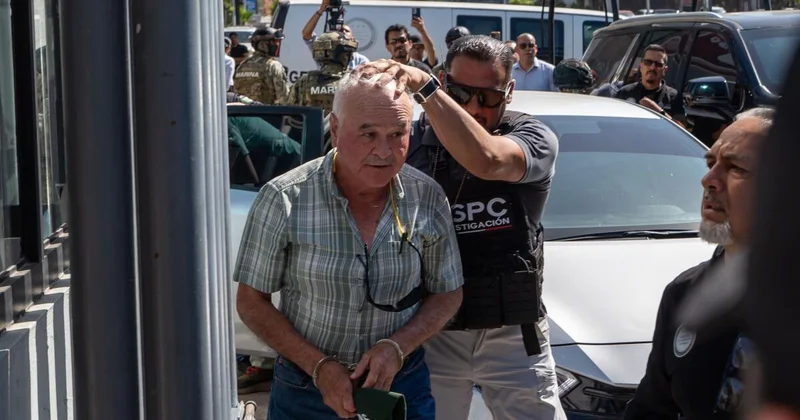
The follow-up investigation led to last month’s stunning arrest of one of Mexico’s most celebrated political figures — Ernesto Ruffo Appel, the former governor of Baja California.
The conservative Ruffo and his backers call him the victim of a political vendetta by Mexico’s left-wing government. Prosecutors label him a central player in a complex, multibillion-dollar fuel-smuggling racket linked to cartels.
“It’s false to say there is anything political here,” President Claudia Sheinbaum told reporters in July. “This is an investigation with a legal basis and with evidence.”
Bootleg gasoline and diesel don’t enter Mexico clandestinely via remote stretches of the borderlands. Rather, the fuel — overwhelmingly purchased legally in the United States — arrives at seaports and border crossings via ships, trains and trucks, part of the daily deluge of imported hydrocarbons.
But the petroleum products are masked in manifests — labeled waste material, lubricants, residues and other items not subject to the high taxes that Mexico levies on imported fuel.
Or, alternatively, importers register arriving tankers as empty or near-empty. Seeing no evil are legions of crooked operators — customs inspectors, tax agents, military commanders, among other enablers.
The massive volume of the illicit traffic creates a windfall.
An astounding one-third to one-quarter of all fuel sold in Mexico may be illicit, according estimates cited by the U.S. Treasury Department, which has sanctioned alleged Mexican fuel traffickers.
Fuel smuggling now nets organized crime tens of billions of dollars annually, representing the cartels’ second-largest source of revenue, after drug trafficking, the Treasury says.
“The cartels’ smuggling schemes also fuel rampant corruption and violence that sustain their global drug trafficking operations and control in Mexico,” according to a June alert from the Treasury’s Financial Crimes Enforcement Network.
The Supreme Court tossed Mexico’s $10-billion lawsuit against U.S. gun makers, but the case forced U.S. officials to acknowledge that thousands of guns are smuggled into Mexico from the United States.
Both Washington and Mexico City have launched crackdowns against a complex web of unscrupulous functionaries, front companies and document fraudsters, among others. Abetting the scams is a vast network of tankers, rail lines and trucks that transport refined fuel from borders and seaports to Mexican gas stations.
The conspiracy extends to freight, logistics and fuel companies on the U.S. side, authorities say. The operators of at least one south Texas oil distributing outfit — targeted in a U.S. operation dubbed “Liquid Death” — are facing federal charges of cartel collusion and money laundering for allegedly utilizing a reverse-engineered huachicol blueprint: importing Mexican oil into the United States with phony customs paperwork, thus avoiding U.S. taxes.
1. Mexican authorities have seized millions of gallons of contraband fuel in scores of railroad cars near the border with Texas. 2. Railroad cars seized by federal authorities in Mexico as part of its wide-ranging investigation into fuel smuggling. (Mexico Attorney General’s Office)
The recent arrest of Ruffo, the former Baja governor, stunned many Mexicans because he made history a generation ago as the nation’s first opposition governor, representing the center-right National Action Party.
A former U.S. ambassador to Mexico writes that President Andrés Manuel López Obrador feared a cartel boss arrested by the FBI would “spill the beans” on corrupt officials.
He was regarded as a trailblazer against the one-party rule that marked Mexico for much of the 20th century. Yet last month there he was in a news photo, the 74-year-old, San Diego-born Ruffo in handcuffs, like just another narco suspect.
He is accused of heading a company that routinely mislabeled shipments to evade taxes on fuel imported from Texas. He and seven alleged confederates were ordered held at Mexico’s notorious, high-security Altiplano prison — the site of the cinematic 2015 jailbreak by Joaquín “El Chapo” Guzmán, legendary co-founder of the Sinaloa cartel.
Ruffo has denied the charges. His defenders call him a “political prisoner.”
Even before ensnaring Ruffo, the ever-expanding huachicol fiscal scandal had already scarred the Mexican navy, long one of the nation’s most trusted institutions. Corrupt naval officers turned ports they were supposed to be supervising into bribe-laden smuggling hubs, authorities say.
In March 2025, Mexican agents seized a Malaysian-flagged tanker, the Challenge Procyon, in the Gulf port of Tampico. Investigators linked the tanker to 2.6 million gallons of Texas diesel falsely labeled as lubricating oil additives.
The investigation soon led to a pair of navy nepo-babies: Manuel Roberto Farías Laguna and his brother Fernando — known as Los Primos (The Cousins), even though they are siblings. The two young admirals, many assert, enjoyed meteoric career rises thanks to family patronage: They are nephews of a former secretary of the navy, José Rafael Ojeda Durán.
Manuel Roberto Farías now sits in the Altiplano prison on smuggling charges. His brother, who fled to Argentina, was arrested in a trendy Buenos Aires neighborhood and remains in custody, pending Mexico’s extradition request.
The case of Los Primos has dramatized the proliferation of graft in the armed forces.
Some see a dark irony: Five years ago, an exasperated President Andrés Manuel López Obrador bemoaned that a corrupt customs regime had allowed organized crime to take over land and maritime ports of entry. The president shifted control of ports to the military, a major change.
Surviving crews say they were bombed, and detained, by U.S. forces. The Pentagon denies any role in the sinking of the vessels.
However, many say graft has only worsened under the aegis of generals and admirals.
“There have always been networks of and corruption in customs,” said Víctor Manuel Sánchez, a professor at the Autonomous University of Coahuila, a northern border state where police have seized boxcars full of contraband fuel from neighboring Texas. “But it seems the whole problem of huachicol fiscal took off when customs’ responsibility was turned over to the military.”
Ojeda Durán, the former navy chief and uncle of Los Primos, has been cleared in the scandal, Sheinbaum has said.
Fuel contraband is a high-stakes affair. There is no reprieve for anyone perceived as a snitch or double-crosser.
In November 2024, assassins on a motorcycle in the Pacific port city of Manzanaillo shot dead a rear admiral who was said to have blown the whistle on navy entanglement in fuel-smuggling. A few weeks earlier, a similar motorcycle hit team in Manzanillo gunned down a federal agent who was reportedly investigating port corruption.
In 2021, Sergio Carmona Angulo, a politically connected entrepreneur known as Rey Huachicol (“King Huachicol”), was gunned down in a barber shop in the Monterrey suburb of San Pedro Garza García, often called the richest town in Mexico.
While the fuel-oil tax-dodge is a relatively recent phenomenon, purloined Mexican fuel, known simply as huachicol, has circulated for decades.
Thieves have long used a variety of methods — tapping into ducts, hijacking tanker trucks or robbing directly from facilities of Petroleos Mexicanos, the state energy company known as Pemex.
Staggering losses from fuel theft are among the many factors contributing to Pemex’s perpetually debt-plagued status.
But the emergence of huachicol fiscal has given fuel thievery an expanded and more sinister profile.
Paying the price are Mexican consumers at the gas pump, but also the population at large. The taxes diverted from government coffers could have funded education, healthcare and other societal needs.
“We are talking about hundreds of millions of dollars that should have been used for the social good,” said Sánchez in Coahuila. ”Instead it all ends up in the hands of the mafias.”
*Contributing was special correspondent Cecilia Sánchez Vidal. *