Critically endangered Raffles’ banded langur spotted at Bukit Timah Nature Reserve after 39 years
AI generated
SINGAPORE – The critically endangered Raffles’ banded langur – whose population here is now largely confined to the Central Catchment Nature Reserve – has been spotted in Bukit Timah Nature Reserve for the first time in nearly 40 years.
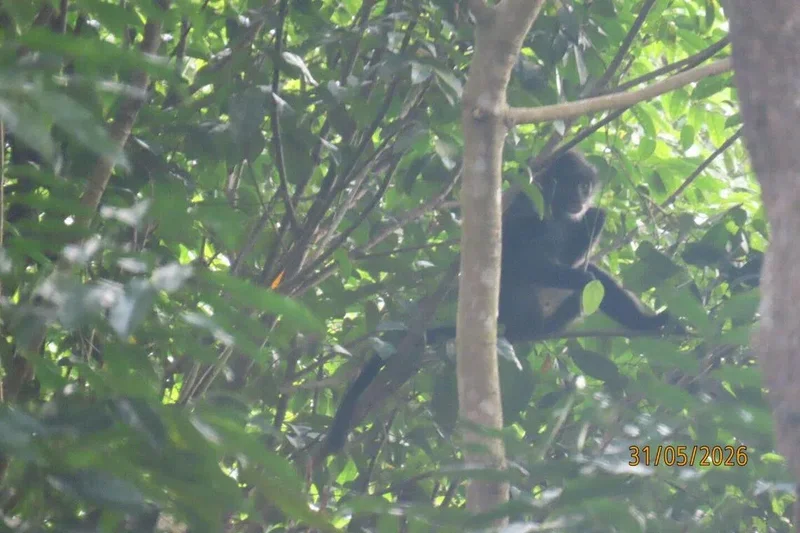
An adult male was spotted and photographed at the summit of Bukit Timah Nature Reserve at about 9am on May 31, according to a biodiversity record published on July 31 in the peer-reviewed journal Nature in Singapore.
According to the paper, the observation represents the first photographic evidence of the species’ return to that nature reserve in nearly 40 years, presumably via the Eco-Link@BKE or the Rifle Range Flyover.
The primate is currently listed as globally critically endangered, according to the International Union for Conservation of Nature (IUCN) Red List of Threatened Species. There are about 70 to 80 of this species in Singapore now, said Dr Andie Ang, a primate expert. She is one of the two authors of the July 31 article in Nature in Singapore.
Following the death of the last Raffles’ banded langur (Presbytis femoralis) in the Bukit Timah reserve in 1987, its population was long restricted to the Central Catchment Nature Reserve, the Nature in Singapore report read.
However, in recent years, langurs have begun venturing into areas outside the Central Catchment reserve, the report noted.
According to the report, the langur – which has black fur and white bands – was spotted on May 31 in the trees and moved off after 10 minutes.
In one of the two images, the langur can be seen sitting on a branch and eating leaves. The other image shows the silhouette of the langur.
The langur was identified by Ang, who heads the Raffles’ Banded Langur Working Group that was established in 2016. It was spotted by citizen scientists Chris Devillers and Alvin Wong, who is also the report’s co-author. Wong photographed the elusive primate.
Some movements were observed in nearby trees, but it is unclear if they were made by other Raffles’ banded langurs, the paper read.
In a Facebook post on Aug 2, the Raffles’ Banded Langurs Working Group called the sighting of the primate a “monumental observation for Singapore”. The group was formed to ensure the long-term conservation of these langurs.
It said the sighting follows a series of promising signs over recent years, including langurs being spotted at Dairy Farm Nature Park in 2021 and Rifle Range Nature Park in 2022, and captured by a camera trap on the Eco-Link@BKE in 2023.
The Eco-Link@BKE is an ecological bridge that sits over the BKE, and lets animals cross safely between the Bukit Timah and Central Catchment reserves, according to information on NParks’ website. Both nature reserves used to be connected before the highway was constructed in 1986.
“More field monitoring is needed to determine whether more than one langur now resides in (the Bukit Timah reserve), with the ultimate hope that additional langurs will recolonise the area and establish a viable breeding population there,” the July 31 paper read.
Numbers of the shy tree-dwelling monkey, which are found only in Singapore and southern Peninsular Malaysia, were predicted to dwindle to the point of extinction in the 1990s due to habitat loss and fragmentation.
A study published in the Raffles Bulletin of Zoology journal in September 2023 found that the langur population is expected to double to 150 in the next 15 years, and go up to more than 240 monkeys by 2071.
Those who spot the primate can inform the Raffles’ Banded Langur Working Group’s through its Facebook or Instagram accounts, said Ang.
The working group hosts community science programmes every six months, said Ang. In these programmes, volunteers learn to conduct field surveys, she added.
The group is looking at expanding the field surveys to the Bukit Timah Nature Reserve, given the confirmed sighting there, according to Ang. Field surveys are currently not done at the reserve.