FEATURE · THE OWNERSHIP ISSUE
Benjamin Boyce is rebuilding the internet’s most popular subscription tools as one-time purchases — and giving the base code away. With an AI copilot and a 100-day clock, he’s betting that “you’ll own nothing” was never inevitable.
Somewhere in Vietnam, a single developer is trying to do to the subscription economy what the subscription economy did to software you used to buy once and keep. The project is called OneTime Suite, and the premise is almost aggressively simple. Pick a piece of software that millions pay for every month — a link-in-bio page, a screen recorder, a voice-dictation tool — and rebuild it. Then do the two things the incumbents will not: publish the working code, free and open source, and offer anyone who doesn’t want to self-host a one-time price instead of a forever one. Then do it again tomorrow. One hundred times, in one hundred days.
The math nobody does
To understand why anyone would take that bet, it helps to look at the number most people can’t recite: their own. Ask an American what they spend on subscriptions each month and the average guess lands around $86. Ask them to itemize every recurring charge — the streaming tiers, the cloud storage, the productivity apps, the AI assistants, the gym, the tool they signed up for in 2023 and forgot — and the real figure comes to roughly $219, according to research from C+R that gets cited across the industry. That is a gap of more than $130 a month, better than $1,500 a year, hiding in plain sight. A separate study from West Monroe found that nearly nine in ten people underestimate the total. The subscription economy — now worth north of half a trillion dollars a year — is engineered around exactly that blind spot: charges small enough to wave through, spread across enough billing dates that they never add up in anyone’s head.
Software sits at the center of that pile, and it has quietly done the thing consumers resent most: it stopped being a purchase and became a lease. This is the world Benjamin Boyce is building against.
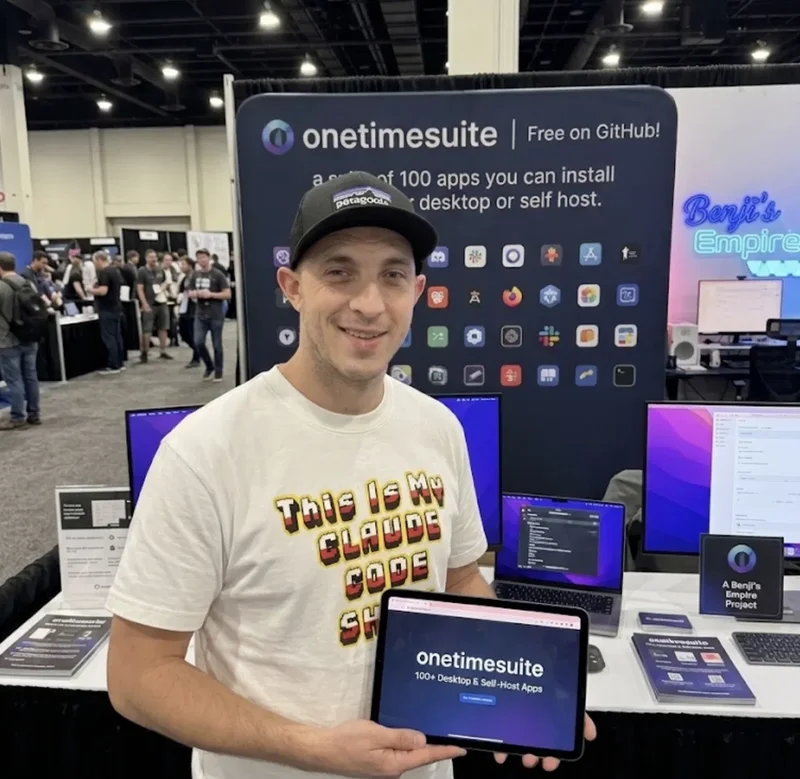
OneTime Suite — the name is the whole argument. “Software used to be something you owned,” he says. “Somewhere along the way, the entire industry decided you should rent it instead — and never stop paying.” His rebuttal isn’t a manifesto or a Substack; it’s a GitHub account, updated daily and entirely in public. He’s branded the run “100 Apps in 100 Days,” documents each build on video, holds court in an open Discord, and — at least once — has worked a conference booth in a t-shirt reading “This is my Claude Code shirt,” wearing his tooling on his sleeve, literally. The bit is the point: the work is the marketing.
The economics are the part that lands. Linktree, the default link-in-bio tool for a generation of creators, raised the price of its most popular plan by 67% last November; Pro now runs $15 a month, or $180 a year, forever. Boyce’s alternative, LinkLeaf, costs $50 once — or nothing at all, if you’re willing to run the code yourself. His screen recorder, BloomRecorder, is a $20 one-time purchase against Loom’s $180–$240 a year. His dictation tool, Wispertalk, is another $50 one-time buy, aimed squarely at Wispr Flow, which will happily bill you $144 a year and offers no way to own the thing at any price. Line the three up and the incumbents all land around $15 a month — roughly $540 over three years — while OneTime’s prices sit in the double digits, once. Stretch the comparison across a few years and the discount stops looking like a discount and starts looking like an argument.
The thing you’re paying for every month was a choice all along.
— Benjamin Boyce, Founder, OneTime Suite
The machine did the scaffolding. The human does the craft.
What makes the pace possible is a detail that would have read as science fiction two years ago: Boyce didn’t write 102 apps by hand. He pointed two subscriptions of Anthropic’s Claude Fable 5, running inside Claude Code, at the entire catalog and let the model scaffold every one — 102 GitHub repositories, generated in a single week. That is the raw material. Not finished products, but functional skeletons: a hundred-plus baseline apps, each a bare, working minimum-viable version, sitting in public waiting to be made real.
Which reframes what the hundred days actually are. They’re not the building — the building took seven days. They’re the finishing. Each morning Boyce wakes up, pulls one app off the pile, and drags it from skeleton to what he’ll call production-ready: real features, a proper interface, a landing page, documentation, the thousand unglamorous decisions the model doesn’t make for you. The machine did the scaffolding in a week; the human does the craft one app at a time, and keeps circling back to add more. It is, in miniature, the argument everyone in tech is currently having about what AI does and doesn’t replace — playing out as a public, daily deliverable rather than a think piece.
Here’s the catch
If the code is free and open source, why would anyone pay? This is the question that usually deflates open-source businesses, and Boyce’s answer is the cleverest turn in the scheme. Free gets you the shell. The repositories you can clone and self-host for nothing are the MVPs the AI generated — genuinely runnable, but stripped to the studs. The one-time fee buys the version Boyce actually builds on top: the extra features, the polish, the integrations, the parts that needed a person. The open code earns the trust and the search traffic; the added craft earns the fifty dollars. His bet is that the distance between the free shell and the finished app is usually wide enough that paying is simply the obvious move — and that the people who’d never pay were never going to, and can now self-host instead of pirating.
The honest questions don’t vanish, and Boyce mostly invites them. A one-time price is easy to love and hard to sustain when a product needs servers humming behind it, support tickets answered, and dependencies patched for years. His model bends to fit: the lightest desktop apps are pure one-time buys; anything that needs hosting carries an optional monthly subscription — still under the incumbent, still a choice rather than a toll. He’s candid that a subscriber who stays past a year or so is, quietly, the math that keeps the lights on.
The bigger idea
There’s a maintenance question, too, that no amount of AI scaffolding erases: a hundred apps is a hundred surface areas to keep alive, and shipping is not the same as maintaining. And there’s the defensibility question every open-source founder eventually faces — what stops a competitor, or a customer, from taking the free code and running with it? Boyce’s wager is that the answer, increasingly, doesn’t matter. When building is this cheap, the moat was never the code; it was the trust, the brand, and the finish.
Underneath the price comparisons is the idea that makes the project feel like more than a stunt: the subscription model spread because it worked — for the companies charging it — and its inevitability was always a story the industry told, and told well. What Boyce is really testing is whether the tools to disprove that story have finally gotten cheap enough for one person to wield against firms with hundreds of employees and tens of millions in funding. If a solo builder with two AI subscriptions and a hundred days can stand up credible alternatives to a shelf of venture-backed products, the barrier that protected them — that good software is slow, expensive, and needs a team — starts to look less like a law and more like a habit.
The plan doesn’t stop at the first three. Boyce has mapped the back half of the challenge as parallel tracks — dozens of small hosted utilities alongside another wave of desktop apps — and published the roadmap so the community can argue with it. There’s a mechanic where followers vote on which subscription tool gets rebuilt, polished, and featured next, turning the backlog into something closer to a spectator sport. It’s marketing, plainly. It’s also the thesis in work clothes: if the software you rent could just as easily be sold to you once, the only reason it isn’t is that nobody bothered — and Boyce is bothering, in public, on a clock, under a banner that reads “Benji’s Empire.”
“The point isn’t that I built a hundred apps,” Boyce says. “The point is that anyone can, now — and that the thing you’re paying for every month was a choice all along.” The code is public. The clock is running. And somewhere between the free shell and the fifty-dollar finish, the tools you rent are, quietly, on notice.
OneTime Suite is built in the open. Developers can fork the repositories on GitHub and join the OneTime Suite Discord community to talk about the software and contribute. Explore every app at onetimesuite.com.
The details
Live now: LinkLeaf (Linktree), BloomRecorder (Loom), Wispertalk (Wispr Flow).
Web:onetimesuite.comCode: github.com/bensblueprints/onetime-suite-plansCommunity: DiscordContact: Benjamin Boyce, Founder — ben@advancedmarketing.coPricing verified July 2026.
OneTime Suite is owned by Advanced Marketing Limited (advancedmarketing.co).
This story was distributed as a release by Jon Stojan under HackerNoon’s Business Blogging Program.