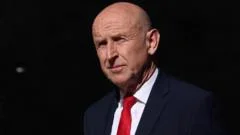
His resignation came days before Andy Burnham's pivotal by-election in Makerfield, adding to the sense that Sir Keir's premiership was falling apart.
Healey earned plaudits from across the political spectrum for resigning on a matter of principle.
He had clashed with Reeves, the woman he is now replacing, pointedly saying in is resignation letter that the Treasury had been "unwilling" to "commit the resources that the nation needs to defend the country at this time of rising threats".
His return to government in the most vital job of all in cabinet after the prime minister is an even bigger surprise than his resignation, given that his name had not been mentioned as a frontrunner in the increasingly feverish speculation about who Burnham would choose.
Sources told the BBC that Burnham and Healey "have the same outlook" on many of the prime minister's priorities, including reindustrialisation, the cost-of-living, and driving growth across the country.
The softly-spoken Yorkshireman has a remarkable record as someone who has been on the Labour frontbench almost continuously since 2001.
Born in Wakefield in 1960 and educated at Lady Lumley's Comprehensive School, Pickering, and Peter's School in York, he studied social and political science at Christ's College, Cambridge.
Before entering politics, he worked as a journalist, briefly editing Parliament's in-house magazine The House, before becoming a disability rights campaigner and trade union official.
He is married and has one son.
He first came into Parliament in Tony Blair's landslide general election in 1997 as MP for Wentworth, a former mining area north of Sheffield, which following boundary changes is now Rawmarsh and Conisbrough.
He retained the seat with a majority of 6,908 in the 2024 general election, with a Reform UK candidate in second place.
In the early 2000s, he held a string of ministerial posts, including housing, local government, and at the Treasury in the Blair and Gordon Brown governments.
He also assisted Brown as his parliamentary private secretary.
But his main interest was housing policy. He served as shadow housing secretary when Jeremy Corbyn was Labour leader, despite supporting a failed attempt to oust Corbyn in 2016.