Europe’s most scenic train journey takes less than three hours
Save
You have reached your maximum number of saved items.
Remove items from your saved list to add more.
AAA
Born out of a wartime escape, the true gold on Norway’s Golden Train is some of Europe’s finest mountain scenery.
In Norway’s Romsdal Valley, the landscape is almost mythical in scale. Europe’s tallest vertical cliff towers overhead and the cairns of more than 100 Viking burials still furrow a section of the valley floor.
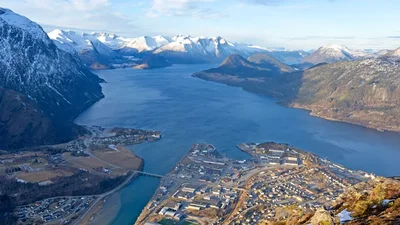
Summit to write home about, with views across Andalsnes and the Romsdalsfjord to the mountains.Andrew Bain
It’s a place connected to ancient tales of trolls, but the greatest story here is that of the Rauma Railway on which I’m travelling.
Running for almost 50 kilometres from Andalsnes to Bjorli, the Rauma Railway was used by Norway during World War II to help smuggle 50 tonnes of gold out of the country when it was invaded by Nazi Germany. Under heavy bombing, the entirety of the gold, along with the Norwegian king, was successfully shipped to Britain.
Today, the train that travels along the line is known as the Golden Train and in 2022 it was named by Lonely Planet as Europe’s most scenic train journey.
Sign up for the Traveller Deals newsletter
Get exclusive travel deals delivered straight to your inbox. Sign up now.
A popular shore excursion for cruise passengers to Andalsnes, the Golden Train runs through the Romsdal Valley like a zipper parting the mountains.
The Golden Train passes through Norway’s Romsdal Valley.iStock
The Golden Train on Kylling bridge.
As we leave Andalsnes, from the train station set immediately beside the cruise-ship port, mountains rise sheer above us, and waterfalls stand frozen against the cliffs, looking like wax drips on a candle.
The most prominent of the mountain features is the Trollveggen – the Troll Wall – Europe’s loftiest rock face, rising more than 1000 metres above the train. Mount Everest was climbed 12 years before this imposing wall was conquered, while two local lads claimed to have climbed the equally daunting Romsdalshornet, which towers over the first stretch of valley, in 1828, but their boast was dismissed as drunken bravado. When it was finally summited by a Danish climber more than 50 years later, he found a cairn built by the pair atop it.
Trollveggen, Europe’s tallest vertical cliff.iStock
If the mountains were difficult to conquer, Rauma Railway’s course through the valley was no less problematic – opened in the 1920s, the line took 13 years and more than 600 men to build, and it ran 600 per cent over budget.
The railway largely follows the line of the Rauma River through this valley, far deeper than it is wide. In winter, the sun is a stranger and the river lies frozen, more an ice floe now than a flowing stream.
High up the valley, the railway makes a sweeping turn, crossing the river on the Kylling Bridge. With its high, graceful arch, it’s Norway’s most photographed bridge and a star of 2009’s Harry Potter and the Half-Blood Prince, as well as Mission: Impossible – Dead Reckoning Part One.
For all that, Kylling Bridge isn’t the Rauma Railway’s most impressive engineering achievement. As the line completes its horseshoe turn over the bridge, it swings almost immediately into another 180-degree turn, but this time inside a tunnel. The 1400-metre-long Stavem Tunnel was an extraordinarily ambitious and complex design feat that took nine years to complete.
The valley finally widens and flattens as we approach the Golden Train’s turnaround point in Bjorli, where there’s a chance to alight, visit a display on the railway’s gold-smuggling moment and wander Bjorli’s few streets beneath slopes patterned with ski runs.
With cruise passengers taking trains through the Romsdal Valley for more than a century, there was once a restaurant feeding 700 in tiny Bjorli, but it was bombed and destroyed during World War II and the best on offer now is takeaway coffee from a petrol station.
As we’ve travelled the 50 kilometres inland from Andalsnes, the temperature has plunged by about five degrees – it’s now a frosty minus six – and Andalsnes’ snow-free streets have been replaced by a thick pelt of snow.
In the day’s late light, the train’s polished exterior glows as golden as its name. I’m quickly back aboard, ready for a second screening of this remarkable valley and its high peaks and cliffs. On The Golden Train, the journey is very much the destination.
THE DETAILS
RIDEThe Golden Train runs daily from Andalsnes, with round-trip tickets for the 2½-hour trip costing from $100. See thegoldentrain.com
TRAVELMany of Hurtigruten’s Norwegian cruises, including the 15-day North Cape Line cruise, dock in Andalsnes, offering the Golden Train as a shore excursion. See hurtigruten.com
MOREvisitnorway.com
The writer travelled as a guest of Hurtigruten.
Save
You have reached your maximum number of saved items.
Remove items from your saved list to add more.
Andrew Bain is a Hobart-based writer and author who has been writing about travel and adventure for more than 25 years, and is most at home in the outdoors and remote places.