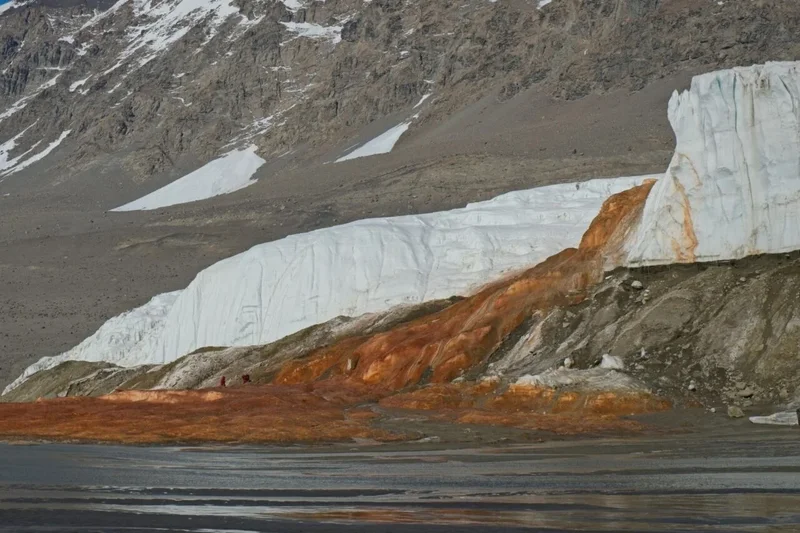
At the edge of the Taylor Glacier in the McMurdo Dry Valleys of Antarctica, crimson water pours into Lake Bonney below. Scientists have aptly named this outflow “Blood Falls,” attributing its striking color to its mineral makeup. But despite decades of investigation into the falls, one important question has long gone unanswered: Where did this blood-red water come from?
Scientists believe the waterfall’s color stems from iron-rich brine discharged from beneath the glacier, and a study published today in the journal Nature Geoscience has revealed the water itself to be of ancient marine origin. The evidence lies in a community of microorganisms the researchers found hiding in the scarlet waters.
“Finding what is effectively a marine oasis in a polar desertâmore than 20 miles from the oceanâwas extraordinary,” co-author Andrew Allen, a marine biology professor at the Scripps Institution of Oceanography, told Gizmodo in an email.
An ancient ocean beneath the ice
Prior geochemical research suggested that the rusty-red water that feeds Blood Falls could actually be ancient seawater that inundated Taylor Valley during past warm periods. When sea levels fell, this water likely became trapped beneath the advancing glacier. Marine bacteria previously found in the brine provided strong biological evidence to support that hypothesis, and this new study offers even more.
Allen and his colleagues analyzed 167 samples of water, sediment, and air from the McMurdo Dry Valleys region to investigate where the microbes at Taylor Glacier and Blood Falls came from. They used a suite of genetic techniques to identify eukaryotic groups (organisms whose cells contain a nucleus and other organelles) and prokaryotic groups (organisms that have neither a nucleus nor specialized organelles).
The researchers found nearly all of the microorganisms in the red ice, mud, and sediment at the terminus of the glacier to be associated with marine environments, whereas freshwater and terrestrial populations dominated surrounding sites. They also found that the glacier terminus shared far more eukaryotic species with nearby marine samples than at other Dry Valley sites, further pointing to Blood Falls’ possibly ancient marine origins.
“Adding eukaryotes to the mix contributes another independent line of evidence for the relic marine system at Blood Falls case,” Allen said.
Blood Falls’ tiny survivors
Based on these findings, future studies could investigate the microorganisms living in Blood Falls to better understand when the subglacial water became trapped, revealing how the polar landscape evolved.
“There is still work to be done in interpreting these finding for past climate conditions but it is a cool first major step in that direction for us,” Allen said. “The information stored in these eukaryotes could be used to help constrain the timing for the flooding/isolation event.”
What’s more, the findings offer a rare glimpse into how life can survive through dramatic environmental changes.
“The diverse microbial community we found retains a biological connection to an ancient marine environment while demonstrating the remarkable resilience and adaptability of life,” Allen said. “Time and again, we’re learning that when we use the right tools to look in the right places, even the harshest environments reveal rich, highly specialized ecosystems.”