Recife Honors Luiz Gonzaga, King of Baião, in Second Street Tribute
Music & Culture: Recife
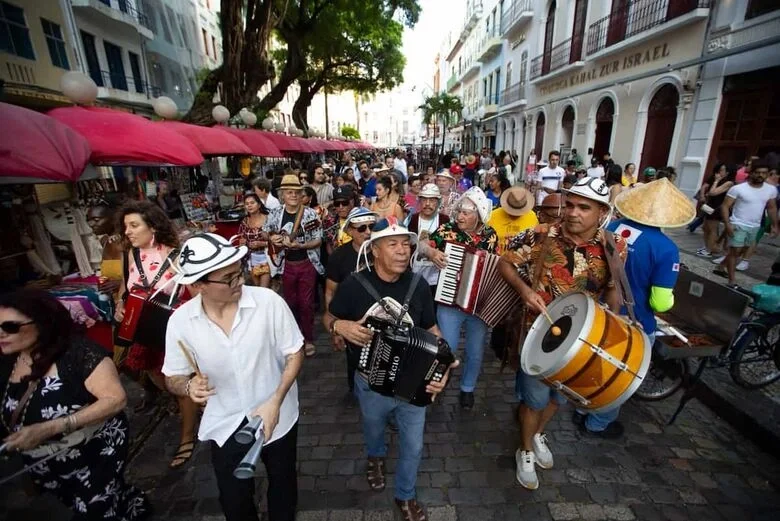
Recife’s historic Bairro do Recife filled with accordions, drums and dance on 2 August as a grassroots cultural movement staged its second annual street tribute to Luiz Gonzaga, the ‘King of Baião.’
A Street Procession Through Recife’s Historic Waterfront
The tribute unfolded across the Bairro do Recife, also called Recife Antigo, the cobblestoned district where the city was founded in the 16th century. Once a decaying port zone, it has been restored into one of Recife’s main cultural hubs, lined with converted warehouses, bars and museums beside the rivers that ring the old town.
Activities began at 2 p.m. with a gathering at Armazém do Campo, a cultural space and market on Rua da Moeda. From there, musicians and cultural groups set off in a cortejo, or street procession, moving through Rua Dona Maria César, Avenida Rio Branco and the postcard-famous Rua do Bom Jesus before reaching Praça do Arsenal.
A cortejo is a defining feature of northeastern Brazilian street culture: an open, walking celebration that carries music and dance directly to passers-by rather than confining it to a stage. Sanfonas (accordions), zabumbas (bass drums) and dancers turned the district into a moving performance open to anyone who happened to be in the street.
Who Was Luiz Gonzaga, the King of Baião?
For readers new to Brazilian music, Luiz Gonzaga is one of the towering figures of the country’s 20th-century culture. Born in Exu, in the dry sertão backlands of Pernambuco, on 13 December 1912, he learned the accordion as a child under his father, Januário, himself a maker and player of the instrument.
Gonzaga turned the rhythms of the northeastern interior into national symbols, carrying the baião, the xote and the xaxado to audiences across Brazil from the 1940s onward. His songs told of drought, migration and the hardship and pride of sertão life, giving a national voice to a region often overlooked by the country’s wealthier coastal centers.
Classics such as ‘Asa Branca,’ ‘Xote das Meninas’ and ‘Súplica Cearense’ are still sung at Brazil’s June festivals and covered by artists nationwide. Gonzaga died on 2 August 1989; his home, a museum and his mausoleum are preserved at the Parque Asa Branca in Exu, where he is buried alongside his wife, Helena.
Forró, Baião and the Sound of Brazil’s Northeast
Forró is the umbrella name for a family of dance rhythms from northeastern Brazil, traditionally driven by a trio of accordion, zabumba and triangle. It is both a genre of music and a partner dance, and it anchors the São João (Saint John) festivities that sweep the region every June.
The baião, popularized by Gonzaga and the composer Humberto Teixeira in the late 1940s, is the rhythmic backbone of that tradition. For decades it shaped how the rest of Brazil imagined the northeast, and it later fed into movements from tropicália to contemporary Brazilian pop.
Defending the ‘forró tradicional,’ or roots forró, was an explicit goal of the Recife tribute. Organizers framed the event as a stand for the acoustic, community-rooted style against the amplified, pop-oriented forró eletrônico that dominates commercial radio and large festival stages today.
The Lineup: More Than 20 Popular Artists
The program moved in the late afternoon to the Bar Teatro Mamulengo, an intimate venue named for the mamulengo, the traditional glove-puppet theater of Pernambuco. More than 20 artists and groups shared the stage across the afternoon and evening.
Confirmed performers included Toinho Vanderlei, Daniel Bento and his Trio Pé de Serra, Aécio dos 8 Baixos, Wellington Santeiro and Eliezer Cavalcante, alongside the eight-year-old accordion prodigy Luna, billed as a sanfoneira mirim, or child accordion player.
The bill deliberately mixed generations and traditions. It featured the Bacamarteiros da Sobac, a black-powder musket-and-drum group from Cabo de Santo Agostinho, and the Banda Luar do Sertão, an ensemble made up of blind musicians, underscoring the event’s roots in community and popular culture rather than commercial celebrity.
Why the Tribute Matters for Pernambuco’s Cultural Movement
The tribute is organized by Rebuliço Cultural, a movement that supports what Brazilians call culturas raízes, or root cultures, and campaigns for the livelihoods of local artists. Now in its second edition, the event is building toward an annual place on the city’s calendar, as reported by Diario de Pernambuco.
Events like this matter economically as well as symbolically. Grassroots festivals sustain a network of working musicians, instrument makers, dancers and small venues that rarely benefit from big-budget productions, and they help keep the Bairro do Recife active outside the peak tourist season.
They also reinforce a broader civic project. In Pernambuco, the second of August, the anniversary of Gonzaga’s death, doubles as a symbolic day for northeastern culture, and street tributes like this one keep his legacy tied to a living, participatory tradition rather than a museum display.
What Foreign Visitors Should Know About Recife Antigo
The Bairro do Recife is walkable, compact and easy to reach from the city center, making it one of the most accessible entry points into Pernambuco’s cultural life for visitors. Its bars, galleries and the riverside Marco Zero square host frequent events, especially on weekends.
The district is also home to the Cais do Sertão museum, a modern institution dedicated to Gonzaga and to northeastern culture, which sits a short walk from the procession route. For travelers, it offers year-round context on the music that filled the streets during the tribute.
Street processions such as this one are free and open to the public, with no ticket required to follow the cortejo through the district. For foreign residents and visitors, they offer a rare, unfiltered look at living Brazilian popular culture, performed by the communities that created it.
Frequently Asked Questions
When and where did the second Tribute to Luiz Gonzaga take place?
The second edition of the Tribute to King Luiz Gonzaga was held on Sunday, 2 August 2026 in the Bairro do Recife, the historic waterfront district of Recife, Pernambuco, in northeastern Brazil.
Who organized the tribute and who performed?
It was organized by Rebuliço Cultural, a movement supporting root cultures and Pernambuco artists. More than 20 acts performed, including Toinho Vanderlei, Aécio dos 8 Baixos, the young accordionist Luna and the all-blind Banda Luar do Sertão.
Who was Luiz Gonzaga?
Luiz Gonzaga (1912–1989) was a Brazilian singer and accordionist known as the ‘King of Baião.’ He turned northeastern rhythms such as the baião, xote and xaxado into national symbols and remains a defining figure of Brazilian music.
Sources: Diario de Pernambuco; Wikipedia.
This article was produced by The Rio Times’ automated newsroom system. How we use AI · Report an error