Danish brewing magnate Carl Jacobsen commissioned and paid for Copenhagen’s famous Little Mermaid. But a small statue of a fishtailed woman sitting naked and chilly on a rock is hardly the highlight of Denmark’s capital.
And sorry, nor is our Mary’s palace, nor the brightly coloured houses along Nyhavn, nor the pedestrian Stroget. You really want to get away from tourist-dense downtown and see Copenhagen’s nifty neighbourhoods, such as trendy Vesterbro and Norrebro and delightful, gracious Frederiksberg.
Which brings me back to Carl Jacobsen (1842-1914) for whom Carlsberg beer was named by his father. He owned what was once one of the world’s biggest factories, just a short cycle or a few metro stops from central Copenhagen.
It isn’t producing beer anymore but has been turned into new neighbourhood Carlsberg Byen or Carlsberg City District: just the place to base yourself for a couple of days.
If you think a former industrial estate might be grim, have a rethink. Its 19th-century architecture is ornate and magnificent, and this is now one of the city’s trendiest destinations, with a growing reputation for gastronomy and culture.
Get exclusive travel deals delivered straight to your inbox. Sign up now.
To see how functionality and beauty can make a match, start at the 56-metre Winding Chimney, which marks the district like an exclamation mark. It has a twisting shape and gargoyles, like a steeple to the religion of commerce – or perhaps beer.
A short walk away is my favourite Carlsberg monument, the Elephant Gate that once provided entry to the brewery compound. Its four huge stone elephants emblazoned with Buddhist swastikas are completely unexpected, as out of place as … well, elephants in Denmark.
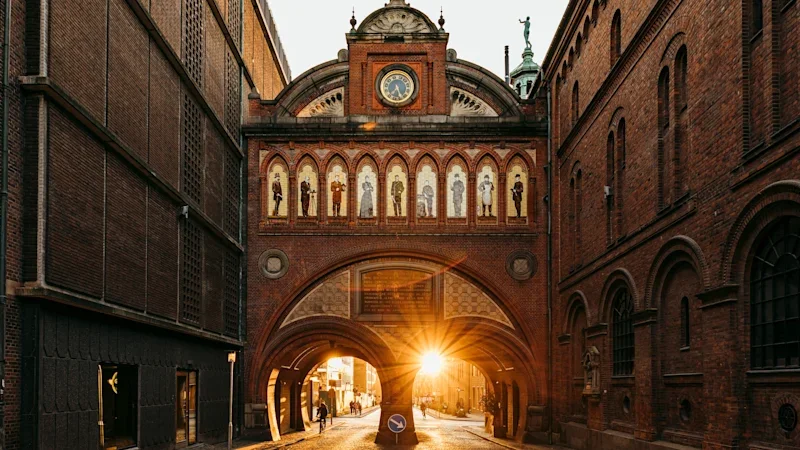
Just up the road is another striking gate, the Dipylon, with Jacobsen family members and significant Carlsberg brewing figures shown in mosaic work as if they’re Byzantine saints.
There are plenty of dotty buildings too. New Carlsberg Brewhouse was inspired by an Italian palazzo and is topped, like St Mark’s Basilica in Venice, with a giant bronze (one that shows Norse god Thor battling giants). Chalk Tower is topped by a lighthouse for no discernible reason.
“Work and frugality” is the company slogan emblazoned on it, although there’s nothing frugal about these buildings or plenty of others: storehouses, silos, boiler halls, a machine room with granite columns and marble floors. Walk around with your neck cricked and admire the architecture. Information boards in English tell you more.
Storage Basement 3 was nicknamed The Castle by brewery workers and has a facade covered in gold-leaf discs. It and the adjacent Malt Magazine have been transformed into Hotel Ottilia, named after Jacobsen’s wife.
The hotel is uber-stylish, very friendly and monastic but striking in its unpolished industrial look: the perfect complement to this striking district. The former workers’ canteen in the large courtyard behind is now hip burger joint Gasoline Grill.
Carlsberg City District isn’t all old. Its 16-year transformation was only completed in 2024. The soft red brick of the factory buildings sits alongside new steel-and-glass office and residential buildings. Some are glamorous, others social and student housing. The hard angles are softened by squares and gardens and pocket-sized parks.
After you’ve admired the architecture, check out the Danish design in some high-end stores: Henrik Vibskov and Haastrup for fashion, Stillark and Carl Hansen for homeware, Stelling for art, PP Mobler for absurdly stylish chairs.
The restaurants are suave too. You can get anything from vegan to ramen, sourdough pizzas or French gastronomy with Nordic and Japanese influences, but head to Aamanns for upmarket, Michelin-recommended, all-organic Danish smorrebrod or open sandwiches, some served warm.
Can you get beer? Well, yes you can. Try Aben for craft beers on tap, or hit the 70-metre-long bar in Carl’s, housed in the former malt silo. Home of Carlsberg, the company museum, still has a small specialist brewery and beer tastings in its old cellars.
THE DETAILS
FlyTurkish Airlines flies from Melbourne and Sydney to Copenhagen via Istanbul. See turkishairlines.com
StayHotel Ottilia in a converted factory features industrial chic, stylish Nordic furniture, a great rooftop restaurant and very welcoming staff. Rooms from DKK 1266 ($305) a night. See brochner-hotels.com
The writer stayed as a guest of Wonderful Copenhagen.