The Los Angeles Dodgers got Tarik Skubal, damn them. Damn them for having money; damn them for being too damn good; damn them for ruining baseball. That they got Skubal, the hottest commodity on the stove at the trade deadline, for relative peanuts, well. In this case, you damn everyone else.
This trade will ostensibly impact the Dodgers' odds through the 2026 World Series, though that's the least relevant part of the picture. All anyone can think about, at least as it pertains to the Dodgers, is what baseball will look like in 2027, if we get any baseball in 2027 at all. In that sense, the 2026 World Series does matter. No doubt the future of the sport depends heavily on the team that wins; considering Tarik Skubal and his $9.5 million in remaining salary cost three decent prospects, you could infer that every single owner wants it to be the Dodgers. For the greater good, you see.
If one were conspiracy minded, one could trace the logical threads from this trade to that conclusion. There are qualifiers on Skubal's performance this year that might justify a lower price—he has had injury trouble and a novel surgical procedure to treat it; though his ERA is still excellent, his peripherals aren't nearly as tidy; he is a rental only through the end of the year—but those qualifiers would be in place at any price, no matter where he went. It is both borderline incomprehensible and self-evidently true that other teams in the rarefied contention window like the Tampa Bay Rays or the Milwaukee Brewers—neither of which, mind you, have ever won a World Series—did not outbid the Dodgers' winning offer, not even for the sake of driving the price higher. It is equally strange that the Detroit Tigers did not shop more rigorously around the league for a higher return.
Perhaps the Dodgers are accelerationists, confident in their ability to succeed in any environment and pissing everybody off for the sake of hastening the transition to one with a salary cap. Perhaps the 29 other owners in the league are content to let the Dodgers do their thing and roll over and not even try to compete, in the hope of inciting more discussion about "parity" and a salary cap and how baseball is ruined, or at least well along the process of being ruined, should they not step in and save it via a lockout.
This form of ruined baseball, curiously, doesn't look too different from how baseball looked during the BDOE (Before Dodgers Ohtani Era), which was a whole three years ago. While the Dodgers' luxury cap hit has skyrocketed, the material impacts of their spending are a little less clear. They have broken no regular season win records. The ten best players each year by WAR are still healthily scattered across multiple teams. Major League Baseball is at a high point of popularity that hasn't been seen since the 2000s. The great anti-competitive sins of the West Sacramento A's and Pittsburgh Pirates and Colorado Rockies are neither perpetrated nor necessitated by the Dodgers or anything they do.
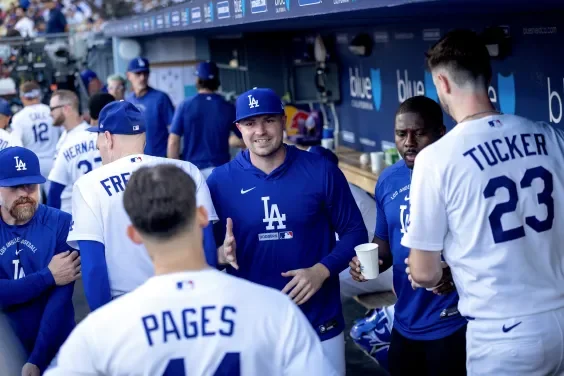
Does one World Series Game 7 home run from Miguel "Miguel fucking Rojas" Rojas truly define the difference between a ruined game and a healthy sport? The discourse would look very different if Rojas had not fluttered his wings, or if Andy Pages had not caught that ball, and if the Dodgers thus did not have two consecutive World Series rings under their belt. For all that the Dodgers are a supposed inevitable entity that has solved baseball by being somehow richer and smarter and more competent than God, it has never truly panned out that way on the field. The actual sport remains incredible to watch, no matter what the Dodgers are doing in their corner. As of today they are tied in the standings with the damn Brewers.
The one area where the DOE (Dodgers Ohtani Era) Dodgers undeniably do perform like an inevitable entity that has solved baseball by being richer and smarter and more competent than God is the offseason. Free agency, after all, is founded on perception. Players are more willing to pick a given team if they perceive that doing so will give them an honest shot at winning a ring.
The DOE Dodgers have money, yes, but more than that, they have a track record and a reputation. Their third-greatest draw—behind money and Shohei Ohtani—is one afforded by the discourse surrounding them. If the club is an inevitable entity that has solved baseball, it is primarily because everyone else agrees that it is an inevitable entity that has solved baseball, no matter how the actual games play out each year. So long as people say that the Dodgers are too good, the Dodgers will continue to have an easier time acquiring free agents, other teams will be less motivated to try or at least happy with the excuse to try less, and the cycle will continue. Perversely, the more people complain about the Dodgers being a juggernaut, the more the team has become one; and it is the spending, not the baseball, on the forefront of everyone's mind.
Judith Butler may be happy with this example of the original definition of performative language: words that actually enact something upon reality, which have an impact by being spoken. Perhaps in the same way that the Dodgers' reputation has been constructed, baseball is already ruined just because people keep insisting that it is. I suppose your verdict depends on whether you believe more in what you hear or what you see.