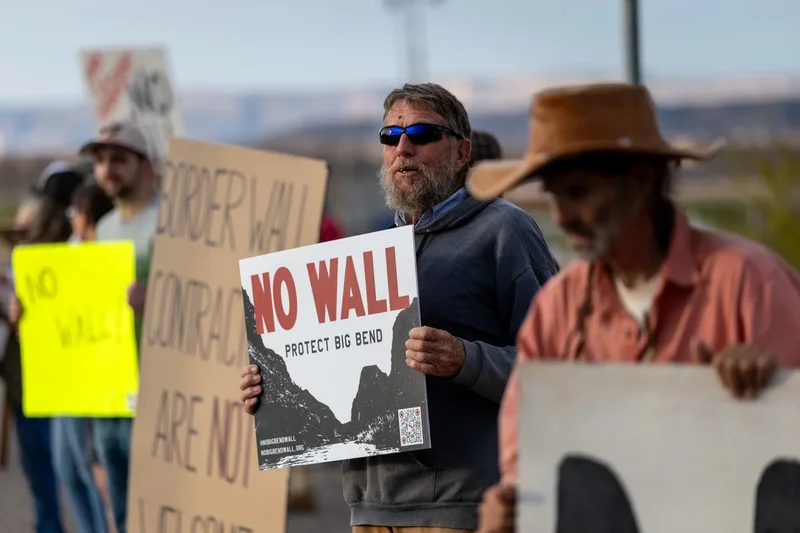
A federal judge will let Donald Trump’s administration build a wall through a levee system protecting a small border town in the Big Bend area of southwestern Texas from severe flood risk despite “understandable concerns” from local officials and residents.
The town of Presidio filed a lawsuit in June to stop construction on the project, warning that replacing the existing earthen levee with a 30-foot-tall steel and concrete barrier would make its 3,200 residents “vulnerable to deadly flash floods capable of destroying infrastructure, homes, farmland and agriculture.”
Sunday’s late-night decision from Texas District Judge Reggie B Walton is a victory for the president’s $48 billion efforts to build a physical barrier along the U.S.-Mexico border from the Pacific Ocean to the Gulf of Mexico, a critical component of his vast anti-immigration campaign.
The administration was “already barreling ahead to implement this decision, including by awarding contracts and putting boots on the ground to begin construction” without approval from relevant agencies, the town’s lawyers wrote in June.
“We are very disappointed that the court will allow this potentially disastrous construction to continue, but we remain committed to protecting the Big Bend area and those who rely on the threatened levees,” the town’s development district said in a Monday statement.
On his first day in office, the president declared a national emergency on the southern border and directed the Department of Defense and Homeland Security to “immediately take all appropriate action, consistent with law … to construct additional physical barriers along the southern border.”
He issued another order directing the agencies to take “appropriate action to deploy and construct temporary and permanent physical barriers to ensure complete operational control of the southern border of the United States.”
The government has since worked on a so-called “Smart Wall” along the southern border composed of a “steel bollard wall or waterborne barrier, along with roads, detection technology, cameras and lighting and in some cases a secondary wall,” according to court filings.
The Presidio Municipal Development District said it asked Homeland Security for details about the project but was rejected due to “national security” concerns.
In 2008, the binational International Boundary and Water Commission invested millions of dollars into a flood control system around Presidio after Tropical Depression Lowell surged floodwaters into homes, some of which filled up with 10 feet of water.
The town, which sits on the Rio Grande River, argued that the Trump administration’s construction project violates the Rivers and Harbors Act, which was passed by Congress more than a century ago to block the government from interfering with waterways by building bridges, dams and walls without approval.
“Here in Presidio, the river has never divided us. It’s the reason our whole community is here, on both sides,” John T. Kennedy, executive director of the Presidio Municipal Development District, said in a statement after filing the lawsuit.
“The levee is what lets us live safely alongside it, and we’re asking that it get the flood-safety review the law requires before anyone builds on it,” he said.
Homeland Security has faced a series of legal challenges from environmental and tribal groups, among others, arguing that the government’s rapid construction of physical barriers on the southern border endangers protected sites.
In May, facing bipartisan pushback, the administration said it would not build a physical wall through Big Bend National Park, which spans hundreds of miles through the Chisos mountain range and the Chihuahuan Desert.
The area is “a cherished region of Texas and our nation alongside the Rio Grande,” according to Skye Perryman, president and CEO of Democracy Forward, which filed the lawsuit on Presidio’s behalf. Compromising Presidio’s levee system “means real harm to real people in the area,” she added.
The federal government, however, has repeatedly issued exemptions and waivers of federal laws intended to protect the environment, Native American remains and archaeological sites to speed up construction of Trump’s border wall project.
In court filings, government attorneys argued that plans for the Presidio wall are not final while maintaining that the administration has authority to broadly waive regulations to support the president’s efforts to ban all border crossings
In his ruling, the judge claimed it was clear “that Congress did not intend to limit” that authority.
The administration has waived more than two dozen legal protections for the Big Bend area alone, including provisions of the Endangered Species and Clean Water Acts.
In June, Arizona’s Indigenous Tohono O’odham Nation sued to block a portion of wall allegedly on tribal land, and a Catholic diocese in New Mexico says the administration is infringing on 14 acres of church land for a border wall that would “desecrate” a 25-foot-tall, mountaintop statue of Jesus.
Border wall construction has also alarmed environmental advocates who fear significant consequences to barriers that block natural watersheds, disturb animal migration patterns and compromise native plants and protected wildlife.