Now that the Gen Z revolutionaries have exited Jantar Mantar, the analysts and strategists at the Prime Minister’s Office must be taking stock. For starters, Prime Minister Narendra Modi’s team got at least one decision right — the decision to get former Union Minister Dharmendra Pradhan to resign just in time. Any further delay would most likely have become a point of no return for the National Democratic Alliance (NDA) government. Demonstrations were occurring at the district level and a critical momentum was building across the nation with Bihar, the ground zero of unemployment, fast turning violent.
But apart from Mr. Pradhan’s timely resignation, all the other interventions of the Government of India as a response to the Cockroach Janta Party’s (CJP) movement was a mix between the ridiculous and the laughable. It is clear as daylight that the Prime Minister’s team singularly failed to grasp who and what they were actually dealing with.
Brewing anger
The starting assumption of the government was that it was confronting a rag-tag collection of middle-class youth whose sense of politics was immature and lacking in stamina for any mass movement to emerge. The overwhelming official common sense was to let the CJP movement simply fizzle out in the monsoon heat and humidity. Part of the misreading involved keeping the CJP leaders waiting at Union Health Minister J.P Nadda’s residence for over two hours, while the government simultaneously set up plans to cut a deal with Sonam Wangchuk alongside operationalising a brutal lathi charge on the Gen Z campaigners on July 20.
To the government’s evident surprise, however, by July 20 evening, there was a massive turnaround in both the quality and quantity of the resistance. Not only did the CJP survive the brutal lathi charge and tear gas shelling, the campaign now took on the flavour of an all-India level ‘revolt’ of the people at large. An anti-Modi mood had become plainly discernible, with Instagram fired up with creative messaging and demonstrations by the Bharatiya Janata Party (BJP)’s own taken-for-granted upper class and upper caste social base.
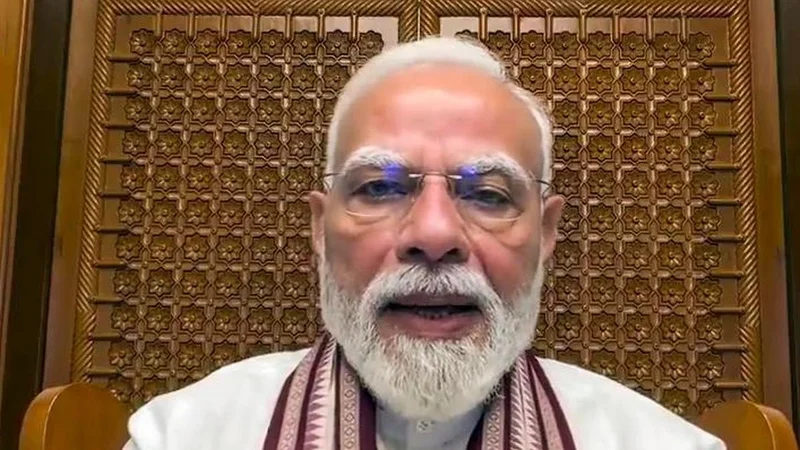
However, even at such a high-pressure moment, the best the Prime Minister’s team could manage was a late night badly sketched Instagram video by Mr. Modi himself. Poorly executed and full of misplaced messaging, it, unsurprisingly, only added fuel to the fire. And after the Prime Minister released another hapless reel the following day, the Government of India finally threw in the towel with Mr. Pradhan’s resignation.
There is no doubt that the CJP is every bit a rag-tag outfit that is organisationally inchoate. But what it nonetheless managed to effectively achieve was to quickly tap into and electrify a vast reservoir of resentment, anger, grievance and unhappiness amongst India’s economically much beleaguered middle class and aspirational poorer classes. By doing so, it managed to reveal the considerable fragility within the Indian political landscape. The extreme centralisation of power has, over the years, been steadily undermining the resilience within Indian political institutions. Consequently, the CJP by pitching its campaign as a resistance rather than within the rules of institutional Opposition politics was able to rattle the highest level of political authority.
Undermining democracy
At the heart of this crisis lies the Modi-Shah political playbook. For years, democratic politics with institutional safeguards have been systematically undermined in India. There is, in fact, the standard fix now for eliminating any opposition. The Modi-Shah political playbook has mainstreamed the use of the Enforcement Directorate and the Central Bureau of Investigation; the wanton buying and selling of MPs and MLAs; and have been making courts pliable at the highest level. Additionally, the questionable manner in which the highly controversial Special Intensive Revision (SIR) is being implemented can also be added to this list. There is great fear that the election process will increasingly become a selection exercise for the government in power.
In such conditions, a single trigger event, such as the CJP movement, could spark an immediate existential threat to an existing political order. However, while credit should be given to the CJP for showing resolve, and for the ability to organise and direct a grievance peacefully, their strategy is located entirely outside the political terrain of institutional politics. Thus, although Mr. Pradhan’s resignation may appear to be a signature victory for them, it more ominously reveals the turbulence and fragility within India’s political institutions. There could be less control over the street in the days to come, unless the Modi-Shah playbook ends.
The CJP has revealed that India is perilously close to losing its ability to manage a peaceful democratic transition. Though Rahul Gandhi, the Congress party, and several other Opposition parties did manage to register a strong presence throughout the Jantar Mantar movement, their hold was still less than enough and far too tenuous.
Mr. Pradhan’s resignation should perhaps be more correctly seen as the first tremor within a Republic that is buckling from its weakening democratic foundations. If anything, the most important lesson to be taken from the CJP campaign is that the constant undermining of any legitimate opposition space by the Modi-Shah play book can, unless checked, result in social instability and political chaos.
Rajesh Mahapatra is independent journalist and former editor of the Press Trust of India; Rohan D’Souza is Professor at Graduate School of Asian and African Area Studies, Kyoto University, Japan
Published - August 04, 2026 02:01 am IST