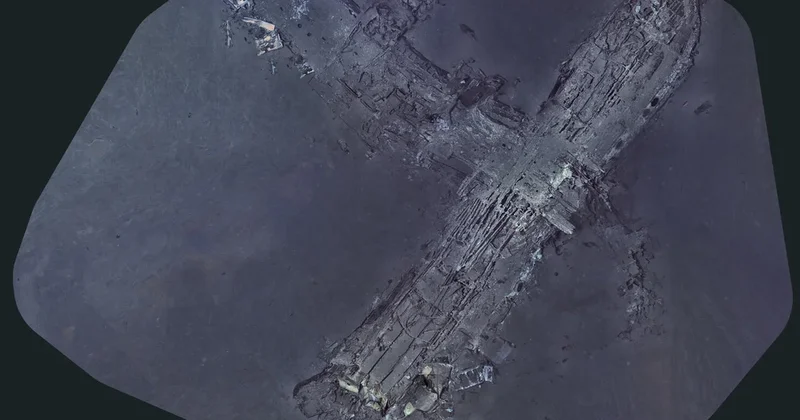
Searchers have found the wreckage from a Pan Am flight that plunged into the ocean off Puerto Rico in 1952, an accident that killed 52 and led to requirements for the passenger safety briefings given on every commercial flight.
The New York-bound plane, the Clipper Endeavor, made a hard landing after losing engine power shortly after takeoff. The 17 passengers and crew who survived told investigators everyone lived through the landing, but panic set in as many passengers struggled to find life vests and the crew had a hard time pulling out life rafts.
According to the Pan Am Historical Foundation, the cabin crew tried to calm the 64 passengers.
"Although the Clipper was equipped with life rafts and personal floatation for all aboard, most of the passengers remained glued to their seats, more afraid of facing the reality of their situation than the momentary mirage of safety offered by remaining in the plane's cabin," the foundation said. "It would prove a fatal mistake for 52 of them."
Within minutes, the plane sank.
Explorers found the wreckage of the DC-4 last month by using an autonomous sonar drone to locate the fuselage and tail in 2,000 feet of water.
This undated composite image provided by the Air/Sea Heritage Foundation and Deep Sea Vision on Tuesday, July 21, 2026, shows the Clipper Endeavor wreck.
Air/Sea Heritage Foundation and Deep Sea Vision via AP
"This accident changed aviation forever," the Discovery Channel's Josh Gates said in a social media video announcing the discovery. "It led to sweeping changes, including the introduction of the now mandatory safety briefing every time you fly."
Now before takeoff, flight attendants instruct passengers about exit locations and where life vests are located and how to inflate them.
"This one became a catalyst, and it helped drive safety steps forward of better flotation equipment and the preflight briefings," said aviation safety expert John Cox, a pilot and founder of Safety Operating Systems. "So this is one steppingstone along the path to what we today enjoy as aviation safety. It was a rallying cry at the time."
And now the discovery of this wreck could offer new hope for families who lost loved ones in other ocean crashes like Malaysia Airlines Flight 370 that disappeared 12 years ago with 269 people aboard.
Years of research helped locate the wreckage
This crash first caught the attention of Russ Matthews in 2019 when he saw a blurb about a luggage tag from the flight washing ashore in Florida. He said the historical significance of the Clipper Endeavor prompted him to dig deeper.
That led to years of digging through the Pan Am Airlines and Coast Guard archives looking for clues about the location of the plane's watery grave. Reports from the Civil Aeronautics Board, which was the predecessor to the Federal Aviation Administration, also helped.
But the key to finding the wreckage was found in records in Puerto Rico from a hearing that was held on the crash, and a map estimating the location of the crash that was done by Air Force pilots who witnessed the crash because they just happened to be in the area on a training flight.
This undated image provided by the Pan Am Historical Foundation on Tuesday, July 21, 2026, shows the Clipper Endeavor.
Pan Am Historical Foundation via A
Bad weather disrupted a previous attempt to locate the wreck in 2024 with a towed sonar array that was also documented by the Discovery Channel's "Expedition Unknown" show. But Matthews said he and the volunteers who work with his Air/Sea Heritage Foundation dreamed of making a second attempt to find it before next year's 75th anniversary of the crash with one of these newer advanced drones that were originally developed for military uses like finding undersea mines.
Undersea drone played a key role in the search
Tony Romeo, who is CEO of the undersea exploration firm Deep Sea Vision, had been talking with Matthews for a while about the possibility of helping try to find this plane if one of his ships was ever in the area, and then in April one just happened to be passing right by Puerto Rico between two other jobs while carrying an advanced underwater drone with the right sensors to be able to find it.
"There we were, and everything kind of came together at the moment: good weather, the right team, and the right equipment and ship. So we took a shot at it," Romeo said.
This undated composite image provided by Air/Sea Heritage Foundation and Deep Sea Vision on Tuesday, July 21, 2026, shows a Pan American World Airways logo on the nose section of the Clipper Endeavor wreck.
Air/Sea Heritage Foundation and Deep Sea Vision via AP
Deep Sea Vision previously led an unsuccessful six-month search to find Amelia Earhart's plane, but Romeo had a special interest in this case because his father was a mechanic and pilot for Pan Am airlines. In fact, the drone they used in the search already had a Pan Am sticker on the side.
"This discovery offered a rare opportunity to connect with a pivotal moment in history while demonstrating how the proper application of research and cutting-edge technology can unlock even the most elusive undersea mysteries," Romeo said.
Capturing the moment of discovery
All the research Matthews' group had done, combined with weather data from the time of the crash, was synthesized to create a map of the most likely location and a search area of 10 square nautical miles. The drone actually found the wreckage on its first pass over that area, although the explorers didn't know that until it returned to the surface with its images.
Gates and his crew were again along for this latest search to capture the moment the plane showed up on images from the drone after they were downloaded.
The search will be featured in a special episode of the show this fall, but a few highlights released Tuesday show the moment everyone in the control room realized what they had found. Shouts of "Oh God!" and "That's a plane!" erupted when the image loaded on screen.
"To have a front-row seat to an expedition like this as it's unfolding is tremendous, and so I feel really lucky that we were able to be a part of it," Gates said.
The expedition team said it is working with the government of Puerto Rico to create expanded protections for the wreck site. They have also been in contact with some of the families impacted by the crash, including the accident's only two known living survivors.
This undated photo provided by the Discovery Channel Tuesday, July 21, 2026, shows, from left, Air/Sea Heritage Foundation (ASHF) President Russ Matthews, ASHF Director Idee Matthews-Montijo, Expedition Unknown's Josh Gates and Deep Sea Visoin President of Operations Craig Wallace inside an AUV hangar.
Discovery Channel via AP