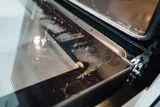
There are many things about everyday objects that we give little thought to.
Take, for example, your oven door. Look very closely, and you might find that the glass pane is covered in lots and lots of small dots surrounded by a black border. You might even notice the dots are arranged in a very specific pattern, with the dots closer to the edge appearing larger and more concentrated, and those closer to the center appearing smaller and more sparse.
Inspect your washing machine, and you might find a similar pattern. Your car windshield? It’s there, too.
At first, this might seem a little random, but these dots do serve an important purpose. In fact, these dots — or ceramic frit dots, to use their more official name — make your appliances safer and more efficient. What’s more, the technology you see on several common household objects today is linked to a science that goes back thousands of years, all the way to Ancient Egypt.
Learn more about frits and the science behind them — because the dots on your washing machine door are not just an aesthetic choice.
Read More: Starch Traces on Stone Tools Push Back Evidence of Hominid Plant Prep by 400,000 Years
What Are Frits?
Frits are a glassy material made from a mixture of substances. These can include oxides, silicates, and aluminosilicates, which are melded together in furnaces that reach temperatures of up to 2,700 degrees Fahrenheit (1,500 degrees Celsius), before being rapidly cooled with air or water, and ground to a fine powder. Frits can be used for a wide range of purposes from ceramics to medicine to electronics.
The black pattern — or ceramic frit dots — you see on oven doors and car windows are frits mixed with ceramic paint that are applied to the glass surface and then baked on.
How Do Frit Dots Make Our Appliances Safer And More Efficient?
Ceramic frit dots make our household appliances safer by regulating temperature. The black dots on an oven door, for example, help the heat distribute more evenly across the entire surface, which prevents the glass from coming under too much thermal stress. This, in turn, means it is much less likely to crack, warp, or shatter. The area where the glass meets the metal of an oven door or car is particularly vulnerable to this type of stress
In the car, the ability of the ceramic frit dots to distribute temperature also helps reduce optical distortion—a phenomenon that makes straight lines look curved or bent. According to a paper published in the Journal of the American Society of Trace Evidence Examiners, the frit has the added benefit of protecting the adhesive that secures the window to the car from UV, which could cause it to deteriorate. It also provides the adhesive with better grip.
And while its function isn’t purely aesthetic, the placement of the ceramic frit along the edges of the car windshield or oven door does improve its appearance by helping to hide any sealant and hardware.
An Ancient Art
The ceramic frit dots you see on your car windshield are a twentieth-century invention that serves a very modern purpose. However, frits have a history that goes back thousands of years.
According to a paper published in the journal Coatings, the manufacture of frits can be traced back to the Ancient Egyptians, who were creating colored glass coatings for their amulets and jewelry as early as 1,300 B.C.E.
Over time, the practice was adopted by various other cultures, including the Greeks and Byzantines, who appreciated the material’s durability and appearance. With the advent of industrialization and the trend towards mass production in the nineteenth century, enamel manufacture became a large-scale commercial endeavor.
Frits continue to be valued today for their ability to withstand exceptionally high temperatures and resist oxidation.
Read More: Ancient Ceramics and Beading Shed Light on Human Life Over 20,000 Years Ago
Article Sources
Our writers at Discovermagazine.com use peer-reviewed studies and high-quality sources for our articles, and our editors review for scientific accuracy and editorial standards. Review the sources used below for this article:
- This article references information from a study published in the Journal of the American Society of Trace Evidence Examiners: Forensic Examination of Ceramic Frit on Automotive Glass
- This article references information from a Patent: Partially crystallizing lead-free enamel composition for automobile glass
- This article references information from a Patent: Oven doors
- This article references information from a study published in Coatings: Low-Temperature Glass Formation from Industrial Enamel Frit Production Waste
- This article references information from th Spanish National Association of Frit, Glaze and Ceramic Colour Producers (ANFFECC): Frits