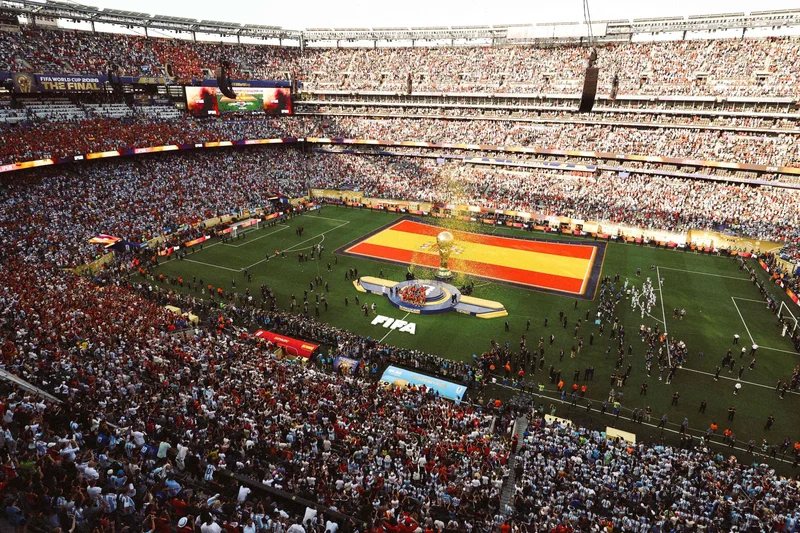
Spain is world champion again. Ferran Torres, on for Mikel Oyarzabal in the second half, settled a bruising, goalless stalemate in the 106th minute to beat Argentina 1-0 in extra time and deny Lionel Messi a second straight title. It was Spain’s second World Cup, added to the one won in 2010, and it made them the first nation to hold both the men’s and women’s crowns at once. They conceded just one goal across the whole tournament, a record for a champion. This was not a team that got lucky. It was a team that suffocated the best player of his generation on the biggest night of his career.
That is worth sitting with, because Messi’s Argentina came to New Jersey trying to become the first side to win four straight major tournaments. Instead, in what he has all but confirmed was his final World Cup match, Messi watched his side manage only two shots in 120 minutes and saw a late corner skip agonizingly over his own crossbar through a teammate. Spain, by contrast, wore Argentina down for two and a half hours until a substitute finished the job. It is a fitting way for one era to close and another to be crowned.
But Spain’s triumph was not the only story worth telling from this World Cup, and it did not happen in isolation. FIFA’s expansion to 48 teams is what made this the most unpredictable tournament in years, and Spain had to survive that unpredictability to get here.
In the group stage, tiny Cape Verde held them to a goalless draw in Spain’s own opening match. The Cape Verdeans, unbeaten through the group on three draws, then pushed reigning champions Argentina to extra time in the round of 32 before finally losing 3-2, with 40-year-old goalkeeper Vozinha turning himself into a household name along the way. Curaçao, a nation of roughly 150,000 people, became the smallest country ever to score at a men’s World Cup. These were not sideshows. They were part of the same expanded format that forced Spain to earn every step of their run, and they gave fans who had never seen their country at a World Cup something to believe in.
The tournament had its darker moments too. Egypt’s exit to Argentina, marred by a disallowed goal and two waved-away penalty appeals, left the Egyptian federation filing a formal complaint and pundits across the world questioning the officiating. FIFA denied any bias, and no wrongdoing was ever proven, but the controversy followed Argentina all the way to the final.
Iran, meanwhile, went unbeaten through three draws only to be eliminated on goal difference, competing with quiet pride while their country lived through open conflict with the United States. Neither story erased the politics or the doubts around them. But for 90 minutes at a time, they gave millions of fans something to hold onto that had nothing to do with war or grievance.
Spain deserved their trophy, and they earned it the hard way, against a Cape Verde side that would not fold and an Argentina side that would not break until the very last stretch of extra time. But the tournament that crowned them was bigger than any one result. It gave small nations a real stage, closed the international careers of Messi and Ronaldo within the same fortnight, and still left the world watching the same match, feeling the same thing. That is what makes this World Cup, and Spain’s place at the top of it, worth remembering.
The views and opinions expressed in this article are solely those of the author. They do not necessarily reflect the editorial stance, values or position of Daily Sabah. The newspaper provides space for diverse perspectives as part of its commitment to open and informed public discussion.
The Daily Sabah Newsletter
Keep up to date with what’s happening in Turkey,
it’s region and the world.
SIGN ME UP
You can unsubscribe at any time. By signing up you are agreeing to our Terms of Use and Privacy Policy.
This site is protected by reCAPTCHA and the Google Privacy Policy and Terms of Service apply.