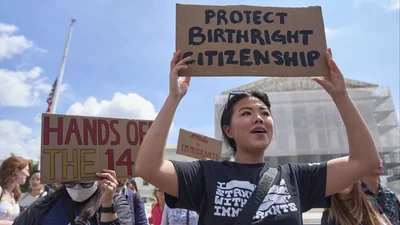
When the US Supreme Court rejected President Donald Trump’s attempt to restrict birthright citizenship, his attention soon turned from the justices to China, prompting a sarcastic social media post.
“I would like to congratulate President Xi, and the Great Country of China, on their massive Birthright Citizenship WIN! President DONALD J. TRUMP,” Trump wrote on social media.
In the hours that followed, the Department of Justice instructed federal prosecutors to prioritise investigations of so-called “birth tourism” schemes. Days later, US House Speaker Mike Johnson said lawmakers were examining legislation addressing women who enter the country to give birth.
The moves suggest that, after losing its constitutional challenge, the Trump administration and its congressional allies are shifting towards immigration enforcement and possible legislation, with China increasingly central to their rhetoric. Yet no federal data set directly measures how many women enter the United States primarily to give birth, and available figures indicate that births to women living in China represent a minute share of US births.
Trump signed an executive order on his first day back in office, directing federal agencies to deny citizenship documents to children born in the US when their parents were undocumented or present under temporary visas. After lower courts blocked the policy, the Supreme Court
that those children were citizens at birth under the 14th Amendment.
Giving birth while visiting the United States is not, in itself, a criminal offence. Prosecutions described as “birth tourism” cases have generally relied instead on allegations of visa fraud, conspiracy, money laundering or other offences involving travellers who allegedly concealed the purpose of their visits and businesses that helped them do so.
US President Donald Trump signs an executive order on birthright citizenship on January 20, 2025. Photo: Getty Images via TNS