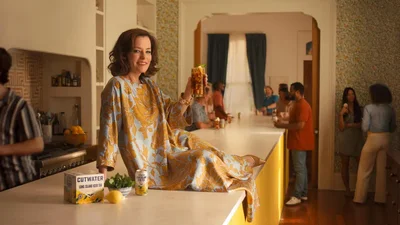
Parker Posey presides over an oversized kitchen island in Cutwater’s new campaign for its ready-to-drink Long Island Iced Tea.
Cutwater
Parker Posey Gives The Long Island Iced Tea A Chic Second Act
Parker Posey has always known how to make excess look like a private joke. Now she has turned her attention to the Long Island Iced Tea, a drink famous for requiring half the bottles on a home bar and enough concentration to make its preparation feel like work.
“She’s dressed and ready,” Posey tells me. “At first, she was complicated and overwhelming, but now she’s a party trick, something you can’t believe comes in a can.”
The drink is the centerpiece of “The Longest Island,” a new Cutwater campaign built around an exaggerated kitchen island and Posey in a flowing kaftan. The premise is simple. A host should be able to open a drink, pour it over ice and return to the people who came to see her.
The campaign also includes a national sweepstakes for people 21 and older. One winner will receive $10,000 to upgrade a kitchen island or home entertaining space, along with a year’s supply of Cutwater Long Island Iced Tea. Entry information is available through Cutwater’s social channels.
Parker Posey Knows What To Do With Too Much
Posey became one of the defining faces of 1990s independent film through performances in Dazed and Confused, The House of Yes and Party Girl. The Academy of Motion Picture Arts and Sciences calls Party Girl, in which she plays a New York club fixture who becomes a librarian, a cult classic of ’90s independent cinema.
Her work in Christopher Guest’s mockumentaries made her especially good at playing people who are completely convinced of their own taste. Posey can deliver an absurd line with such conviction that arguing with her would seem rude.
More recently, she appeared in Mr. \& Mrs. Smith and Beau Is Afraid. Her performance as Victoria Ratliff in The White Lotus earned her a 2025 Emmy nomination for supporting actress in a drama series.
Her history makes the Cutwater pairing feel unusually natural. The campaign gives Posey room to be specific, slightly eccentric and fully committed to the joke.
She appears behind an absurdly long kitchen island wearing a kaftan inspired by two women whose influence she has carried since childhood.
“A woman my age in a gorgeous kaftan,” Posey says. “That’s a nod to Mrs. Roper and Agnes Moorehead. Both were inspirations for me when I was dreaming of being an actress.”
The island was physically built for the shoot.
“There were no special effects,” she says.
Posey had already noticed how far people will go to fit giant islands into their homes. Walls come down. Foundations get reworked. Entire kitchens are designed around a surface where everyone eventually stands with a drink.
She recently found herself at a neighbor’s house looking at his island and imagining an entirely different use for it.
“I was like, ‘Let’s make a cooking show, like now. Where are the cameras?’”
In Posey’s hands, the kitchen island becomes part bar and part stage. It is also a place where a host can stop working.
The Long Island Iced Tea Has Always Been A Production
The Long Island Iced Tea asks a lot from a home bartender.
The International Bartenders Association’s official recipe calls for vodka, tequila, white rum, gin and Cointreau. Lemon juice and simple syrup follow before the drink is topped with cola. Despite its name, it contains no tea.
Cutwater puts the idea into a 12-ounce can made with four of the company’s spirits, citrus notes and cola. According to Cutwater’s, each can contains 13% alcohol by volume. It has 345 calories and 20 grams of sugar.
Posey is less interested in the mathematics than in what happens once the bottles disappear.
“There are more jokes told, more soft-shoe dancing, more general movement of your arms and your entire body,” she says. “Your hands and muscles aren’t being used to juggle all those bottles needed to make a Long Island Iced Tea from scratch.”
Her conclusion is much shorter.
“You don’t have to count and you don’t have to measure. You simply open the can.”
When I asked if skipping the usual bar tools appealed to her, I mentioned that nobody had to pretend to know where the muddler was.
“I don’t know what a muddler is, sorry,” she replied.
Canned Cocktails Continue To Find An Audience
Cutwater is selling convenience at a moment when that promise has real value.
Premixed cocktails, including spirits-based ready-to-drink products, generated $3.8 billion in U.S. supplier revenue during 2025, according to the Distilled Spirits Council of the United States. Revenue grew 16.4% from the previous year. Every other major spirits category reported a decline.
That growth helps explain why companies continue placing familiar cocktails into cans. Consumers already understand what a margarita or Long Island Iced Tea is supposed to be. The purchase requires little explanation, and serving it requires even less.
Cutwater describes itself as the country’s leading spirits-based canned cocktail brand, citing Circana data for the 52 weeks ending July 12, 2026. Its Long Island Iced Tea is sold nationally in four-packs.
The canned format also changes the host’s role. There is no line forming at the bar while one person measures ingredients. Guests can serve themselves, and cleanup mostly involves collecting cans and glasses.
“If it’s a crowded party and loads of people come, it’s so much easier to clean up afterward,” Posey says. “With nothing more than a decision about whether we crush or cube the ice, or what garnish we use, the space left for fun is maximized.”
The Parker Pour Keeps The Work Small
The campaign introduces a signature serve called the Parker Pour. Cutwater Long Island Iced Tea is poured over crushed ice and finished with an orchid and starfruit.
Posey’s version of summer entertaining is more forgiving. She wants a large supply of ice and something colorful frozen inside it.
“Copious amounts of ice, and don’t forget the fruit,” she says. “Freezing fruit in ice cubes is a great trick for cocktails. You can freeze herbs, too.”
At home, the orchid is optional. Lemon works. So do frozen berries or whatever happens to be growing in the garden. The garnish should look inviting without creating another job for the host.
“With the Parker Pour, I don’t have to worry about lifting all those bottles to measure the quantities because it’s done for me,” Posey says. “I get to choose the garnish and make it look fun and pretty and effortless.”
She defines effortless hosting with similar practicality. Plan the evening. Avoid taking on more than you can manage. Give guests something to contribute.
“Delegate who brings what so you don’t put it all on your shoulders, and let your friends show up for you,” she says.
Then she imagines a guest asking about the cocktail.
“‘How did you make this?’ ‘Oh, this?’ Sound of can opening. ‘Like that.’”
A Cocktail Ready For Its Second Act
The Long Island Iced Tea carries plenty of baggage. It is strong, nostalgic and closely associated with nights that went on longer than planned.
Posey saw a comeback story.
“The Long Island Iced Tea definitely had a reputation for being a bit overcomplicated to make,” she says. “I loved the idea of giving it a second act with Cutwater.”
The timing suits her. Posey’s appearance in The White Lotus introduced her to viewers who may have missed Waiting for Guffman or Best in Show. The show reminded a wide audience how much she can do with an arched eyebrow and a line that sounds slightly inappropriate.
Cutwater wisely follows her lead. The campaign feels strongest when Posey starts talking about the peculiar things that make a gathering memorable. Her advice has little to do with expensive table settings.
“When a conversation stalls and people feel stuck, that’s when you bring out the bag of puppets,” she says. “The kitchen island instantly becomes your stage.”
A puppet does not require a shopping trip. Posey says a face drawn on a finger will do. She draws the line at one common substitute.
“No, your phone is not a puppet.”
That willingness to let a party get a little silly explains why Posey is such a good fit for a cocktail with a reputation of its own. She is not trying to make the Long Island Iced Tea respectable. She wants it to loosen up and enjoy itself.
When I ask what she hopes people remember from the summer, her answer lands like the final line of a scene.
“I hope they remember the punchlines and not serving the punch.”