‘It was two weeks before my 30th birthday when I went to brush my teeth one morning and noticed that something didn't feel right. My mouthwash was dribbling out of the side of my mouth,’ says Denise, now 59, a business change management contractor from Milton Keynes.
‘When I looked in the mirror and tried to apply lipstick, I could see that my face was lopsided. I went into work as usual that morning and mentioned it to my colleagues. My team insisted I go to A\&E that day.
‘It was scary at first, because I wasn’t sure if I had had a stroke, but as soon as I walked in and mentioned my face, the doctor told me immediately I had Bell’s palsy. For reassurance, he sent me straight away for a brain scan the same day to ensure it wasn't a stroke.
‘Bell's palsy is a condition that causes temporary weakness or paralysis of the facial muscles, resulting in a drooping appearance on one side of the face.
‘When I was told I had it, I was horrified, because I'd only come across one person who had suffered with that and their face completely dropped on one side. At first, I had no idea if it was temporary or permanent. I was especially upset because I had a big birthday event coming up!
‘The doctor told me that the external symptoms would last around three to four months and internally it may take a little longer (for example, regaining the ability to move food from one side of the mouth to the other, or back to the centre). In fact, it took about two-and-a-half years to feel like myself again.
‘I was sent for one session of physiotherapy, where I was told to softly stroke my face with a make-up brush, lightly prick myself with a pin and slap my face with the back of my hand; and say the letters B and P repeatedly, which is VERY difficult with Bell’s palsy – as your face completely twists when you do. I had to do facial exercises in the mirror which I hated, because it just accentuated the issue.
‘As for coping with it in everyday life, I just hid behind my hand for months. The left side of my face was frozen. I couldn't close my eyelid, I couldn't grip the edge of a cup with my lips, food got stuck on the left-hand side of my mouth and had to be pulled to the centre with my fingers.
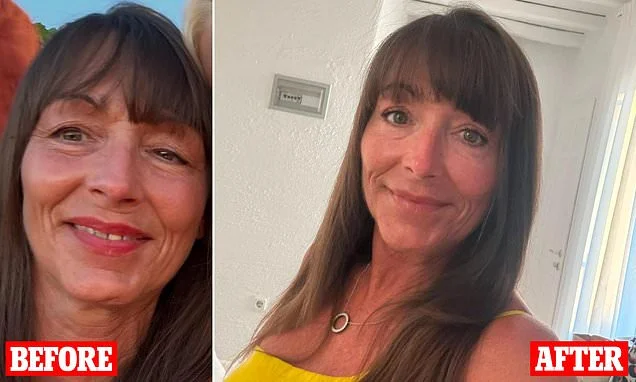
Denise noticed that her 'face was lopsided' and was then diagnosed with Bell's palsy, which causes weakness of the facial muscles (pictured before treatment, left, and after, right)
Denise looked at 'whether Botox could help soften the lines and improve facial balance', then saying that the treatment 'exceeded my expectations'
‘My mouth was pulled to the other side of my face. I cried once and one side of my face didn't move at all whilst the other was an ugly crying face. I had no idea how long it would last, and that was the scariest thing.
‘Not long afterwards, at my 30th birthday celebration, I discovered just how much the condition affected everyday life when I tried to blow out the candles on my caterpillar birthday cake and couldn't.
‘My friends were really supportive. Once I started telling people I realised just how common it was. Almost everyone knew someone who had had it. My team at work were fabulous too. My boss had told them and my suppliers in advance, so they didn’t ask lots of questions. They were just super supportive, and we laughed about the silly things like dribbling my tea, and my inability to eat certain foods in the way I used to – cakes and sandwiches were cut up super small!
‘I had two younger sisters and I warned my mum to talk to them before they saw me because I didn’t want to scare them. I don’t have children, but was in a long term relationship. My partner just kept saying I don’t look any different, but of course I did.
‘After around four months, the paralysis began to improve, at least on the outside. Internally, simple things such as eating remained difficult because the muscles were still weak and uncoordinated.
‘A couple of years later, most people would probably have assumed that I had fully recovered. However, Bell's palsy had left lasting changes. The creases on both sides of my face were very different. There was a pronounced difference in the crow's feet on either side of my face. The marionette lines were very different too. Smiling caused synkinesis (involuntary eye narrowing when moving the mouth) on the left hand side. I have always been very aware of this, especially in photographs.
‘The asymmetry always bothered me, particularly when it showed up in photos and videos. I always tried to wear sunglasses in pictures. We had to edit many of my sister's family wedding photos because my eyes were wonky thanks to me being super smiley that day! It knocked my confidence considerably and I hated it.
‘In 2025, aged 58, I underwent surgery privately to address the synkinesis. I had never sought further support from the NHS. Given how long ago it was, I didn't consider it an option, and so sought private treatment after a close friend encouraged me to go and find out what would be possible. The surgery helped, but I remained conscious of the pronounced difference in the crow's feet and the facial asymmetry that had persisted for decades.
‘In March 2026, at the age of 59, I visited Dr Sabika Karim at Skin Medical to explore whether Botox could help soften the lines and improve facial balance. The same friend who encouraged me to speak to a surgeon, encouraged me to see her. A few of my friends have Botox, and I guess with another milestone birthday coming up, it was a now or never type of decision. This year is my year of saying “yes” to everything. I figured I had nothing to lose by asking the question. I am so glad I did. I only started seeing Dr Sabika Karim this year and have had two treatments, with each lasting three to four months.
‘Dr Karim injected Botox into selected areas on both sides of my face to relax the overactive muscles and reduce the appearance of the lines. The results exceeded my expectations.
‘After living with facial asymmetry for nearly thirty years, I felt that my features looked much more balanced and harmonious. The improvement gave me a real boost in confidence. After six years of being single (following the end of a 28-year relationship), I even decided to join a dating site. I’d always been put off before, because it's all based on photographs. Now, I've been fortunate enough to meet a man who has become one of my best friends, and I couldn't be happier.
'The combination of the surgery and the botox has revolutionised my life. I feel like a different person, and no longer feel the need to hide my face behind sunglasses in photos! My friends can't believe the difference in my self confidence. For anyone else suffering with a similar condition, I’m proof that it’s never too late to find a solution.’
Dr Sabika Karim says that when 'someone has more pronounced facial asymmetry, achieving a natural result becomes even more dependent on the injector’s expertise'
Aesthetic doctor and founder of Skin Medical, Dr Sabika Karim, explains: ‘Every face is unique, and the muscles are rarely perfectly symmetrical, so there should never be a "one-size-fits-all" approach to treatment. The dose and injection points should always be tailored to each individual’s anatomy rather than following a standard pattern.
‘When someone has more pronounced facial asymmetry, achieving a natural result becomes even more dependent on the injector’s expertise. The artistry lies in combining an in-depth knowledge of facial anatomy with decades of experience using different types of botulinum toxin, allowing the practitioner to accurately predict how each patient is likely to respond.
‘This enables precise adjustments to both dose and placement, sometimes deliberately under-treating one side initially, before reviewing the patient and fine-tuning the treatment to achieve the best possible final result.'
‘Stories like Denise’s demonstrate that the impact of aesthetic medicine can extend far beyond physical appearance. After living with facial asymmetry for almost 30 years, helping Denise achieve greater balance allowed her to feel more comfortable in herself and gave her the confidence to embrace a new chapter in her life. Her 30-year struggle was over with just a 30-minute treatment.
‘For me, this is what aesthetic medicine should be about. It isn’t about creating perfection or changing someone into a different person; it’s about recognising what matters to that individual and using our medical expertise to help them feel the best version of themselves. Sometimes the most powerful treatment outcomes aren’t measured in millimetres or photographs, but in the confidence to do something you may not have felt able to do before.’