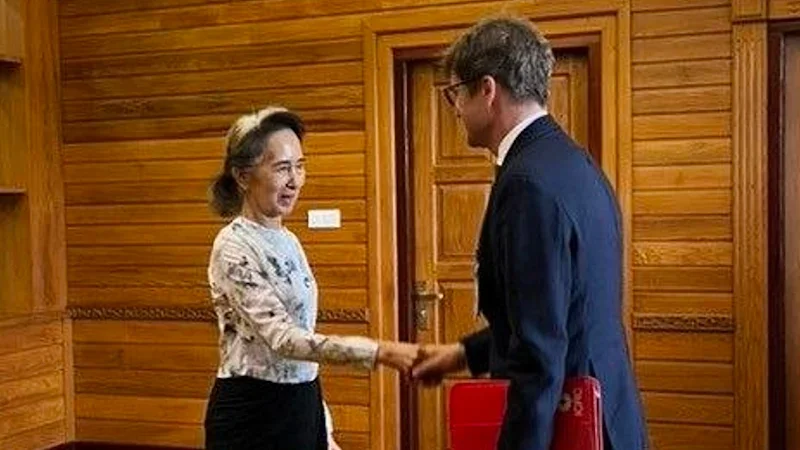
Singapore: Myanmar’s military regime has released long-awaited proof that the nation’s ousted civilian leader, Aung San Suu Kyi, is still alive after more than five years in detention, easing the worst fears of her London-based son, Kim Aris, who has been unable to communicate with her.
In photos published on Monday by military-controlled media, Suu Kyi, who is now 81, is seen meeting the International Committee of the Red Cross’ (ICRC) representative in Myanmar, Arnaud de Baecque.
The story in the English-language mouthpiece Global New Light of Myanmar is just one sentence long and is accompanied by apparently older photos of Suu Kyi cutting a cake piped with the words “Happy Birthday Aunty Suu 29.6.2026”.
There is no mention of where Monday’s private meeting with de Baecque was held. The ICRC confirmed it took place, but did not release details about her health or what was discussed.
Suu Kyi, a Nobel laureate, has been detained and shut off from the outside world since the Myanmar military removed her democratically elected government in a February 2021 coup.
The generals’ return triggered a nationwide civil war that has claimed more than 100,000 lives, according to Armed Conflict Location and Event Data (ACLED), a non-profit war monitor. Millions of people are displaced, and the economy has collapsed.
Attempting to win favour among the international community, the regime announced in May that it had moved Suu Kyi from prison to home detention somewhere in the capital, Naypyidaw.
Her son, however, viewed this with scepticism and continued to demand proof of life. On Monday, he got it.
“Today brings hope,” he posted on social media before the ICRC had confirmed its visit.
“I welcome reports that the ICRC has met my mother, Daw Aung San Suu Kyi. If confirmed, this would be the first positive development concerning her in more than five years.
“I am deeply grateful to everyone who has stood with my family, especially those who supported the Proof of Life campaign. Your voices, together with the growing efforts of ASEAN and the international community, have helped keep my mother’s plight in the global spotlight.
“This is an important first step, but it must not be the last. I hope it leads to greater humanitarian access, direct contact with my mother, credible and independently verified information about her wellbeing, and ultimately, her immediate and unconditional release, together with all political prisoners.”
Dangerous figure
Suu Kyi, who is the daughter of assassinated independence hero Aung San, rose to prominence as a leading voice in a 1988 uprising against military rule. She was detained the following year and won the 1991 Nobel Peace Prize while still under house arrest.
She was released in 2010, after almost 15 years of on-and-off detention, and went on to lead her National League for Democracy to election victories in 2015 and 2020. Though she disappointed her legion of admirers by defending the military against charges of genocide against the Rohingya people, she remains a wildly popular symbol of freedom and democracy.
That’s what makes her so dangerous to the regime.
The moves to swap prison for home detention and allow her access to a humanitarian organisation, however, are unlikely to signal a liberalising shift in a regime that continues to bomb schools, hospitals and gatherings.
Rather, the generals crave legitimacy, the lifting of sanctions, and a reboot of international trade. Suu Kyi is Myanmar’s most famous citizen, and treating her more humanely projects a kind of beneficence, albeit a warped one.
Another means to legitimacy was sham elections, devoid of any meaningful opposition, staged this year that allowed coup leader Min Aung Hlaing to exchange his military uniform for a presidential suit. To the horror of resistance groups and traumatised citizens, it appears to be working. Min Aung Hlaing has since been welcomed in China and India. On Thursday, he is scheduled to make an official visit to neighbouring Thailand.